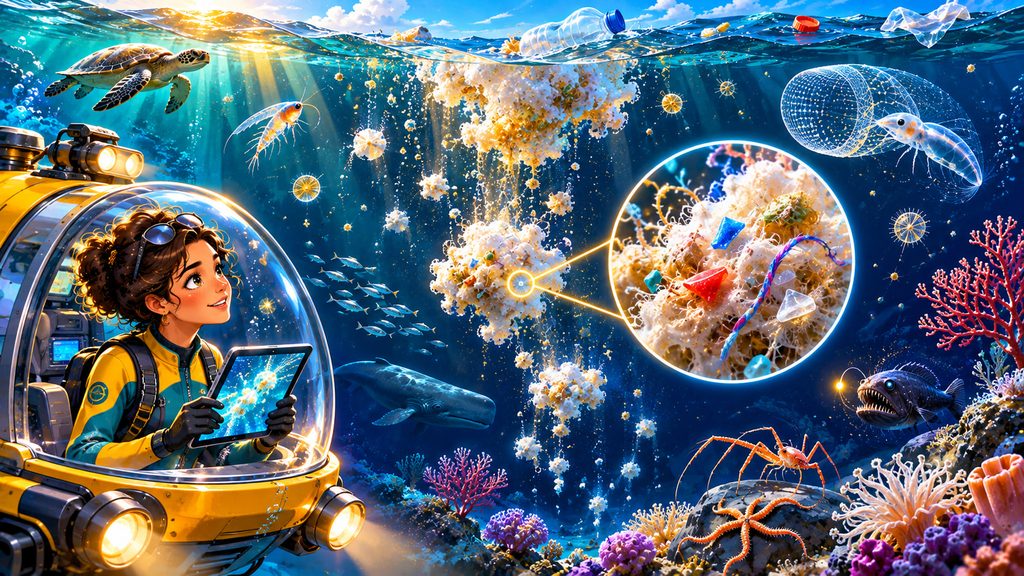
Deep beneath the waves, delicate white flakes drift through the water like a permanent snowfall. They are not ice crystals. They are fragments of once-living organisms, sticky biological material, and minerals sinking from above. This supplies food to deep-sea animals and carries carbon downward.
Now scientists have discovered two important complications. The microscopic texture of marine snow can determine how much carbon reaches the deep ocean, while plastic pollution can change how the flakes form and sink. Research published in 2026 reveals the importance of structures invisible to the naked eye.
What Exactly Is Marine Snow?
Marine snow consists of dead plankton, fecal pellets, mucus, minerals, and other debris that stick together in seawater. Many of its ingredients originate with phytoplankton, microscopic organisms that use sunlight and carbon dioxide to grow. When cells die or release sticky substances, their remains combine with surrounding particles.
Some aggregates grow several centimeters across. As they descend, animals eat them and microbes decompose their contents. This continuous supply helps sustain life in deep environments that receive little or no sunlight.
The Ocean’s Natural Carbon Delivery System
Marine snow contributes to the biological carbon pump, a group of processes that move biologically captured carbon from surface waters toward the deep ocean. Near the surface, phytoplankton use dissolved carbon dioxide during photosynthesis. Some carbon enters sinking particles.
How far it travels matters. If microbes break down a flake near the surface, its carbon can be returned to waters that exchange gases with the atmosphere relatively quickly. If carbon reaches deeper waters, it may remain isolated from the atmosphere for centuries or longer. Every sinking flake is therefore both a potential meal and a tiny carbon-delivery vehicle.
A 2026 Discovery: Some Marine Snow Is Harder to Digest
Scientists led by Bryce Inman, working with Stuart Humphries and Farooq Azam, reported a remarkable finding in Science in October 2026. Marine snow is not uniformly soft inside. It contains regions of different microviscosity, meaning resistance to movement at a microscopic scale.
Bacteria tended to occupy the less viscous portions of the aggregates and were scarcer in denser regions. The team also found that more viscous material broke down more slowly. A model using laboratory measurements suggested that, under the conditions examined, more viscous particles could carry over six times as much carbon to depth as less viscous ones. That is a model result, not a measured global increase.
How Researchers Looked Inside a Fragile Snowflake
Ordinary preparation can damage these fragile aggregates. Researchers instead used fluorescent molecular rotors, dye molecules whose light emission changes with the viscosity of their immediate surroundings. A confocal microscope captured thin optical layers that software combined into three-dimensional maps.
The team mapped bacterial positions alongside viscous regions, creating a picture of the microscopic habitat inside marine snow. This July 2026 method enabled the October results. A particle’s appearance cannot reveal microbes’ access to its interior.
Why Sticky Mucus Can Both Help and Hinder Sinking
The biological glue binding marine snow is largely composed of extracellular polymeric substances, sticky molecules released by organisms. Their internal structure can help shield organic matter from microbial breakdown. But mucus outside a sinking particle can produce a nearly invisible tail that increases resistance from the surrounding water.
A 2024 study showed that these mucus “comet tails” can slow descent. That creates an intriguing balance: sticky structures may preserve some carbon but also give microbes more time to consume it. Scientists need to understand both effects before predicting how much carbon will reach the deep sea.
How Microplastics Enter the Underwater Snowfall
Microplastics are plastic particles smaller than five millimeters. They enter oceans through rivers, wastewater, lost fishing materials, airborne fibers, and the breakdown of larger debris. Once suspended in water, plastic fragments can become trapped in sticky organic aggregates.
This allows normally buoyant particles to descend. A 2025 modeling study found that repeated cycles of attachment, sinking, and separation could gradually transport some small floating particles toward deep-sea sediments. Marine snow can thus carry nutrients and human-made pollution along the same path.
Plastic Fibers and Pellets Change the Journey
Not every plastic particle behaves identically. Experiments published in Water Research in 2026 showed that dense polyethylene terephthalate pellets could form compact, faster-sinking aggregates. Lighter polyethylene particles and some plastic fibers produced looser, slower-sinking structures.
Separate research found that plastic microfibers could make marine snow less cohesive, increasing fragmentation and reducing its settling speed. Plastic may alter snow formation and carbon transport. Plastic pollution does not merely ride along; in some circumstances, it changes the vehicle itself.
What This Means for the Deep-Sea Food Web
For animals living far below the sunlit surface, falling organic particles are valuable food. Filter feeders, crustaceans, and other organisms collect or consume them. When marine snow carries plastic fragments, those particles may enter the marine food web alongside edible material.
The effects depend on the species, particle size, and exposure. Scientists are investigating changes in feeding, growth, and other biological functions, rather than assuming every swallowed particle causes the same harm. The natural food-delivery network also creates a pathway for microplastic exposure.
Can Plastic Change the Ocean’s Ability to Store Carbon?
The connection between pollution and carbon storage is particularly important. If plastic fibers slow marine snow or cause it to fragment, microorganisms may have more time to process organic matter before it reaches the deep ocean. Conversely, certain denser plastic particles may increase the speed of some aggregates.
These effects have been demonstrated in experiments, but translating them into a precise global carbon estimate remains difficult. The new findings about microviscosity provide another variable that researchers can now measure directly. Understanding plastic’s influence could help explain changes in ocean carbon transport.
What Can Be Done to Protect This Hidden System?
Removing microscopic fragments from deep water without disturbing marine life is extremely difficult. Preventing plastic from reaching the sea is a more practical priority. Better collection of waste, reduced loss of industrial plastic pellets, improved handling of fishing gear, and controls on synthetic textile fibers can all reduce inputs.
Scientists can also improve measurements with sediment traps, laboratory experiments, and underwater imaging. Long-term monitoring can reveal how pollution alters sinking particles across different seas and seasons. Protecting marine snow means protecting a food source, a pathway for ocean carbon, and the living systems that connect the surface to the deep.
Marine snow reminds us that the smallest ocean structures can influence enormous planetary processes. Which discovery surprises you more: that the “stickiness” of an invisible flake may affect carbon storage, or that floating plastic can hitch a ride to the deepest waters? Share your thoughts in the comments.
Interesting Facts
- Marine snow is made from organic and mineral debris, not frozen water.
- A 2026 study found that bacteria were less common inside more viscous regions of marine snow.
- Under modeled conditions, highly viscous aggregates could carry more than six times as much carbon to depth as less viscous aggregates.
- A 2024 study described nearly invisible mucus tails that slow sinking marine snow.
- A 2025 model explored how floating microplastics can descend through repeated attachment and separation from sinking flakes.
- In 2026 experiments, dense plastic pellets and lightweight fibers affected the sinking behavior of marine snow differently.
Glossary
- Marine Snow — Organic and mineral particles that clump together and sink through seawater.
- Phytoplankton — Microscopic organisms that use sunlight to produce organic matter in aquatic environments.
- Biological Carbon Pump — Ocean processes that move biologically captured carbon away from surface waters.
- Microviscosity — Resistance to molecular-scale movement within a tiny region of a material.
- Molecular Rotors — Fluorescent molecules used to probe microscopic viscosity.
- Extracellular Polymeric Substances — Sticky compounds released by organisms that help bind particles together.
- Microplastics — Plastic particles smaller than five millimeters.
- Marine Food Web — The interconnected feeding relationships among ocean organisms.