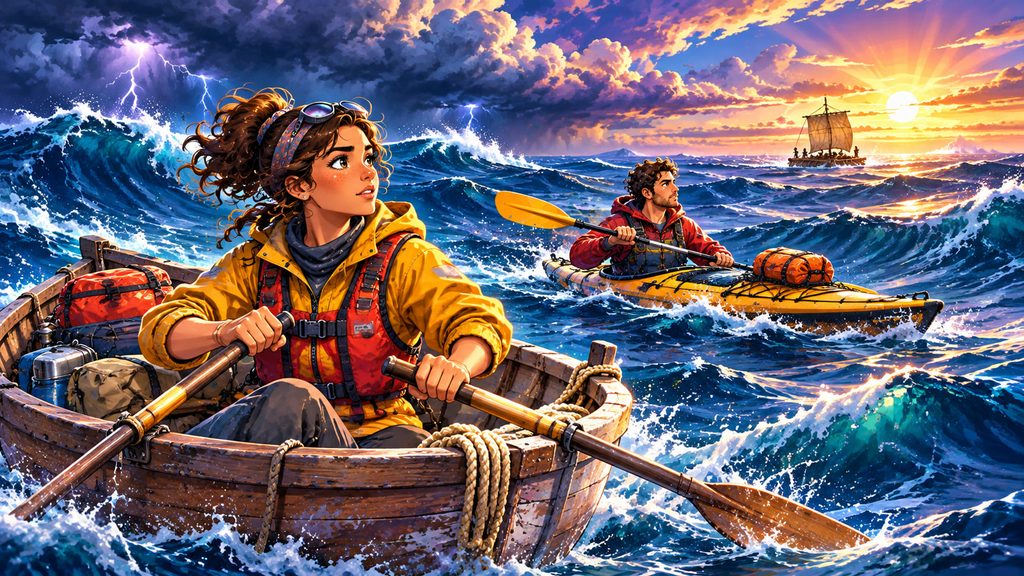
An open rowboat vanishes between Atlantic swells. Its occupants battle wind and exhaustion. For generations, travelers have crossed oceans in impossibly small vessels. Their stories reveal endurance and extraordinary danger.
An ocean crossing is no ordinary boating trip. Storms overturn vessels, equipment fails, and rescue may be impossible. These expeditions are extreme, potentially fatal undertakings and must not be copied as personal challenges. Understanding these voyages matters more than recreating them.
Harbo and Samuelsen: The Rowboat That Crossed the Atlantic in 1896
In June 1896, Norwegian-born seamen George Harbo and Frank Samuelsen departed New York in Fox, an open wooden rowboat about 5.5 meters (18 feet) long. After 55 days, they reached Britain’s Isles of Scilly, the first documented Atlantic rowing pair. They traveled more than 5,000 kilometers through severe weather and shortages. A passing ship replenished food and water lost in a storm. Their voyage demonstrated extraordinary seamanship, not that ordinary boats can safely undertake such journeys.
Thor Heyerdahl: Crossing the Pacific on a Balsa-Wood Raft
In 1947, Norwegian explorer Thor Heyerdahl and five companions sailed westward from Peru aboard Kon-Tiki, a raft built primarily from balsa logs. They relied on wind and ocean currents rather than an engine, reaching a reef near Raroia Atoll in Polynesia after 101 days. The journey tested whether such a raft could cross the Pacific. It did not prove that ancient South Americans settled Polynesia. The raft offered little protection from the surrounding sea.
John Fairfax and Sylvia Cook: Rowing Into the Record Books
British adventurer John Fairfax completed a solo Atlantic crossing in 1969, rowing from the Canary Islands region toward the Americas in a purpose-built boat called Britannia. He then joined Sylvia Cook aboard Britannia II to row across the Pacific from 1971 to 1972. They reached Australia nearly a year later, the first to row across the Pacific. Cook became the first woman to row an ocean. Their route was far longer and less predictable than a line on a map.
Tori Murden McClure: The Woman Who Returned After Disaster
American adventurer Tori Murden McClure attempted to row the Atlantic alone in 1998, but Hurricane Danielle battered her craft and forced her to abandon the attempt. She returned in 1999 aboard American Pearl, a specialized 7-meter (23-foot) rowboat. After approximately 81 days, she reached Guadeloupe, becoming the first woman to row solo across an ocean. Hurricane Lenny brought waves reportedly reaching six meters (20 feet). Her history makes an essential point: even experienced, determined ocean rowers can be overwhelmed by weather beyond their control.
Gérard d’Aboville and Aleksander Doba: Two Very Different Boats
French explorer Gérard d’Aboville rowed alone across the Atlantic in 1980 and later crossed the North Pacific from Japan to the United States in 1991. The latter voyage lasted roughly 134 days, and his enclosed rowboat reportedly overturned dozens of times. Such boats may include self-righting features intended to help them recover from a capsize, but nothing makes a small vessel invulnerable. Far from land, even minor failures become dangerous.
Polish kayaker Aleksander Doba pursued a different approach in a specially designed ocean kayak named Olo. He crossed the Atlantic from Senegal to Brazil in 2010–2011 after about 99 days at sea, then completed another transatlantic expedition reaching Florida in 2014. The second involved 167 days and serious mechanical problems. In 2017, he crossed west to east, reaching France at age 70. His reinforced craft was nothing like a recreational kayak.
Why the Ocean Is Far More Dangerous Than It Looks
Ocean waves are not uniform rolling hills. Forecasters use significant wave height, the average height of the highest third of observed waves, yet individual waves can be much larger. A boat that seems stable in moderate conditions may roll violently when waves approach from different directions. Distant storms can send powerful swells across open seas.
Winds and ocean currents can also change the outcome of an expedition. Trade winds help drive some traditional Atlantic routes, but they are not guaranteed propulsion or protection. Currents can erase hours of progress; steering failures cause uncontrolled drifting. Even experienced rowers cannot simply turn toward shore when they are thousands of kilometers away.
What Months at Sea Do to the Human Body
Long crossings involve repeated physical exertion, limited space, saltwater exposure, and interrupted rest. Sleep deprivation can impair judgment and coordination, increasing the chance of errors during dangerous conditions. Moisture damages skin; seasickness and shortages worsen exhaustion. Mental isolation adds another burden that cannot be measured by distance alone.
Falling overboard introduces an immediate danger, particularly in cold water. Professor Mike Tipton, a leading researcher in human physiology at the University of Portsmouth, has studied cold-water shock and the body’s responses to sudden immersion. His research shows that involuntary gasping makes initial immersion especially dangerous. Swimming ability alone cannot guarantee survival.
Modern Technology Does Not Eliminate the Risk
Today’s expedition boats may carry satellite communications, navigation instruments, watertight compartments, and an emergency position-indicating radio beacon, or EPIRB. When activated, a suitable distress beacon can alert rescue services through a satellite system. Distress signals cannot guarantee timely rescue in remote waters. Equipment can break, batteries can fail, and the nearest rescue vessel may be far away.
Experienced expedition teams must plan for maritime regulations, vessel engineering, medical emergencies, and rescue coordination. Historical outcomes depended on luck as well as preparation. Celebrating success can obscure failed expeditions and lost travelers. Survival stories should be understood as exceptional cases, not demonstrations that the risk is acceptable.
Why You Should Never Try to Repeat These Crossings
Do not attempt to cross an ocean in a small boat, ordinary rowboat, recreational kayak, or improvised raft. These travelers faced life-threatening conditions, sometimes surviving disasters before success. Even professional maritime experience and purpose-built equipment cannot make such crossings safe. For an ordinary traveler, deliberately repeating these voyages would be an unjustifiable risk to life and to rescuers who might have to respond.
You can appreciate maritime history without putting yourself in that situation. Visit a nautical museum, follow oceanographic expeditions, or take a professionally supervised boating course on sheltered waters. Those experiences teach waves, weather, and navigation without ocean-crossing risks. Which explorer’s story surprised you most, and what does it reveal about the ocean’s power? Share your thoughts in the comments.
Interesting Facts
- In 1896, Harbo and Samuelsen crossed the Atlantic in an open rowboat approximately 5.5 meters long.
- The Kon-Tiki raft reached Polynesia after 101 days at sea in 1947.
- John Fairfax completed the first solo ocean crossing by rowing in 1969.
- Sylvia Cook became the first woman to row an ocean during the 1971–1972 Pacific expedition.
- Tori Murden McClure finished her solo Atlantic row in 1999 after a previous attempt ended in disaster.
- Gérard d’Aboville spent about 134 days rowing across the Pacific in 1991.
- Aleksander Doba crossed the Atlantic by ocean kayak three times, finishing his final crossing in 2017.
Glossary
- Self-Righting — A design capability that helps a vessel return upright after overturning.
- Capsize — The overturning of a boat or other watercraft.
- Significant Wave Height — The average height of the highest one-third of waves during an observation period.
- Ocean Currents — Persistent movements of seawater driven by winds, density differences, and other forces.
- Trade Winds — Prevailing tropical winds that generally blow toward the equator from the east.
- Sleep Deprivation — Insufficient sleep that impairs mental and physical performance.
- Cold-Water Shock — An immediate physiological response to sudden cold-water immersion, often involving gasping and rapid breathing.
- Emergency Position-Indicating Radio Beacon (EPIRB) — A maritime distress device that uses satellite systems to alert search-and-rescue authorities.