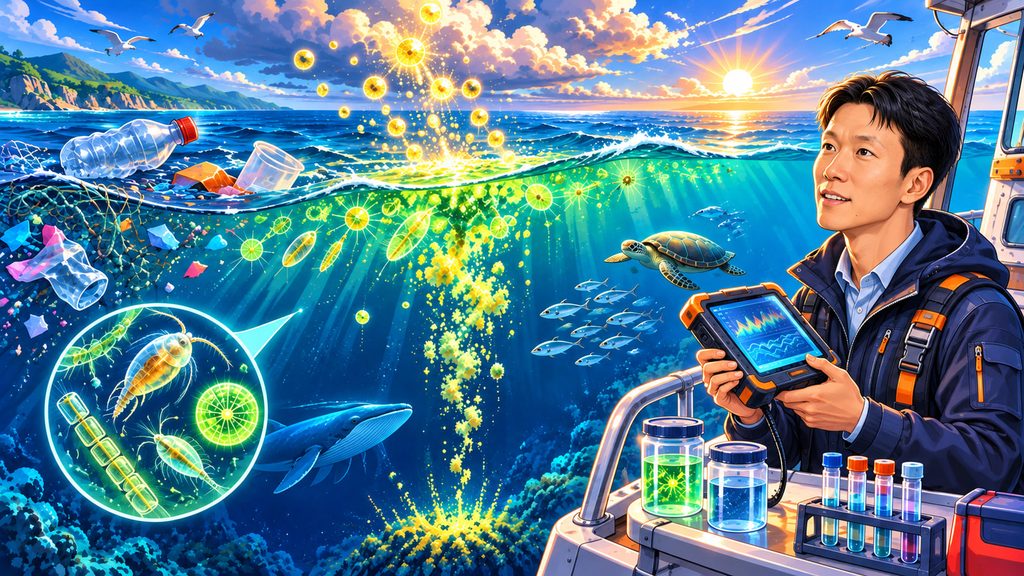
Carbon dioxide constantly moves between the atmosphere and the ocean. Microscopic organisms capture carbon while currents transport it into deeper water. That invisible traffic helps regulate Earth’s climate. Meanwhile, discarded packaging and almost invisible plastic fragments are entering the same system. The ocean is one of Earth’s most important carbon regulators, and plastic pollution may interfere with some of the biological processes that help it work.
This connection goes beyond floating bottles. Carbon circulates through air, water, life, and rocks over vastly different timescales. Human emissions are loading this system with additional CO₂. Plastic adds another pressure to a system already responding to warming and changing chemistry.
How Does CO₂ Move Through Nature?
The carbon cycle begins everywhere at once. Plants and algae use photosynthesis to convert carbon dioxide and water into organic matter, releasing oxygen in the process. Animals, plants, and microbes return CO₂ through respiration, while decomposition releases carbon from dead organisms. Volcanoes and rocks contribute over longer timescales.
Natural exchanges have varied throughout Earth’s history. Burning coal, oil, and gas transfers carbon from geological stores into the atmosphere extraordinarily quickly. Deforestation reduces carbon storage in vegetation. Some excess CO₂ remains airborne, while land and ocean absorb substantial shares.
Why Is the Ocean Such a Powerful Carbon Sink?
The sea covers about 71% of Earth’s surface, giving it an enormous area for exchanging gases with the air. When atmospheric CO₂ concentrations rise, more carbon dioxide tends to dissolve into surface seawater. This is part of the solubility pump, which transfers dissolved carbon into deeper water. Cold water can generally hold more dissolved CO₂ than warm water.
The ocean absorbed roughly 29% of human-caused CO₂ emissions over the decade from 2015 to 2024. That keeps billions of tonnes of CO₂ out of the air annually. This climate service has limits and costs. It also influences how much additional CO₂ remains in the atmosphere. Absorbing carbon changes seawater chemistry, while warming can make future uptake more difficult.
How Tiny Plankton Move Carbon Into the Deep
Sunlit surface waters contain phytoplankton, microscopic organisms that build organic matter using CO₂ and sunlight. They feed tiny grazers, fish, and larger animals. Dead organisms and waste form sinking carbon-rich particles. This export of organic carbon is called the biological carbon pump.
Much sinking material decomposes before reaching deep water. Some reaches deep water, storing carbon for decades, centuries, or longer. Ocean scientist Ken Buesseler of Woods Hole Oceanographic Institution has spent decades studying this downward movement of particles. His research highlights how deeply sinking particles influence carbon storage.
Why More CO₂ Also Means Ocean Acidification
Dissolved CO₂ reacts with seawater, producing hydrogen ions and shifting its chemical balance. Ocean acidification has lowered average surface-water pH by about 0.1 since preindustrial times. On a logarithmic scale, that means roughly 30% greater acidity. Seawater remains alkaline, but its chemistry has changed.
These changes reduce the availability of carbonate ions needed by many corals, shellfish, and plankton to build calcium carbonate structures. Responses vary by species and location. This is more than a laboratory measurement. It can influence the organisms and food webs involved in moving carbon through the sea.
Where Plastic Enters the Carbon Cycle
Most conventional plastics are manufactured from fossil-fuel-derived chemicals, so their carbon originally came from ancient geological reservoirs. Production and disposal generate greenhouse gas emissions. Once plastic reaches the sea, waves and sunlight fragment larger items into microplastics, typically defined as particles smaller than five millimeters. They spread through water, sediments, and marine organisms.
Plastic does not simply replace dissolved CO₂ or stop the ocean from absorbing it. Instead, particles and chemicals affect carbon-processing ecosystems. Experiments show effects on microorganisms, photosynthesis, and sinking particles. Their global significance remains uncertain.
Can Microplastics Interfere With Plankton?
Small plastic particles can be mistaken for food by zooplankton, the tiny animals that graze on phytoplankton. Ingestion may alter feeding and waste production, depending on exposure. Some experiments also find changes in phytoplankton growth. Results vary across species and conditions.
Plastics can also release dissolved organic carbon into seawater, potentially changing how bacteria grow and consume organic material. Not every plastic particle reduces CO₂ absorption. Pollution changes networks of microscopic interactions. Their importance depends on real-world exposure.
The Surprising Connection Between Plastic and Marine Snow
Not all underwater snow is made of ice. Marine snow is a drifting mixture of dead cells, mucus, fecal pellets, and other particles that carries organic carbon downward. Some plastic fibers become trapped in these aggregates, potentially changing their structure and sinking speed. Slower sinking allows more microbial recycling before particles reach depth.
In one controlled experiment, copepod fecal pellets containing microplastics sank substantially more slowly than pellets without them. Further experiments found altered carbon content and sinking behavior in plastic-containing marine snow. These findings suggest a mechanism, not a measured global effect. Different particle sizes and depths also influence the outcome. The crucial question is how often such changes occur in real oceans and at what scale.
Does Plastic Itself Release Greenhouse Gases?
Plastics are chemically persistent, but they do not remain completely unchanged in sunlight. Researchers have shown that some common plastics, including polyethylene, can release small amounts of methane and other gases as they weather. Emissions also arise throughout the plastic lifecycle. These emissions differ from the ocean’s carbon pump.
A 2025 modeling study explored how plastic toxicity, dissolved carbon release, and burial might influence marine carbon cycling. It suggested that plastic pollution could reduce ocean carbon uptake under certain assumptions, but its global estimates are model projections rather than direct measurements. Regional effects still need investigation. Measurements across ocean regions are needed to test these scenarios.
How Can We Protect the Ocean’s Carbon Balance?
Cutting fossil-fuel CO₂ emissions addresses the main driver of climate change and ocean acidification. Reducing unnecessary plastic production, improving waste collection, and preventing discarded fishing gear from entering the sea address another set of threats. Healthy coastal habitats such as mangroves, seagrass meadows, and salt marshes also store carbon in vegetation and sediment, a process often discussed as blue carbon. Protecting them benefits both biodiversity and long-term carbon storage.
Cleanup cannot replace preventing waste from entering waterways. Removing plastic cannot substitute for cutting CO₂ emissions. Both pressures need attention alongside further ocean research. When you think about protecting the ocean, which matters most to you personally: reducing plastic waste, restoring marine habitats, or cutting carbon emissions? Share your thoughts in the comments.
P.S. Plastic pollution has reached alarming levels; there are now “continents” of plastic in the ocean that, combined, exceed the size of the United States and Australia. This is a problem we can only solve by working together. I came across an excellent documentary online that breaks down the issue: Nanoplastics: Threat to Life.
Interesting Facts
- The ocean absorbed about 29% of human-caused CO₂ emissions during 2015–2024.
- More than two-thirds of Earth’s surface is covered by ocean water, making air–sea gas exchange a planetary-scale process.
- Ocean surface pH has declined by approximately 0.1 units since preindustrial times, representing about 30% greater acidity.
- Marine snow transports carbon-rich particles into deep water, even though many particles decompose before arriving.
- In laboratory research, some copepod waste pellets containing microplastics sank markedly more slowly than uncontaminated pellets.
- Some sunlight-exposed plastics can release methane and other gases as they degrade.
Glossary
- Carbon Cycle — The movement of carbon among air, oceans, living organisms, rocks, and sediments.
- Photosynthesis — The process by which plants and many aquatic organisms use light to make organic matter from carbon dioxide.
- Solubility Pump — The physical uptake of atmospheric CO₂ by seawater and its movement into the ocean interior.
- Phytoplankton — Microscopic photosynthetic organisms that form the foundation of many aquatic food webs.
- Biological Carbon Pump — The movement of biologically captured carbon from surface waters toward the deep ocean.
- Ocean Acidification — The ongoing chemical changes that lower seawater pH as additional CO₂ dissolves.
- Carbonate Ions — Dissolved ions used by many marine organisms to build calcium carbonate shells and skeletons.
- Microplastics — Plastic particles smaller than five millimeters.
- Zooplankton — Small drifting animals and other animal-like plankton that consume organic matter.
- Dissolved Organic Carbon — Carbon-containing organic compounds dissolved in water.
- Marine Snow — Falling aggregates of organic matter and other particles that transport material into deeper water.
- Blue Carbon — Carbon captured and stored in coastal and marine ecosystems, especially vegetated coastal habitats.