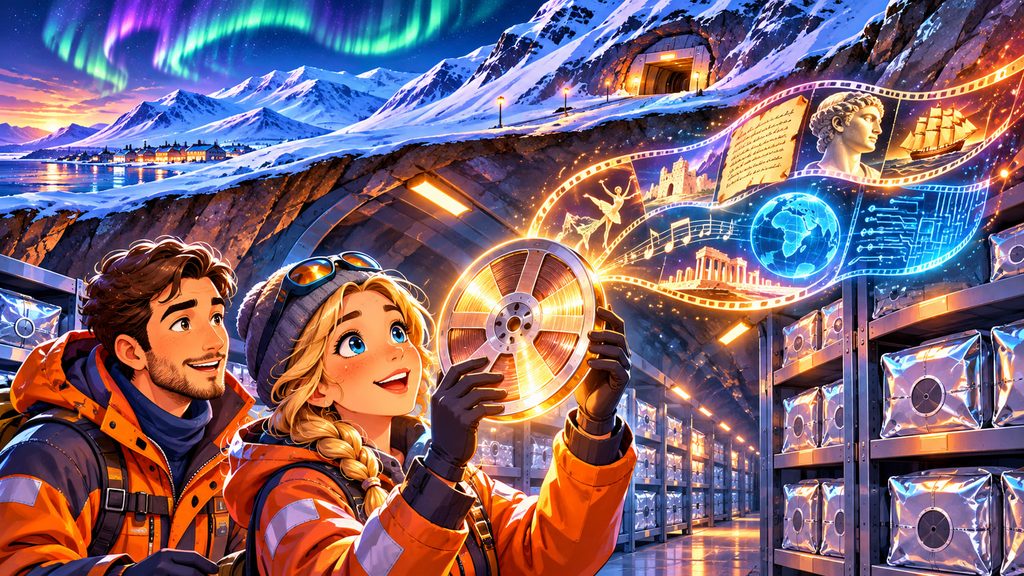
Imagine a library with no reading rooms, dusty bookshelves, or ordinary visitors. Instead, deep inside a mountain on the Norwegian archipelago of Svalbard, sealed reels hold manuscripts, photographs, music, records, and computer code. Its contents survive a power failure. This is the Arctic World Archive, sometimes nicknamed the Doomsday Library, built to give human knowledge a chance to outlast the technologies that created it.
The idea is surprisingly simple: civilization depends on information, yet digital information is easy to lose. Hard drives fail, storage services shut down, and file formats can become unreadable. A disaster need not destroy the whole world to erase a treasured collection. On Svalbard, engineers and archivists have created a different sort of backup, one designed to outlast software upgrades.
Where Is the Doomsday Library Hidden?
The Arctic World Archive lies near Longyearbyen, a small settlement on Spitsbergen, Svalbard’s largest island. Its storage chambers are approximately 300 meters inside a decommissioned coal mine known as Mine 3. The surrounding mountain provides a cold, dark environment where physical materials can deteriorate more slowly. Its remoteness offers additional protection.
Opened in 2017 by Norwegian preservation company Piql in cooperation with mining specialists, the archive was designed for records of lasting cultural or historical value. In 2025, an independent nonprofit foundation was established to support its long-term mission. Visitors can tour parts of the former mine, but not walk freely into the archive itself. Deposits follow controlled procedures. The vault is a place for safeguarding copies, not an underground reading room.
Why Is It Different From the Svalbard Seed Vault?
Svalbard is also home to the famous Global Seed Vault, which stores backup samples of crop seeds. Because both facilities are often described as “doomsday vaults,” they are sometimes confused. Yet their missions are distinct: one protects agricultural diversity, while the other protects knowledge and cultural memory. They are separate facilities, not rooms inside the same bunker.
Think of them as two types of insurance for the future. Seeds can help restore crops after a disaster, while archived records can help people recover languages, research, history, and essential information. Neither replaces working libraries or seed banks. Both exist because losing something unique can be much easier than recreating it.
How Can Digital Books Be Stored Without Computers?
The archive’s essential invention is piqlFilm, a specially developed, durable photosensitive film. Digital files are encoded into microscopic patterns on the film, and some content can also be stored as visible images or text. A reel occupies a fraction of the space required by a roomful of paper. Stored reels require no electrical supply.
This approach combines modern digital encoding with an old principle: light can reveal information recorded on film. Instructions for decoding are stored alongside the data. A future reader would still need appropriate equipment to recover complex files, but would not need to keep today’s proprietary software running forever. The stored information is physically offline, reducing exposure to hacking and remote data corruption.
What Actually Happens When a Book Enters the Vault?
Imagine preserving a rare manuscript. Specialists first create high-resolution images of its pages. They prepare the files and relevant metadata, such as the document’s description, language, and context. The completed collection is written onto film, checked, packaged, and transferred to the secure Arctic facility.
The original book remains wherever its owner keeps it. The vault preserves a backup of its information rather than transporting every priceless object into the mountain. This distinction matters because a digital image can preserve words and appearance without preserving the texture, binding, or history of the physical artifact itself. The archive complements museums and libraries instead of replacing them.
Which Treasures Have Been Preserved?
Depositors have included the Vatican Library, national archives of Brazil and Mexico, Norway’s National Museum, UNICEF, and the European Space Agency. Their collections illustrate the archive’s unusual breadth: legal history can sit near art, institutional memories, and scientific records. Some deposits safeguard documents linked to cultural identity; others preserve information valuable to researchers. The storage boxes may look ordinary, but their contents reach across centuries and continents.
One striking contribution involves GitHub’s Arctic Code Vault, a preserved snapshot of public open-source software repositories. Source code is a form of knowledge: it documents how tools, systems, and digital infrastructure are built. Keeping a snapshot cannot preserve every future update, but it provides a record that could otherwise vanish with changing platforms. In this library, lines of programming belong beside pages of human history.
What Changed in 2026?
The collection continued to grow in February 2026, when the archive received its largest coordinated deposit up to that point, involving more than 25 organizations. UNESCO contributed documentary heritage, including materials connected to its Memory of the World program. Other deposits included Chopin-related music, historical records, and documentation of early whalers’ graves. Preservation extends beyond books.
Communities overlooked by major museums also contributed. Preserving local manuscripts, songs, and memories helps broaden the historical record. Their inclusion makes the collection more representative of the people whose lives it seeks to document. A meaningful backup of civilization should include more than the achievements of its largest institutions. What survives shapes what future generations can learn about the past.
Could the Film Really Last a Thousand Years?
The project aims for extraordinarily long archival longevity. Its engineers use accelerated aging tests to estimate how film and protective packaging respond to time, while Svalbard’s cold conditions slow many forms of chemical degradation. The medium aims to survive for centuries or longer. These figures are design goals supported by materials testing, not a promise that nothing can ever go wrong.
The former mine adds physical protection, but maintaining an archive also requires monitoring conditions and caring for the storage environment. Rock, moisture, packaging, and changing climate conditions all matter over long timescales. Durable media still require stewardship. A sealed reel can be remarkably resilient, but preservation remains a human responsibility.
How Could People Read the Archive in the Distant Future?
Imagine researchers opening the vault in the year 3026. Their computers may look nothing like ours, and today’s internet platforms may be forgotten. The film’s human-readable instructions are intended to help them understand how to decode the stored patterns. Light, optical equipment, and suitable computing tools could then turn the marks back into readable pages or digital files.
This limits technological obsolescence, when information survives but the equipment to read it disappears. Archivists also preserve context so that a file is more than an unexplained string of symbols. A preserved language dictionary, for example, may help make other documents intelligible. Survival and understanding are two different challenges, and the archive tries to address both.
Why Does the Doomsday Library Matter Today?
The archive is not only preparation for an apocalypse. Fires, wars, floods, institutional failures, and neglected storage can destroy irreplaceable records in ordinary times. Co-founder Katrine Loen has stressed the importance of keeping information beyond vulnerable online systems, especially when it could help people rebuild. That practical idea makes the vault relevant even if no global catastrophe ever occurs.
Its deeper achievement is to make preservation a visible choice. A community that records its history, a museum that duplicates its collections, or a developer who shares useful code is helping future readers inherit something meaningful. If you could place just one piece of human knowledge in Svalbard’s Arctic vault, what would you choose to preserve for people living a thousand years from now? Share your choice in the comments.
Interesting Facts
- The Arctic World Archive opened in 2017 inside a former coal mine on Svalbard.
- Its records are stored about 300 meters inside the mountain, not in public library stacks.
- The archive’s film needs no electricity while it is in storage.
- GitHub deposited a snapshot of public open-source code in its Arctic Code Vault.
- In February 2026, more than 25 organizations joined a coordinated deposit into the archive.
- The Svalbard Global Seed Vault is a separate facility protecting crop diversity, not books.
Glossary
- PiqlFilm — Specially developed archival film that stores information as optical patterns and images.
- Digital Encoding — The process of representing information in a structured form that can be recorded and recovered.
- Metadata — Descriptive information that helps identify, organize, and interpret a document or file.
- Arctic Code Vault — GitHub’s project to preserve a snapshot of public open-source software repositories.
- Archival Longevity — The expected duration for which stored material can remain usable and recoverable.
- Technological Obsolescence — The loss of access to information when required hardware, software, or file formats become outdated.