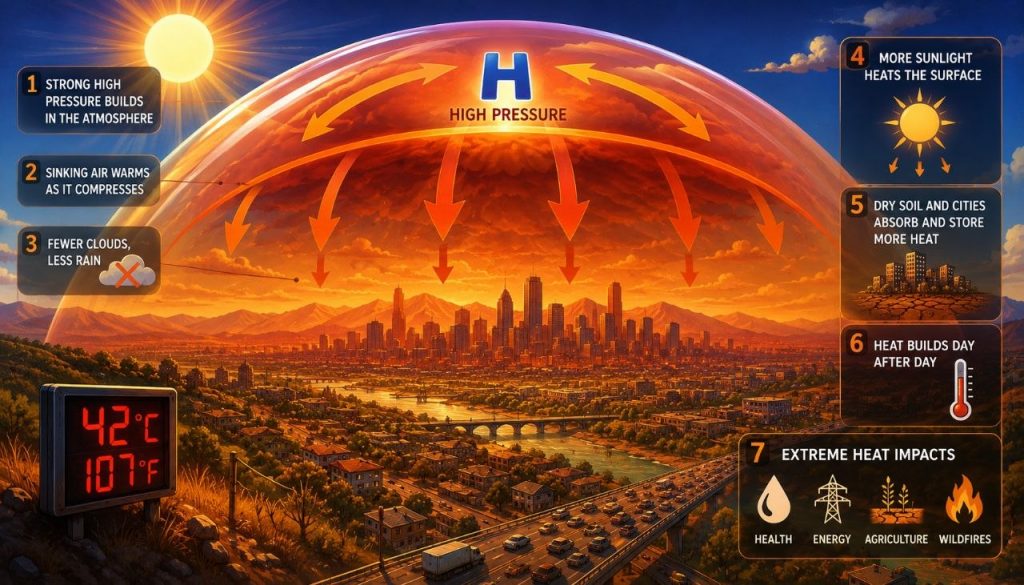
A heat dome is one of the most dangerous summer weather patterns because it can turn ordinary hot weather into a long-lasting extreme heat event. The phrase sounds dramatic, but the physics is clear: a strong area of high pressure settles over a region, pushes air downward, blocks cooler weather systems, and allows heat to build day after day.
This “dome” does not have a physical roof. It is an atmospheric pattern that acts like a lid. Under it, air sinks, clouds often decrease, winds weaken, rainfall becomes less likely, and the sun keeps heating the land surface. If the pattern stays in place for several days or weeks, temperatures can become dangerously high.
A heat dome is not just hot weather. It is trapped heat under a persistent high-pressure system.
How a Heat Dome Forms
A heat dome usually develops when a strong high-pressure system becomes stuck over a region.
Under high pressure, air sinks toward the surface. As it sinks, it compresses and warms. This is called adiabatic warming.
NOAA explains that under high pressure, sinking air acts like a dome that caps the atmosphere and traps heat instead of allowing it to rise freely.
This creates a feedback loop:
- Air sinks and warms.
- Clouds become less common.
- More sunlight reaches the ground.
- Soil and pavement heat up.
- Rain becomes less likely.
- The lower atmosphere becomes even hotter.
The longer the dome stays in place, the more intense the heat can become.
Why High Pressure Traps Heat
High-pressure systems are usually associated with stable air.
Stable air resists vertical motion. That means hot air near the ground has a harder time rising, mixing, and escaping.
This is why a heat dome can feel stagnant. The air may become hot, dry, heavy, and still.
If humidity is high, the danger increases because sweat evaporates less efficiently. The body cools itself mainly by sweating, but humid air slows that process.
So the same temperature can feel much worse when moisture is high.
Heat domes are dangerous not only because of temperature, but because they reduce the atmosphere’s ability to ventilate itself.
The Jet Stream Connection
The jet stream is a fast-moving river of air high in the atmosphere.
It usually helps move weather systems from west to east. But sometimes the jet stream becomes wavy and slow. When one of these waves creates a persistent ridge of high pressure, a heat dome can form and remain in place.
NOAA notes that heat domes are often linked to jet stream behavior, especially when wavelike patterns slow down and allow high pressure to linger for days or weeks.
This is why heat domes can become regional disasters. They do not pass quickly like a typical afternoon hot spell.
They stay.
A stuck jet stream can turn a hot day into a historic heatwave.
Why Heat Domes Can Last So Long
Heat domes persist when the atmosphere becomes “blocked.”
Atmospheric blocking happens when normal west-to-east weather movement slows or stalls.
This can prevent cooler air masses, storms, and fronts from entering the region.
The trapped area may experience:
- Clear skies
- Weak winds
- Dry soil
- Intense sunlight
- Warm nights
- Poor air quality
- Rising electricity demand
Warm nights are especially dangerous. When nighttime temperatures remain high, the body has less chance to recover.
The National Weather Service defines a heat wave as a period of abnormally hot weather generally lasting more than two days, with or without high humidity, and warns that it can affect large areas and expose many people to hazardous heat.
Soil Moisture and the Heat Feedback Loop
Soil moisture plays a major role in extreme heat.
When soil is moist, some solar energy is used to evaporate water. This process cools the surface.
When soil is dry, less energy goes into evaporation. More energy goes directly into heating the land and air.
That means drought can make heat domes worse.
Dry vegetation and soil can also raise wildfire risk.
A dry landscape heats faster, turning a heat dome into an even stronger oven.
Cities Make Heat Domes Worse
Urban areas often experience stronger heat because of the urban heat island effect.
Cities contain materials that absorb and store heat:
- Asphalt
- Concrete
- Brick
- Dark roofs
- Metal surfaces
- Dense buildings
These materials release heat slowly, especially at night.
Cities also have less vegetation, less shade, and more waste heat from vehicles, buildings, and air conditioning systems.
During a heat dome, this means urban neighborhoods can remain dangerously hot even after sunset.
A heat dome above a city can become a heat trap inside a heat trap.
Climate Change and Extreme Heat
Heat domes are weather events, but climate change changes the background conditions in which they occur.
A warmer planet makes extreme heat more likely and more intense.
The IPCC states that it is virtually certain that hot extremes have become more frequent and more intense across most land regions since the 1950s, and human-caused climate change is the main driver.
This does not mean climate change creates every heat dome from nothing.
It means that when a heat dome forms, it now often forms in a warmer atmosphere than it would have decades ago.
Climate change loads the dice toward hotter heatwaves.
Why Heat Domes Are Dangerous for Health
Extreme heat can overwhelm the body.
The body tries to cool itself by sweating and increasing blood flow to the skin. But when heat is intense, humidity is high, or exposure lasts too long, this system can fail.
Heat can cause:
- Dehydration
- Heat cramps
- Heat exhaustion
- Heatstroke
- Kidney stress
- Cardiovascular strain
- Worsening asthma or respiratory illness
- Sleep disruption
Heatstroke is a medical emergency.
High-risk groups include older adults, infants, outdoor workers, pregnant people, people with chronic illness, athletes, and people without access to cooling.
Heat is sometimes called a silent killer because it can become deadly without dramatic visible damage.
Heat Domes and Infrastructure
Heat domes can strain modern infrastructure.
They may cause:
- Power demand spikes
- Grid stress
- Road buckling
- Railway track deformation
- Water shortages
- Crop losses
- Wildfire risk
- Air quality problems
- Reduced worker productivity
Air conditioning can save lives, but widespread cooling demand can overload electricity grids. If power fails during a heat dome, the health risk rises sharply.
Extreme heat can also damage food systems. Crops may fail to pollinate properly, livestock can suffer heat stress, and irrigation demand increases.
A heat dome is not only a weather event; it is a stress test for society.
Expert Perspective
Meteorologists and climate scientists emphasize that heat domes are best understood as persistent high-pressure systems shaped by atmospheric circulation. NOAA describes them as linked to high pressure, sinking air, and jet stream patterns that allow heat to build over a region.
The IPCC adds the broader climate context: human-caused warming has already increased the frequency and intensity of hot extremes over most land areas.
The expert view is clear: the heat dome is weather physics, but modern extreme heat is intensified by climate change.
How to Reduce Heat Dome Risk
Individuals can reduce personal risk by staying hydrated, avoiding outdoor exertion during peak heat, using cooling centers, checking on vulnerable people, and keeping homes shaded.
But long-term protection requires system-level changes:
- More urban trees
- Cool roofs
- Reflective pavements
- Better building insulation
- Heat warning systems
- Reliable electricity grids
- Public cooling centers
- Worker heat protections
- Climate-resilient urban planning
- Lower greenhouse gas emissions
Heat domes cannot always be prevented, but their damage can be reduced.
The safest cities of the future will be designed for heat, not just for traffic, buildings, and growth.
Interesting Facts
- A heat dome is not a physical dome but a persistent high-pressure pattern that traps hot air.
- Sinking air warms as it compresses, making high-pressure systems powerful heat builders.
- Heat domes can last from several days to several weeks.
- Dry soil can intensify heat because less solar energy is used for evaporation.
- Cities can stay hotter at night because concrete and asphalt store heat.
- Warm nights are especially dangerous because the body has less time to recover.
- Climate change increases the likelihood and intensity of many extreme heat events.
Glossary
- Heat Dome — A persistent high-pressure system that traps hot air over a region.
- High-Pressure System — An area where air sinks, often creating stable, clear, and dry weather.
- Adiabatic Warming — Warming that occurs when sinking air compresses.
- Jet Stream — A fast-moving current of air high in the atmosphere that helps steer weather systems.
- Atmospheric Blocking — A pattern where weather systems become stuck or move very slowly.
- Urban Heat Island — A city area that becomes hotter than surrounding rural areas because of buildings, roads, and reduced vegetation.
- Heatwave — A period of abnormally hot weather lasting more than two days.
- Heatstroke — A life-threatening condition in which the body can no longer control its temperature.