Railways already have one major advantage in the fight against climate change: they move large numbers of people and goods with far lower emissions than many road and air alternatives. Now, engineers and energy companies are exploring another idea: using railway infrastructure itself to generate solar electricity.
The concept is simple but powerful. Rail networks cover huge areas of land, include thousands of stations, noise barriers, depots, maintenance buildings, embankments, and long open corridors. Much of this space is already owned or managed by railway companies. Instead of building solar farms only on agricultural land or rooftops, rail operators can turn existing infrastructure into distributed clean energy assets.
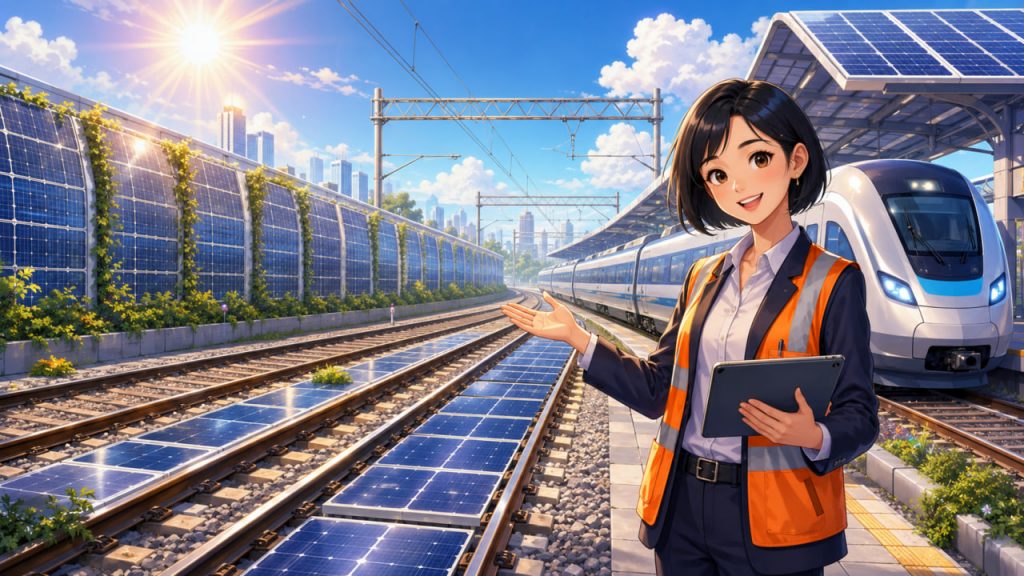
Solar panels on railways are not one single technology. They can appear on station roofs, beside tracks, on depot buildings, on sound barriers, or even directly between rails. Some ideas are already mature and widely used. Others are still experimental and must prove they are safe, durable, and cost-effective.
How Solar Panels Can Be Used on Railways
Railways offer several places where photovoltaic systems can be installed.
The most practical locations include:
- Station roofs
- Train depot roofs
- Parking areas near stations
- Railway maintenance buildings
- Noise barriers
- Unused land beside tracks
- Solar farms connected to railway power systems
- Experimental panels between the rails
The safest and most common approach is installing solar panels on buildings and nearby land.
The more futuristic approach is placing solar panels directly inside or near the track area.
The key challenge is not whether solar panels can produce electricity, but whether they can do so safely in a demanding railway environment.
Solar Panels on Station Roofs
Station rooftops are among the easiest places to install solar systems.
They usually have:
- Large roof surfaces
- Existing electrical infrastructure
- High daytime electricity demand
- Easy access for maintenance
- No direct interference with train movement
Solar electricity from station roofs can help power:
- Lighting
- Ticket machines
- Escalators
- Elevators
- Ventilation systems
- Shops and service areas
- Station offices
In many cases, this reduces operating costs and lowers carbon emissions.
Large railway stations can become small clean energy hubs.
Solar Power for Railway Operations
Railways consume electricity not only in stations but also for train traction, signaling, communications, control centers, workshops, and maintenance facilities.
This is why some rail operators are signing long-term solar power agreements.
Deutsche Bahn, for example, states that it has been drawing solar energy from the Gaarz solar park since 2021, and that since early 2024 another 15 large solar parks across Germany have supplied the company with solar electricity through purchase agreements.
This approach does not require panels to sit directly on tracks.
Instead, railway companies buy solar power from large solar parks and feed it into their electricity supply.
For major rail systems, large-scale solar contracts may be more important than small experimental track panels.
Solar Panels Between the Rails
One of the most interesting new ideas is installing removable solar panels between railway tracks.
Swiss company Sun-Ways has developed a system designed to place photovoltaic panels in the unused space between rails. The company says its technology is removable and estimates potential production of around 200 MWh per kilometer per year, depending on panel power and conditions.
A pilot project in Buttes, in the Swiss canton of Neuchâtel, was launched in April 2025 to test this concept under real railway conditions. SNCF describes the pilot as a multi-year project designed to evaluate panel installation, glare, track inspection, maintenance impact, power output, and dirt accumulation.
Swissinfo reported that the Buttes project installed 48 solar panels on a railway section and began producing early results in Switzerland.
This is an exciting idea because railway tracks represent a vast linear space. However, it is still an emerging technology.
Why Track-Mounted Solar Is Difficult
Railway tracks are not ordinary real estate.
They are safety-critical infrastructure exposed to:
- Vibration
- Dust
- Oil and metal particles
- Snow and ice
- Heavy rain
- Maintenance vehicles
- Ballast movement
- Emergency access needs
- Electrical safety requirements
Panels between rails must not interfere with track inspection, drainage, signaling, emergency repairs, or train safety.
They must also withstand repeated vibration and remain easy to remove when maintenance crews need access.
A railway track is not just an empty strip of land; it is an active mechanical system.
This is why pilot projects are so important.
They reveal problems that cannot be fully understood on paper.
Solar Noise Barriers
Another promising solution is installing solar panels on railway noise barriers.
Noise barriers already stand along many tracks to protect nearby communities from train noise.
Adding photovoltaic panels can turn these structures into energy-producing surfaces.
Lithuania installed a railway noise barrier with integrated solar panels near the Kyviškės–Vaičiūnai railway line, showing how existing protective infrastructure can serve a second function.
This idea may be easier than installing panels between rails because noise barriers are outside the direct train path.
They are also long, exposed to sunlight, and often located near existing railway electrical systems.
Direct Solar Feed-In to Railway Grids
One advanced challenge is feeding solar electricity directly into railway power systems.
Germany provides a useful example because Deutsche Bahn operates its own railway power grid. Fraunhofer ISE reported that the PV4Rail project examined how Deutsche Bahn’s railway power grid could be used for direct solar feed-in, including the development and testing of innovative inverters.
This matters because railway electricity systems may use different frequencies or technical standards than ordinary public grids.
Connecting solar power efficiently requires specialized power electronics.
The future of railway solar is not only about panels; it is also about smart inverters, grid integration, and energy management.
Benefits of Solar Railways
Solar panels on railway infrastructure can offer several advantages.
They may help:
- Reduce railway carbon emissions
- Lower electricity costs
- Use existing land more efficiently
- Power stations and depots locally
- Reduce dependence on fossil electricity
- Support electric train operations
- Improve energy resilience
- Demonstrate visible climate action
Railways already represent one of the most energy-efficient transport modes.
Solar integration can make them even cleaner.
Limitations and Risks
Solar railways also face practical limitations.
Important concerns include:
- Safety certification
- Maintenance access
- Weather resistance
- Dirt and shading
- Theft or vandalism
- Electrical safety
- Installation cost
- Compatibility with railway operations
- Long-term durability
Panels near tracks may also face more dirt and mechanical stress than panels on ordinary rooftops.
This can reduce efficiency and increase cleaning needs.
For this reason, not every railway corridor is a good candidate.
The best solar railway projects will be site-specific, carefully engineered, and tested before expansion.
Expert Perspective
Fraunhofer ISE’s work on direct photovoltaic feed-in to the railway grid highlights an important expert view: railway solar power must be treated as an integrated energy system, not simply as panels placed near tracks. Their PV4Rail project studied railway-specific inverters, trackside photovoltaic potential, and techno-economic questions related to feeding solar power into Deutsche Bahn’s own rail grid.
This perspective is important because successful railway solar projects require coordination between solar engineers, railway safety experts, grid operators, maintenance teams, and transport planners.
Solar railways are not just a renewable energy idea; they are an infrastructure engineering challenge.
The Future of Solar Panels on Railways
The most realistic future will likely combine several approaches.
Station roofs, depot roofs, and solar parks are already practical.
Solar noise barriers may expand where conditions are suitable.
Panels between rails may become useful if pilot projects prove they are safe, reliable, easy to maintain, and economically competitive.
Railway corridors are too valuable to ignore, but safety must remain the top priority.
The railway of the future may not only move clean electric trains — it may also generate part of the electricity they need.
Interesting Facts
- Solar panels can be installed on railway stations, depots, noise barriers, unused railway land, and experimental track sections.
- Switzerland has tested removable solar panels between active railway tracks in Buttes, Neuchâtel.
- Sun-Ways estimates that its between-rail system could generate about 200 MWh per kilometer per year under stated assumptions.
- Deutsche Bahn uses electricity from multiple solar parks across Germany through long-term power purchase agreements.
- Solar railway noise barriers can reduce sound pollution while producing electricity.
- Direct solar feed-in to railway power grids requires specialized inverters and careful grid engineering.
- Railway solar projects must consider vibration, dirt, safety inspections, maintenance access, and weather exposure.
Glossary
- Photovoltaic Panel – A solar panel that converts sunlight directly into electricity.
- Railway Corridor – The land and infrastructure area occupied by railway tracks, stations, signals, and related systems.
- Solar Noise Barrier – A sound barrier fitted with solar panels to reduce railway noise and produce electricity.
- Inverter – A device that converts direct current from solar panels into alternating current suitable for electrical systems.
- Power Purchase Agreement – A long-term contract in which an organization buys electricity from an energy producer.
- Track Gauge – The distance between the two rails of a railway track.
- Distributed Energy – Electricity generated in many smaller locations rather than only at large central power plants.
- Renewable Energy Integration – The process of connecting renewable power sources into existing electrical systems safely and efficiently.