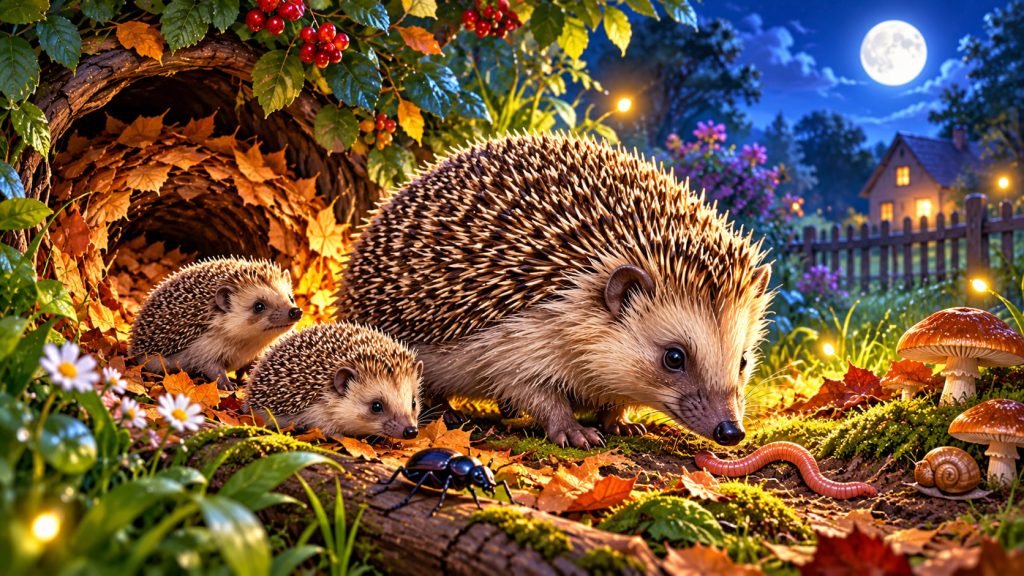
Small, spiky, and surprisingly mysterious, hedgehogs are among the most recognizable wild mammals. Their rounded bodies, curious noses, and remarkable ability to curl into protective balls make them instantly memorable.
But behind their adorable appearance lies a fascinating animal equipped with extraordinary survival adaptations.
Hedgehogs can travel considerable distances at night, locate prey using their sensitive noses, survive cold winters through hibernation, and defend themselves with thousands of sharp spines.
These small mammals play an important role in natural ecosystems, yet some hedgehog populations are declining because of habitat loss and human activities.
Understanding how hedgehogs live reveals why they deserve much more attention than their charming appearance might suggest.
What Exactly Is a Hedgehog?
Hedgehogs are small mammals belonging to the family Erinaceidae.
They occur naturally across parts of Europe, Asia, and Africa, occupying habitats ranging from grasslands and woodland edges to agricultural landscapes and gardens.
Different species have adapted to different environmental conditions.
The European hedgehog, one of the best-known species, typically measures approximately 15–30 centimeters in length.
It has short legs, a pointed snout, small ears, and a body covered with protective spines.
Although hedgehogs resemble miniature porcupines, they are not closely related.
Hedgehogs have evolved their own remarkable combination of defensive behavior, sensory abilities, and feeding strategies.
Why Are Hedgehogs Covered in Spines?
A hedgehog’s most distinctive feature is its protective covering.
These sharp structures are modified hairs made primarily of keratin, the same structural protein found in human hair and fingernails.
An adult European hedgehog typically has approximately 5,000–7,000 spines.
Unlike porcupine quills, hedgehog spines are not normally detached as a defensive weapon.
Instead, they form a protective barrier against predators.
When threatened, a hedgehog uses specialized muscles to curl its body into a tight ball, concealing its vulnerable head, legs, and belly.
This behavior is especially effective against predators that cannot easily penetrate the spiny covering.
However, it offers limited protection against vehicles and certain powerful predators.
Are Hedgehogs Really Nocturnal?
Most hedgehogs are primarily nocturnal, meaning they are most active after sunset.
During daylight hours, they usually rest inside nests hidden beneath vegetation, logs, or other sheltered locations.
At night, they emerge to search for food.
Their eyesight is relatively limited, but they compensate with a highly developed sense of smell and sensitive hearing.
These abilities help them detect food hidden beneath leaves, soil, and vegetation.
A European hedgehog may travel one or two kilometers during a night of foraging.
Their small size hides an impressive ability to explore large areas in search of food and suitable shelter.
What Do Hedgehogs Eat in the Wild?
Hedgehogs are often described as insectivores, although their diet is more varied than that term suggests.
They primarily consume ground-dwelling invertebrates.
Common foods include:
- Beetles and their larvae
- Earthworms
- Caterpillars
- Earwigs
- Millipedes
- Other insects and small invertebrates
Hedgehogs occasionally eat slugs, snails, carrion, eggs, and other available foods.
Their diet changes with habitat and season.
By consuming numerous invertebrates, hedgehogs contribute to local food webs and can help regulate certain garden pest populations.
However, they should not be considered a complete solution to pest problems.
How Do Hedgehogs Survive Winter?
In temperate regions, some hedgehog species survive winter through hibernation.
This is much more than ordinary sleep.
During hibernation, the animal enters a state of greatly reduced metabolic activity, lowering its body temperature, heart rate, and energy consumption.
Before winter, hedgehogs increase their food intake and accumulate fat reserves.
They then construct insulated nests from leaves, grass, and other vegetation.
A winter shelter is sometimes called a hibernaculum.
Hibernation timing depends on temperature, food availability, and geographical location.
European hedgehogs commonly hibernate from late autumn until spring, although they may awaken periodically.
Stored body fat provides much of the energy needed to survive when insects and other food sources become scarce.
How Are Baby Hedgehogs Born?
Baby hedgehogs are called hoglets.
In European hedgehogs, pregnancy usually lasts approximately 35 days, and a typical litter contains four or five young, although litter size varies.
Newborn hoglets are blind, helpless, and dependent on their mother.
Their first spines are soft and become visible soon after birth.
As the young develop, their protective covering becomes stronger.
The mother nurses her offspring and keeps them sheltered until they are sufficiently developed to explore their surroundings.
Young hedgehogs generally become independent after several weeks.
Their survival depends heavily on food availability, weather, and access to safe habitat.
Do Hedgehogs Have Natural Enemies?
Despite their protective spines, hedgehogs face several natural predators.
European badgers are particularly important predators of hedgehogs because their powerful claws and jaws can overcome the animals’ defensive posture.
Large owls and some other carnivores may also attack them.
Hedgehogs generally respond to danger by freezing, raising their spines, or curling into a ball.
Their defensive adaptations have helped them survive in environments shared with predators for thousands of years.
The Strange Mystery of Hedgehog Self-Anointing
Hedgehogs sometimes perform a curious behavior known as self-anointing.
After encountering an unfamiliar smell or tasting a particular substance, a hedgehog may produce frothy saliva.
It then twists its body and spreads the saliva across its spines.
Scientists have observed this behavior in several hedgehog species.
Its exact function remains uncertain.
Possible explanations include responses to unfamiliar chemical substances or scent-related behavior.
The unusual ritual demonstrates how much remains to be discovered about hedgehog biology.
Why Are Hedgehog Populations Declining?
Hedgehogs face increasing environmental pressures in parts of their natural range.
In 2024, the European hedgehog was classified as Near Threatened on the global IUCN Red List.
Major threats include:
- Habitat destruction and fragmentation
- Road traffic
- Reduced availability of invertebrate prey
- Pesticide use
- Unsafe garden equipment and artificial barriers
Habitat fragmentation is especially problematic because hedgehogs often need access to multiple feeding and nesting locations.
Roads, fences, and intensive agricultural landscapes can separate suitable habitats.
The result is a landscape where finding food, shelter, and potential mates becomes increasingly difficult.
Expert Perspective: How Can People Protect Hedgehogs?
The British Hedgehog Preservation Society emphasizes the importance of connected habitats, safe nesting areas, and reducing the use of harmful garden chemicals.
Its practical conservation recommendations include creating small openings between neighboring gardens so hedgehogs can move more freely.
A gap measuring approximately 13 by 13 centimeters can provide useful access.
Leaving wild vegetation, maintaining log piles, and providing clean drinking water can also support visiting animals.
A wildlife-friendly garden becomes more valuable when it connects to other suitable habitats.
People should avoid giving hedgehogs milk because many cannot digest lactose properly.
When supplementary feeding is appropriate, suitable meat-based hedgehog food or plain meat-based cat food can be offered with fresh water.
A hedgehog that appears injured, severely weak, or unusually exposed during daytime may require advice from a wildlife rehabilitator.
Why Hedgehogs Matter to Ecosystems
Hedgehogs participate in complex food webs, consuming invertebrates while also serving as prey for larger animals.
Their presence can reflect the availability of vegetation, shelter, and diverse invertebrate communities.
They also illustrate how small wildlife species depend on connected natural habitats.
Protecting hedgehogs often means improving conditions for other animals, including insects, amphibians, and small mammals.
Helping hedgehogs survive is part of protecting the wider biodiversity of gardens, farmland, and natural landscapes.
Interesting Facts
- An adult European hedgehog typically carries approximately 5,000–7,000 protective spines.
- Hedgehog spines are modified hairs rather than separate defensive weapons.
- European hedgehogs can travel several kilometers while searching for food.
- Hedgehogs are born blind, and their first spines are initially soft.
- During hibernation, a hedgehog’s heart rate and body temperature can decrease dramatically.
- Hedgehogs occasionally spread frothy saliva onto their spines in a behavior known as self-anointing.
- Hedgehogs do not normally carry apples or mushrooms on their spines, despite their frequent appearance in illustrations.
- Different hedgehog species live in forests, grasslands, dry habitats, and human-modified landscapes.
- Wild European hedgehogs often live only two or three years, although some individuals survive considerably longer.
Glossary
- Keratin — A structural protein that forms hair, nails, and hedgehog spines.
- Nocturnal — Describing animals that are primarily active during the night.
- Insectivores — Animals that feed mainly on insects and other invertebrates.
- Hibernation — A state of greatly reduced metabolic activity that helps animals conserve energy during unfavorable conditions.
- Hibernaculum — A protected shelter used by an animal during hibernation.
- Hoglets — The name given to baby hedgehogs.
- Self-Anointing — A behavior in which hedgehogs produce frothy saliva and spread it across their spines.
- Habitat Fragmentation — The division of natural habitats into smaller, disconnected areas.
- Food Webs — Networks of feeding relationships connecting organisms within ecosystems.