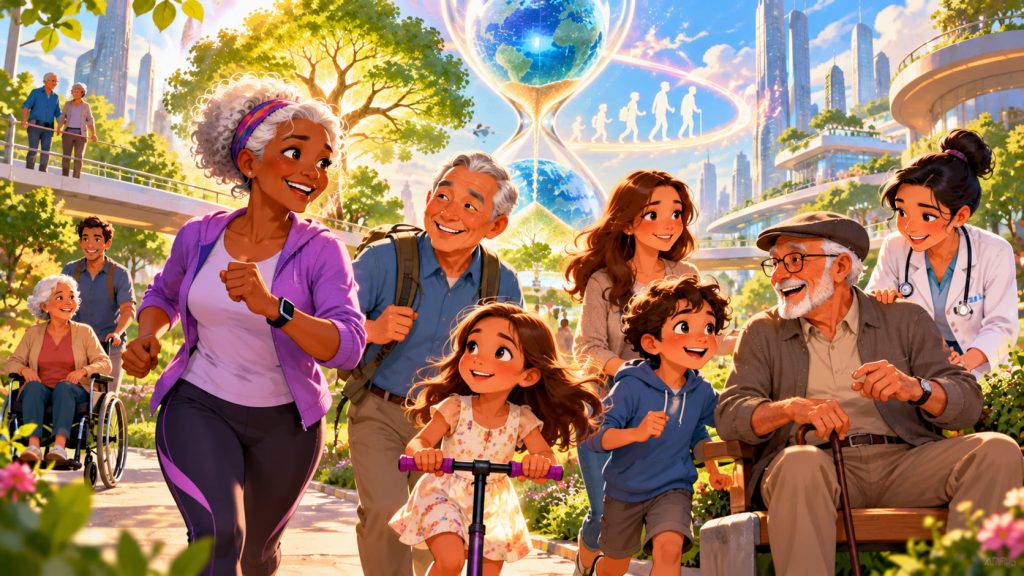
Humanity is entering one of the most significant demographic transformations in history. People are living longer, families are having fewer children, and the proportion of older adults is steadily increasing across much of the world.
This phenomenon, known as global population aging, is already reshaping economies, healthcare systems, labor markets, and family structures.
According to United Nations estimates, approximately 1.2 billion people worldwide were aged 60 or older in 2025. By 2050, that number is projected to reach approximately 2.1 billion.
For the first time in history, societies must prepare for a future in which older generations represent an increasingly large share of the world’s population.
Understanding why this transformation is happening reveals both the challenges and opportunities of a longer-living humanity.
What Is Global Population Aging?
Population aging occurs when the proportion of older people increases relative to younger age groups.
This does not necessarily mean that a country’s population is shrinking.
A nation can experience population aging while its total number of inhabitants continues to grow.
Demographers commonly examine people aged 60 or 65 and above when analyzing aging trends.
The choice of age threshold matters when interpreting statistics.
For example, the United Nations projects that roughly one in six people worldwide will be aged 65 or older by 2050.
Meanwhile, the World Health Organization expects people aged 60 and above to represent approximately 22% of the global population by the same year.
Why Is the World Getting Older?
Two major forces are transforming the global age structure: declining birth rates and increasing longevity.
The average number of children born to women has fallen substantially in many countries.
This measure is known as the fertility rate.
Economic development, education, urbanization, family planning, and changing social expectations have contributed to smaller family sizes.
At the same time, improvements in medicine, sanitation, nutrition, and living conditions have increased life expectancy.
The historical shift from high birth and death rates toward lower birth and death rates is called the demographic transition.
Population aging is largely the result of two major human achievements: longer survival and greater control over family size.
How Quickly Is the Global Population Aging?
The pace of demographic change is remarkable.
By 2030, approximately one in six people worldwide will be aged 60 or older.
By 2050, the population aged 80 and above is expected to reach hundreds of millions.
In 2020, people aged 60 and older already outnumbered children younger than five worldwide.
These figures illustrate a fundamental shift in the balance between generations.
However, aging is not occurring at the same speed everywhere.
Some countries have experienced decades of gradual demographic change, while others are undergoing rapid transitions within a single generation.
Which Countries Are Aging the Fastest?
Japan is one of the most prominent examples of an aging society.
Around three in ten Japanese residents are aged 60 or older.
South Korea, Italy, Germany, and several other countries also have rapidly aging populations.
China faces significant demographic challenges because of falling fertility and the increasing size of its older population.
Many countries in Latin America and Southeast Asia are following similar trajectories.
Meanwhile, much of sub-Saharan Africa retains a comparatively young population, although its number of older residents is also increasing.
Population aging is a worldwide trend, but different countries face very different timelines and economic circumstances.
How Aging Will Transform the Global Economy
As the proportion of older adults increases, the relationship between workers and retirees changes.
Economists often measure this using the old-age dependency ratio.
This indicator compares the number of older people with the population traditionally considered to be of working age.
When the ratio increases, governments may face greater pressure to finance pensions, healthcare, and social services.
However, older adults are not automatically economically dependent.
Many continue working, volunteering, supporting relatives, and contributing to their communities.
Flexible retirement arrangements, lifelong education, and healthier working environments can help countries adapt.
The Future of Pensions and Retirement
Pension systems were developed under demographic conditions that were often very different from today’s.
In many countries, people now spend more years in retirement than previous generations.
At the same time, smaller younger generations may contribute fewer workers to pension systems.
Governments are considering various adjustments, including gradual retirement, changes to pension financing, and policies encouraging voluntary employment at older ages.
However, retirement reforms must account for differences in health, income, and working conditions.
Someone performing physically demanding labor may have very different retirement needs from someone working in an office.
Healthcare Systems Must Adapt
An older population creates greater demand for healthcare services, rehabilitation, and assistance with daily activities.
Conditions such as cardiovascular disease, arthritis, dementia, and osteoporosis become more common with advancing age.
However, growing older does not automatically mean becoming seriously ill.
A particularly important measure is healthy life expectancy, which estimates how many years people can expect to live in good health.
The objective is not simply to extend life, but to increase the years people can remain active and independent.
Healthcare systems will increasingly need to prioritize prevention, early diagnosis, rehabilitation, and coordinated treatment of multiple conditions.
Who Will Care for Older Generations?
As populations age, demand for long-term care is expected to increase.
Long-term care includes assistance with everyday activities such as bathing, dressing, eating, and moving safely.
Traditionally, family members have provided much of this support.
However, smaller families, migration, and changing employment patterns can make informal caregiving more difficult.
Many countries will need additional trained caregivers, accessible housing, home-based services, and community support.
Technology may help through remote health monitoring, fall-detection systems, mobility aids, and assistive robotics.
The greatest opportunity is to support independence for as long as possible rather than treating older age as inevitable dependence.
Expert Perspective: Rethinking Healthy Aging
Public health researcher Dr. John Beard, who helped shape the World Health Organization’s approach to healthy aging, has emphasized the importance of functional ability.
This perspective focuses on what people can actually do in their daily lives rather than judging health only by the presence or absence of disease.
A person living with a well-managed chronic condition may still travel, work, exercise, maintain relationships, and live independently.
This approach recognizes that environments, healthcare access, social connections, and economic opportunities strongly influence quality of life.
Successful aging policies should support people’s capabilities, dignity, and participation throughout their later years.
The Rise of the Silver Economy
An aging society also creates new markets.
The silver economy includes products and services designed to meet the needs and preferences of older consumers.
Growing industries may include:
- Preventive healthcare and rehabilitation
- Smart homes and assistive technology
- Accessible tourism and transportation
- Financial planning and retirement services
- Fitness, education, and leisure activities
Older consumers represent an increasingly important economic group.
Businesses that develop practical, inclusive products may benefit from these demographic changes.
Age-Friendly Cities and Social Inclusion
Urban environments will also need to change.
Age-friendly cities emphasize accessible transport, safer pedestrian areas, convenient healthcare, and public spaces designed for people with different physical abilities.
Simple improvements such as benches, elevators, clear signage, and safer street crossings can benefit residents of every age.
Another challenge is ageism, discrimination or stereotyping based on age.
Ageism can limit employment opportunities, reduce social participation, and contribute to isolation.
Creating inclusive communities allows older adults to remain active participants in society.
What Can Countries Do to Prepare?
Preparing for global population aging requires coordinated long-term planning.
Important priorities include strengthening preventive healthcare, modernizing pension systems, supporting caregivers, and improving accessibility.
Governments can also encourage lifelong learning and remove unnecessary barriers to employment.
Investments in healthier childhoods and working lives matter because the conditions of old age are influenced by experiences across the entire lifespan.
The countries best prepared for demographic aging will be those that recognize longer lives as an opportunity to redesign society for every generation.
Interesting Facts
- Approximately 1.2 billion people worldwide were aged 60 or older in 2025.
- The global population aged 60 and above is projected to reach approximately 2.1 billion by 2050.
- In 2020, people aged 60 and older outnumbered children younger than five worldwide.
- By 2030, approximately one in six people globally will be aged 60 or older.
- Japan already has one of the world’s highest proportions of older residents.
- Women generally live longer than men and represent a majority of the oldest age groups.
- Population aging can occur even when a country’s total population continues to grow.
- Older adults contribute to economies through employment, caregiving, volunteering, and consumer spending.
Glossary
- Population Aging — An increase in the proportion of older people within a population.
- Fertility Rate — A demographic measure commonly describing the average number of children a woman would have over her lifetime under current age-specific birth rates.
- Life Expectancy — The average number of years a person is expected to live under a particular set of mortality conditions.
- Demographic Transition — The historical shift from high birth and death rates toward lower birth and death rates.
- Old-Age Dependency Ratio — The number of older individuals relative to the traditionally defined working-age population.
- Healthy Life Expectancy — The average number of years a person can expect to live in good health.
- Long-Term Care — Ongoing assistance for people who need support with everyday activities because of health or functional limitations.
- Silver Economy — Economic activities and markets associated with the needs and spending of older consumers.
- Age-Friendly Cities — Urban environments designed to support accessibility, participation, independence, and well-being across different ages.
- Ageism — Discrimination, prejudice, or stereotyping directed toward people because of their age.