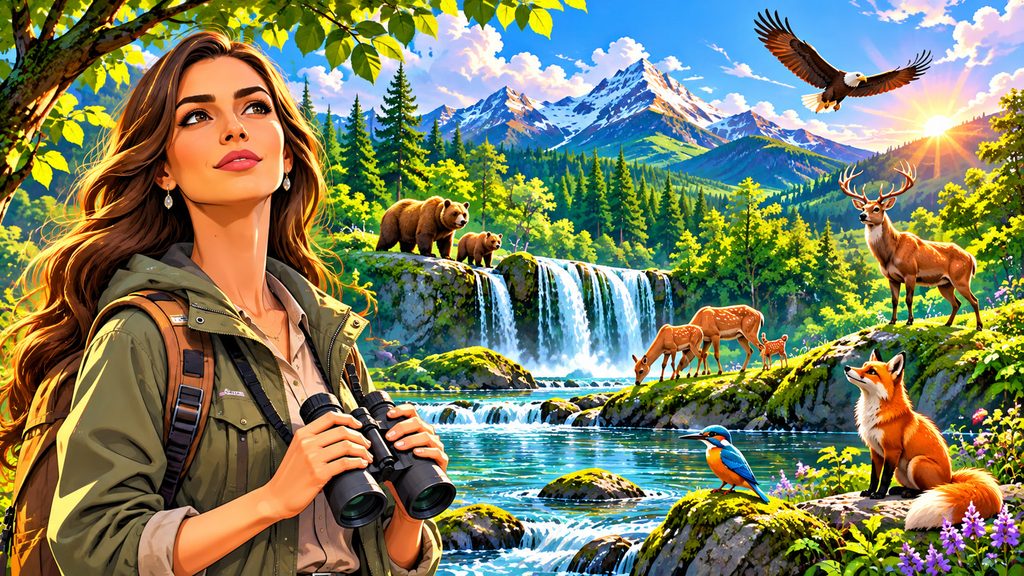
Imagine standing on a hill overlooking what should be a modern city. Instead of skyscrapers, highways, and crowded streets, an enormous wilderness stretches toward the horizon. Herds of wild animals move between forests and grasslands, rivers follow their natural courses, and the only sounds come from wind, water, and wildlife.
This is one possible glimpse of Earth if humans had never evolved. Without agriculture, industrial civilization, and human-driven environmental change, the planet would look dramatically different. It would not simply be today’s world without buildings, but an entirely different arrangement of ecosystems shaped by millions of years of natural processes.
A Planet That Never Experienced Human Civilization
The first distinction is important: imagining humanity disappearing tomorrow is different from imagining humans never existing. In the first scenario, abandoned cities would gradually deteriorate. In the second, those cities, farms, roads, and industrial landscapes would never have been constructed.
Scientists explore such possibilities through counterfactual modeling, using ecological knowledge to investigate how history might have developed under different conditions. Although nobody can reconstruct an alternative Earth perfectly, evidence from fossils, ancient vegetation, and modern ecosystems provides valuable clues.
Our planet’s geography would remain broadly recognizable. Continents, mountain ranges, tectonic activity, and ocean basins would continue evolving through natural geological processes.
Forests Would Cover Vast Areas of Former Farmland
One of the most dramatic differences would involve land use. According to the Food and Agriculture Organization, approximately 4.6 billion hectares of Earth’s land were used for agriculture in 2024. This represents more than one-third of the planet’s land area.
Without human agriculture, enormous areas currently occupied by crops and livestock pastures would support natural vegetation. Depending on local conditions, these landscapes might contain forests, wetlands, shrublands, grasslands, or mixtures of several habitats.
Tropical regions could retain extensive old-growth forests, supporting complex communities of trees, fungi, insects, birds, and mammals. However, a human-free Earth would not be covered entirely by trees. Climate, soils, wildfires, and grazing animals would still maintain naturally open ecosystems.
Europe Might Look Like an Enormous Wildlife Reserve
Imagine traveling across Europe without encountering a single highway or agricultural field. Large areas could contain oak forests, river wetlands, flowering meadows, and open woodlands. Wild horses, European bison, wolves, and other large animals might occupy much broader ranges.
Ecologist Jens-Christian Svenning and fellow researchers have investigated the influence of large herbivores on ancient European landscapes. Their work suggests that prehistoric Europe often contained a complex woodland-grassland mosaic rather than continuous, closed-canopy forest.
Large grazing animals could prevent some areas from becoming densely wooded by eating seedlings and disturbing vegetation. Their activities would create habitats for smaller animals, insects, and plants adapted to open conditions.
Could Mammoths and Other Giant Animals Still Exist?
One of the most fascinating possibilities involves megafauna, the enormous animals that once inhabited many continents. Woolly mammoths, giant ground sloths, giant deer, and other remarkable creatures disappeared during the late Pleistocene and early Holocene.
Scientists have investigated how human hunting, environmental change, and other ecological pressures contributed to these extinctions. Research led by ecologists including Svenning indicates that human expansion played a major role in the global decline of large mammals.
Without humans, some extinct giant animals might have survived much longer or even persisted into the present. Their survival would still depend on changing climates, habitat availability, disease, and competition. A mammoth roaming today’s landscape is therefore an intriguing possibility, not a guaranteed outcome.
North America Would Have a Different Animal Kingdom
North America’s natural landscapes could look especially unfamiliar. Vast grasslands might support enormous herds of bison and wild horses, while forests and mountains could shelter more widespread populations of bears, wolves, and large cats.
Animals such as American mastodons and certain ancient horses might also have experienced different evolutionary histories. Large herbivores would influence vegetation by grazing, dispersing seeds, and transporting nutrients across landscapes.
These interactions are part of trophic dynamics, the relationships connecting organisms through feeding and ecological processes. Removing or preserving large species can affect entire ecosystems, including animals that never directly interact with them.
The Oceans Would Be Richer in Marine Life
An Earth without industrial fishing, shipping, plastic pollution, and human-driven ocean warming would offer very different conditions for marine ecosystems. Many fish populations could be more abundant, while whales and other marine mammals would face fewer human-related threats.
Coral reefs would not experience bleaching caused by anthropogenic greenhouse gas emissions. They would still face natural temperature fluctuations, storms, diseases, and occasional disturbances.
Marine ecosystems would remain dynamic rather than perfectly stable. Nevertheless, the absence of centuries of commercial exploitation and pollution could allow many ocean habitats to retain greater biological abundance and ecological complexity.
Earth’s Climate Would Follow a Different Path
Human civilization has substantially changed the atmosphere. Before industrialization, atmospheric carbon dioxide concentrations were approximately 280 parts per million. By 2025, the global annual average had risen to roughly 426 parts per million.
Without fossil fuel combustion, industrial emissions, and extensive human-driven land conversion, that additional greenhouse warming would not occur. The planet would likely be substantially cooler than the modern human-warmed Earth, although its exact temperature could not be predicted from this difference alone.
Natural climate variability would continue. Volcanic eruptions, changes in Earth’s orbit, ocean circulation, and solar influences would still affect temperature and precipitation. Ice ages and warmer intervals could develop through the planet’s natural climate processes.
Rivers and Wetlands Would Follow More Natural Patterns
Many modern rivers have been dammed, redirected, dredged, or confined within artificial channels. Without human intervention, rivers would more freely reshape their floodplains, create wetlands, and deposit sediments.
Beavers and other ecosystem-shaping animals would influence waterways by building dams and changing water movement. Natural floods could periodically create new habitats while destroying others.
This process contributes to ecosystem dynamics, the continual transformation of biological communities and their environments. Wetlands would be especially important, providing breeding grounds for wildlife, storing water, and supporting complex food webs.
Islands Could Preserve Extraordinary Lost Species
Isolated islands might contain some of the most surprising wildlife. Species such as the dodo of Mauritius and the moa of New Zealand disappeared following human arrival and associated ecological changes. Without those pressures, some might have survived.
Islands are particularly vulnerable to invasive species introduced through human transportation. Rats, cats, and other introduced animals have caused severe declines among native birds, reptiles, and small mammals.
Without these introductions, many isolated ecosystems could retain distinctive animals that evolved over millions of years. Their evolutionary histories would remain unpredictable, but human-associated extinctions would never have occurred.
Nature Would Still Experience Destruction and Extinction
A planet without humanity would not be a peaceful paradise. Lightning would ignite wildfires, volcanoes would erupt, hurricanes would devastate coastlines, and diseases would spread through animal populations. Predators would hunt, herbivores would compete for food, and ecosystems would continuously change.
Natural selection would continue shaping life, favoring traits that improve reproductive success under changing conditions. Some species would disappear while others diversified into new ecological roles.
Earth experienced several mass extinctions long before humans existed. Nature does not require human activity to produce dramatic environmental change, although modern human influence has introduced additional pressures on an extraordinary scale.
Would Earth’s Night Sky Look Different?
Perhaps one of the most striking differences would appear after sunset. Without electric lighting, illuminated buildings, or sprawling cities, almost every region would experience naturally dark nights.
The Milky Way could be visible from many more locations under suitable atmospheric conditions. Moonlight, starlight, auroras, lightning, and natural fires would provide the planet’s nighttime illumination.
Wildlife would also experience different conditions. Nocturnal insects, birds, and mammals would follow their biological rhythms without artificial light disrupting their surroundings.
What Does This Imaginary Earth Teach Us?
A world without humans would contain extraordinary ecological diversity, but its exact appearance would remain uncertain. Fossil evidence, ecological research, and climate models help us understand possibilities rather than reveal a single predetermined alternative history.
The thought experiment also demonstrates the remarkable influence one species can have on an entire planet. Our activities have transformed landscapes, altered the atmosphere, and changed the distribution of countless organisms.
Yet humans also possess the knowledge and technology to protect habitats and restore damaged ecosystems. If you could explore Earth as it might have existed without humanity, which landscape would you visit first: prehistoric European forests, mammoth-filled grasslands, or untouched tropical oceans? Share your imagination in the comments.
P.S. Unfortunately, if we were to compare the natural world as it would be without modern humans, we would have a planet untainted by waste—free from plastic islands and the loss of the vast majority of our biodiversity. Yet, if we recall our own spiritual nature—the commandments given to us by the prophets regarding love for God and our neighbor, and the truth that we possess a Soul within—everything could quickly change for the better. Let’s take action, friends!
Interesting Facts
- In 2024, approximately 4.6 billion hectares of Earth’s land were used for agriculture, more than one-third of global land area.
- Research suggests that large prehistoric herbivores helped maintain mixtures of open woodland, grassland, and forest.
- Of 57 known species of giant herbivores weighing at least 1,000 kilograms during the late Quaternary, only 11 survived to the present.
- Mammoths survived on some isolated islands thousands of years after disappearing from most mainland habitats.
- Many island species became extinct following human arrival and the introduction of unfamiliar predators.
- Before industrialization, atmospheric carbon dioxide levels were approximately 280 parts per million.
- Lightning, volcanoes, disease, and natural climatic changes would still transform ecosystems without humanity.
Glossary
- Counterfactual Modeling — Exploring how events or systems might develop under alternative historical conditions.
- Old-Growth Forest — A mature forest ecosystem with complex structures developed over long periods.
- Woodland-Grassland Mosaic — A landscape containing interconnected patches of trees, shrubs, and open vegetation.
- Megafauna — Large animals, particularly the giant mammals that inhabited prehistoric ecosystems.
- Trophic Dynamics — Ecological interactions involving feeding relationships and their wider effects.
- Climate Variability — Natural changes in climate conditions over different timescales.
- Ecosystem Dynamics — Changes in ecological communities and their physical environments over time.
- Invasive Species — Organisms introduced outside their native range that spread and cause ecological harm.
- Natural Selection — The evolutionary process through which inherited traits influencing reproductive success become more or less common.