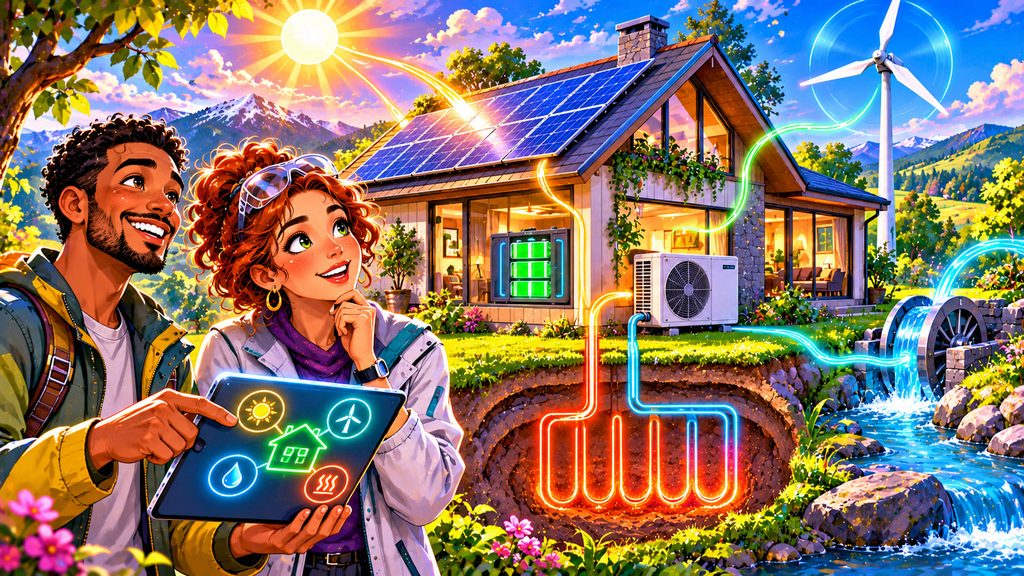
Imagine waking up in a house where sunlight generates electricity, underground heat keeps the rooms comfortable, and a battery stores energy for the evening. Your home still has modern appliances, reliable lighting, and hot water, but depends far less on conventional energy supplies. This is no longer a futuristic idea reserved for experimental buildings.
Renewable energy technologies have become increasingly accessible to homeowners, offering ways to reduce electricity bills, lower carbon emissions, and improve energy independence. However, not every technology works equally well in every location. The best renewable energy system depends on your climate, property, household energy consumption, and budget.
Can Renewable Energy Really Power an Entire House?
A home needs energy for several different purposes: electricity, space heating, cooling, and hot water. These demands can be met by different technologies, sometimes working together. Solar panels generate electricity, heat pumps provide efficient heating and cooling, and solar thermal collectors heat water directly.
Some households can generate as much electricity annually as they consume, but annual balance does not guarantee continuous independence. Production changes with weather, seasons, and time of day. True off-grid living requires sufficient generation, energy storage, and a reliable plan for periods when renewable resources are unavailable.
Solar Panels: The Most Versatile Home Energy Option
Solar photovoltaic panels convert sunlight directly into electricity using semiconductor materials. When sunlight strikes the cells, it produces electrical charges that can be collected and used to power household equipment. An inverter converts the panels’ direct-current electricity into alternating current suitable for most domestic appliances.
Solar panels are popular because they have no moving mechanical parts, operate relatively quietly, and can be installed on suitable rooftops. Their output depends on geographic location, roof orientation, shading, and weather conditions. Panels still generate electricity on cloudy days, although generally less than under strong sunlight.
For example, a 5-kilowatt solar array in a location receiving an annual yield of 1,000 kilowatt-hours per installed kilowatt could produce approximately 5,000 kilowatt-hours annually. Actual generation may be substantially higher or lower. A professional assessment should estimate expected production before installation.
Solar Thermal Energy: Heating Water With Sunlight
Solar panels are not the only way to use sunshine. Solar thermal collectors absorb sunlight and transfer its energy to water or another heat-transfer fluid. The collected heat can provide domestic hot water, reducing the electricity or fuel needed by a conventional water heater.
Well-designed solar water-heating systems can supply a substantial portion of annual hot-water demand. Their effectiveness depends on sunshine, storage capacity, water consumption, and climate. In colder regions, some systems circulate antifreeze through collectors and transfer the heat to household water through a heat exchanger.
Solar thermal systems do not ordinarily generate electricity. They are designed specifically to provide heat, making them potentially useful for households with substantial hot-water needs.
Home Wind Turbines: Electricity From Moving Air
A small wind turbine converts the kinetic energy of moving air into electricity. Its rotating blades drive a generator, allowing wind energy to supply appliances or charge batteries. Wind systems can complement solar panels because some regions experience stronger winds during winter or at night.
However, residential wind power is highly dependent on local conditions. The US Department of Energy identifies an average wind speed of approximately 4 meters per second at turbine height as a preliminary consideration for small systems. Better wind conditions generally improve financial performance.
A turbine installed in a sheltered urban garden may produce far less electricity than one operating on an exposed rural property. Buildings and trees create turbulence, while taller towers often provide access to more consistent winds. Installation also requires attention to noise, maintenance, safety, and local planning rules.
Geothermal Energy: Heating Your Home Using the Ground
The ground a short distance below Earth’s surface maintains a more stable temperature than the surrounding air. Ground-source heat pumps use this temperature difference to transfer heat into buildings during winter and remove unwanted indoor heat during summer. These systems are commonly described as geothermal heating.
A network of buried pipes circulates fluid through the ground, exchanging heat with the surrounding soil or rock. A heat pump then concentrates this energy to provide comfortable indoor temperatures. Because it moves existing heat rather than generating all the heat directly, it can use considerably less electricity than conventional electric resistance heating.
Ground-source systems can be highly efficient, but installation requires excavation or drilling. Their initial costs are often higher than those of air-source alternatives. They are particularly worth considering during new construction or major renovations.
Air-Source Heat Pumps: Renewable Heat Without Digging
An air-source heat pump extracts heat from outdoor air and transfers it into the home. Surprisingly, it can operate even when outdoor temperatures are below freezing because cold air still contains usable thermal energy. Many modern units can also cool buildings during summer.
A heat pump’s coefficient of performance describes how much useful heat it delivers relative to the electricity it consumes. A value of three means that one kilowatt-hour of electricity produces approximately three kilowatt-hours of delivered heat under the specified conditions.
Heat pumps are not electricity generators; they require an electrical supply. When powered partly by rooftop solar or renewable grid electricity, they can help reduce household dependence on fossil fuels. Their effectiveness improves with good insulation and appropriately designed heating systems.
Micro-Hydropower: Electricity From a Flowing Stream
Properties with access to suitable flowing water may have another possibility: micro-hydropower. A small turbine uses moving or falling water to generate electricity. Unlike solar panels, some hydropower systems can produce energy throughout the day and night.
The available power depends mainly on water flow and hydraulic head, the vertical height through which water falls. A stream with substantial flow and elevation change can provide useful generation, while a shallow, slow-moving stream may offer little potential.
Water rights, ecological protections, seasonal droughts, and installation costs make micro-hydropower unsuitable for most urban homes. Where conditions are favorable, however, it can provide a valuable contribution to an off-grid energy system.
Biomass Heating: Using Renewable Organic Materials
Wood, pellets, and certain agricultural residues can provide heat through biomass heating systems. Modern pellet boilers automate fuel delivery and can replace conventional heating equipment in some homes. Their practicality depends on fuel availability, storage space, and maintenance requirements.
Biomass is renewable when sources are managed sustainably, but burning it releases carbon dioxide and air pollutants. The overall environmental impact depends on forestry practices, fuel processing, combustion efficiency, and emissions controls. It should not automatically be considered pollution-free merely because the fuel originated from plants.
Batteries: Making Renewable Electricity Available After Sunset
Solar panels may generate their greatest output around midday, while many households use substantial electricity in the evening. A home battery storage system can store surplus electricity and release it when generation falls. This increases the amount of solar power consumed directly by the household.
Battery capacity is measured in kilowatt-hours, while output power is measured in kilowatts. A battery storing 10 kilowatt-hours could theoretically supply a constant 1-kilowatt load for around ten hours, before accounting for losses and usable-capacity limits.
Not every solar installation provides electricity during a blackout. Many grid-connected systems automatically shut down for safety, so backup operation requires compatible equipment, appropriate controls, and an inverter designed for that purpose.
Why Insulation Should Come Before Expensive Equipment
The most economical energy is often the energy a household does not need to consume. Poorly insulated roofs, walls, and windows allow valuable heat to escape, increasing the amount of energy required for comfortable indoor temperatures. Air leaks and inefficient appliances can create additional unnecessary demand.
Improving insulation, sealing drafts, and choosing efficient equipment can reduce the required size of renewable energy systems. A smaller heat pump or solar installation may then meet household needs at a lower upfront cost. Energy efficiency and renewable energy work best as complementary investments.
Which Renewable Energy System Should You Choose?
For many houses with suitable roofs, solar photovoltaic panels offer a practical starting point. Homes with substantial heating needs may benefit from combining efficient heat pumps with solar electricity. Rural properties with reliable winds or flowing water can investigate wind turbines or micro-hydropower.
A hybrid system combines multiple technologies to reduce dependence on any single energy source. For example, solar panels might supply daytime electricity, a heat pump could provide heating, and a battery could cover part of the evening demand.
Before investing, review electricity bills, assess your roof and property, and obtain realistic generation estimates. Compare installation costs, maintenance, equipment lifespan, grid connection arrangements, and local financial incentives.
Is Complete Energy Independence Worth It?
Producing your own electricity does not necessarily mean disconnecting from the grid. A grid-connected home can export surplus electricity when permitted and import power when renewable generation is insufficient. This arrangement may be less expensive than purchasing enough batteries and additional equipment for complete autonomy.
Off-grid systems can be valuable in remote locations, but they require careful planning for prolonged cloudy weather, seasonal demand, and equipment failures. The smartest goal is not always total independence; it is achieving reliable, affordable energy with the lowest practical environmental impact.
Renewable energy offers homeowners several ways to rethink how their houses operate. Whether you begin with solar panels, a heat pump, or improved insulation, the most effective strategy starts with understanding your actual energy needs. If you could install one renewable energy technology in your home, which would you choose first, and why? Share your thoughts in the comments.
Interesting Facts
- Solar panels can generate electricity on cloudy days, although output is generally lower than in direct sunlight.
- A heat pump can deliver several units of useful heat for each unit of electricity consumed.
- Wind power depends strongly on wind speed; the energy available in wind increases with the cube of its speed.
- Ground-source heat pumps use the relatively stable temperature beneath Earth’s surface for heating and cooling.
- Micro-hydropower can generate electricity continuously where sufficient water flow is available.
- Solar panels alone usually cannot power a grid-connected house during a blackout without additional compatible equipment.
- Improving home insulation can reduce the required size and cost of renewable energy systems.
Glossary
- Solar Photovoltaic Panels — Devices that convert sunlight directly into electrical energy.
- Inverter — Equipment that converts direct-current electricity into alternating current.
- Solar Thermal Collectors — Devices that absorb solar radiation to produce useful heat.
- Wind Turbine — A machine that converts the kinetic energy of wind into electricity.
- Ground-Source Heat Pumps — Systems that transfer heat between a building and the ground.
- Air-Source Heat Pump — A heating and cooling device that transfers thermal energy between indoor and outdoor air.
- Coefficient of Performance — The ratio of useful heating or cooling delivered to the energy consumed by a system.
- Micro-Hydropower — Small-scale electricity generation using flowing or falling water.
- Hydraulic Head — The vertical height difference that contributes to the energy available from flowing water.
- Biomass — Organic material used as a source of energy or fuel.
- Battery Storage — Technology that stores electrical energy for later use.