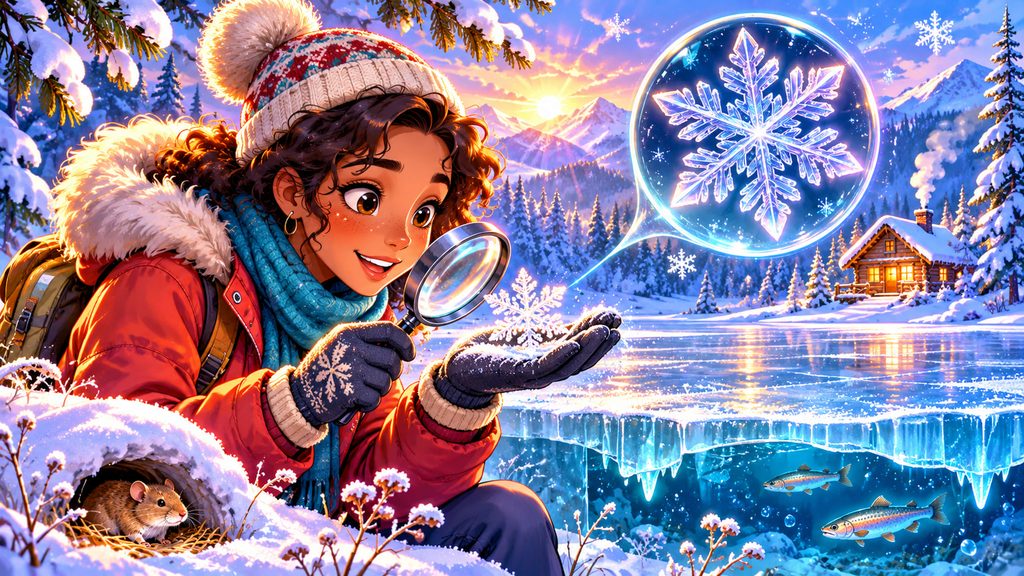
A snowy forest appears silent until you notice the tiny clues: a bird among the branches, fresh animal tracks, and ice crystals sparkling in the weak sunlight. The lake seems motionless, but life continues beneath its frozen surface. Winter may look like nature pressing a pause button, yet it is a season of remarkable physical and biological activity. Every snowflake, shortened day, and frozen pond tells part of a larger scientific story.
Winter also means different things in different places. Some regions experience months of snow, while others have cold rain or merely cooler evenings. The Northern and Southern Hemispheres experience winter at opposite times of year. Understanding the season begins far beyond the clouds, with the motion of our planet.
Why Does Winter Happen?
Earth’s axis tilts approximately 23.4 degrees relative to its orbital plane. As the planet travels around the Sun, each hemisphere alternately tilts toward and away from direct sunlight. During winter, sunlight arrives at a lower angle, and the days grow shorter, reducing the energy received by the ground. The main cause of winter is Earth’s tilt, not its distance from the Sun. In fact, Earth is closest to the Sun in early January, during Northern Hemisphere winter, while much of the Southern Hemisphere enjoys summer.
What Makes the Winter Solstice Special?
The winter solstice marks the shortest daylight period of the year in a hemisphere. It normally falls around December 21 or 22 in the north and around June 20 or 21 in the south. Although daylight starts increasing afterward, temperatures may keep falling for several weeks. This delay, known as seasonal lag, occurs because land, water, and air continue releasing heat accumulated during warmer months. It also explains why the hottest part of a summer day usually comes after noon rather than precisely when the Sun is highest.
How Do Snowflakes Form in the Clouds?
Snowflakes begin as tiny ice crystals growing from water vapor inside cold clouds. Water molecules arrange into a hexagonal structure, giving the crystals their characteristic sixfold symmetry. Temperature and humidity influence whether they grow as plates, columns, needles, or intricate branching stars. Each crystal’s passage through changing cloud conditions produces a distinctive pattern.
Caltech physicist Kenneth Libbrecht has spent decades studying how these forms develop. His research shows that elaborate, thin plates can grow around minus 15 degrees Celsius under suitable moisture conditions, while other temperatures favor different shapes. The familiar six-armed star is therefore only one variety of snow crystal. A snowflake is a tiny record of the atmosphere through which it has traveled.
Why Is Snow White, and Why Does It Crunch?
Ice is largely transparent, so why is a snow-covered landscape white? Countless boundaries between ice and air scatter visible light in many directions, returning a mixture of colors to our eyes. Deep snow sometimes looks blue because longer journeys through ice favor the absorption of red light. Very cold snow can crunch as brittle grains fracture and rub together underfoot. Near freezing, slight melting changes friction and softens the sound, making snow a surprisingly revealing indicator of local conditions.
Can Snow Actually Keep Animals Warm?
Fresh snow can consist mostly of trapped air, which slows the movement of heat. A thick snowpack therefore acts as an insulating blanket over the ground, even when the air above is bitterly cold. Small mammals may move through the subnivean zone, the sheltered space between soil and snow, to escape wind and search for food. Roots and overwintering plants also benefit from this protection. Snow stores water for spring, although its ecological effects depend on depth, density, and the timing of melting.
Why Do Lakes Freeze From the Top?
Freshwater reaches its greatest density near four degrees Celsius, so water at roughly that temperature tends to sink beneath colder surface water. When the upper layer approaches freezing, it forms ice that floats because solid ice is less dense than liquid water. The ice cover then slows heat loss from the water underneath. Fish and other aquatic organisms can remain alive below the frozen surface when oxygen and habitat conditions are adequate. Shallow ponds can still freeze deeply or lose oxygen, so a layer of ice is not an absolute guarantee of survival.
How Do Animals and Plants Survive the Cold?
Winter survival takes many forms: migration, energy conservation, insulation, and shelter. During hibernation, some mammals greatly reduce metabolic activity and body temperature, allowing stored energy to last longer. Migratory birds seek regions with more accessible food, while resident animals may grow thicker coats or change their foraging habits. Deciduous trees shed leaves and enter dormancy, conserving resources when water may be frozen in the soil. Evergreen needles often have waxy surfaces that reduce water loss, while seeds and buds wait for spring.
Why Does Winter Affect Sleep and Health?
Short daylight periods can influence melatonin, a hormone helping regulate daily sleep-wake rhythms. Some people notice changes in energy or mood, while others experience seasonal affective disorder, a recurring form of depression. Regular sleep, outdoor daylight, physical activity, and appropriate clinical support can be useful. Cold weather itself does not cause the common cold; respiratory viruses cause the infection. However, indoor crowding and poor ventilation can help those viruses circulate, making winter health about more than simply staying warm.
Is Climate Change Changing Winter?
A warming climate does not eliminate every snowstorm or freeze. Warmer air can hold more water vapor, sometimes supporting heavy snowfall where temperatures remain low enough. At the same time, many regions are seeing earlier snowmelt, shorter snow seasons, or more winter precipitation falling as rain. Snow also affects climate through albedo, the fraction of sunlight reflected by a surface. Bright snow reflects far more sunlight than dark ground, so losing snow cover can increase the absorption of solar energy. Winter is both shaped by Earth’s climate and an active part of regulating it.
What Can Winter Teach Us About Nature?
Even a quiet winter morning reveals systems operating on different scales. Earth’s orbit changes the available sunlight, microscopic ice crystals respond to clouds, and living organisms adapt to scarce warmth and food. Looking for tracks in fresh snow or examining a crystal on a dark sleeve makes those hidden processes easier to notice. The season is not simply a period between autumn and spring, but an extraordinary display of physics and resilience. Which winter phenomenon fascinates you most: snowflake geometry, life beneath frozen lakes, or the strategies animals use to survive? Share your thoughts in the comments.
Interesting Facts
- Earth is closest to the Sun in early January, during Northern Hemisphere winter.
- Snow crystals often have sixfold symmetry because of the molecular structure of ice.
- Fresh snow can contain approximately 90–95% trapped air, making it a useful insulator.
- Freshwater is densest at about 4°C, helping many lakes freeze at the surface.
- The space beneath deep snow provides shelter for small animals in winter.
- Snow-covered sea ice can reflect up to about 90% of incoming sunlight.
Glossary
- Winter Solstice — The shortest daylight period of the year in a particular hemisphere.
- Seasonal Lag — The delay between a seasonal change in sunlight and the corresponding temperature extreme.
- Subnivean Zone — The sheltered habitat between the ground and an overlying snowpack.
- Hibernation — A state of substantially reduced metabolic activity that helps some animals conserve energy.
- Dormancy — A period of reduced growth or activity that helps plants survive unfavorable conditions.
- Melatonin — A hormone involved in coordinating the daily sleep-wake cycle.
- Albedo — The fraction of incoming solar radiation reflected by a surface.