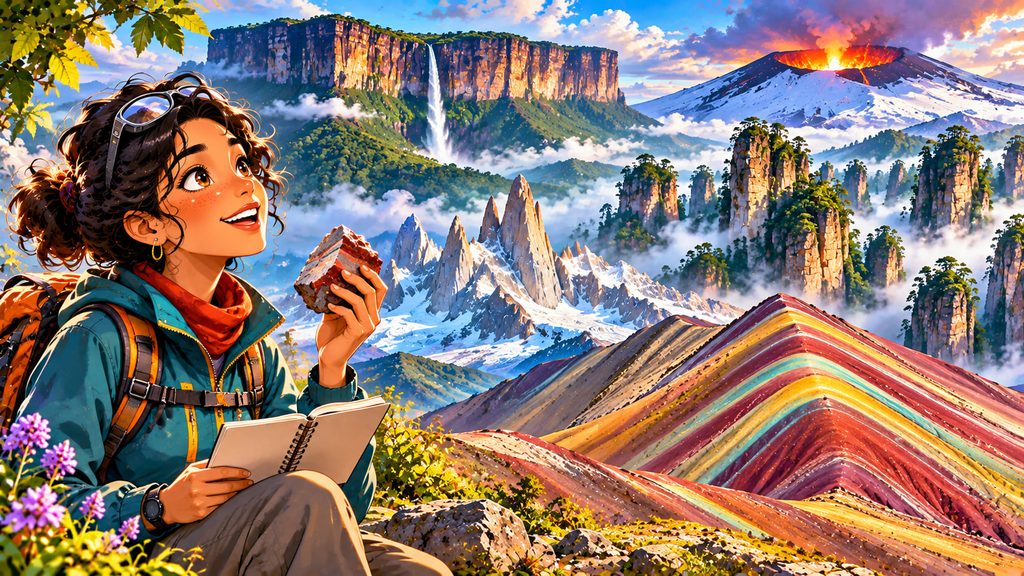
Some mountains resemble enormous stone tables, while others appear painted in rainbow colors or rise from forests like skyscrapers. One Antarctic summit even contains a lake of molten rock surrounded by snow and ice. These landscapes look almost imaginary, yet each is the product of understandable geological processes. The world’s strangest mountains reveal what happens when ancient rock, moving tectonic plates, water, wind, and time interact in unexpected ways.
Mountains are not all built in the same way. Some rise when the Earth’s crust is compressed, others grow around volcanoes, and still others are sculpted from existing rock by erosion. Their extraordinary shapes also influence the plants and animals that can survive there. Here are eight remarkable examples from across the planet.
Mount Roraima, South America: An Island Above the Clouds
At the junction of Venezuela, Guyana, and Brazil, Mount Roraima rises above tropical forests like a giant stone platform. It is a tepui, a table-shaped mountain with steep cliffs and a broad summit, reaching approximately 2,800 meters above sea level. Much of its sandstone belongs to rock formations nearly two billion years old, although the mountain’s present shape is far younger. Over immense periods, weathering and erosion removed surrounding material, leaving a resistant plateau isolated high above the lowlands. Its summit supports unusual plants and animals adapted to an environment of thin soils, frequent mist, and limited connections to neighboring habitats. The result is not simply a remarkable silhouette but an ecological island in the sky.
Vinicunca, Peru: The Rainbow Mountain
High in the Peruvian Andes, Vinicunca displays spectacular bands of red, gold, green, and pale stone. Its stripes come from different sedimentary layers, whose minerals and chemical histories produce contrasting colors. Iron-bearing compounds contribute some reddish tones, while other minerals and sediments produce the greens, yellows, and lighter bands. Geological uplift tilted these deposits, and erosion exposed their colorful pattern on the mountainside. The famous viewpoint lies above 5,000 meters, where thin air makes even ordinary walking demanding. Its colors are not artificial paint: they are a visible record of changing environments preserved in rock.
Zhangye, China: Hills That Look Like Painted Waves
China’s Zhangye Colorful Hills resemble a series of enormous, striped waves frozen in place. Unlike a single isolated mountain, this landscape consists of colorful ridges and hills made of sandstone, siltstone, and mudstone. Their deposits formed during different periods, and mineral composition gave successive layers varying shades of red, green, yellow, and gray. Iron-related oxidation processes help explain several of these colors, while tectonic movements tilted the rock beds. Wind and water gradually carved the exposed layers into rounded slopes and dramatic patterns. The landscape demonstrates how geology can create striking color without volcanic eruptions or unusual lighting.
Tianzi Mountain, China: A Forest Made of Stone
In the Wulingyuan region of Hunan Province, narrow stone columns rise hundreds of meters above forested valleys. The scenery around Tianzi Mountain is famous for thousands of tall pillars composed largely of quartz sandstone. These formations did not grow upward like trees; they are remnants of rock gradually separated by fractures, water, and erosion. Geologists describe this selective removal as differential erosion, because some portions weather away faster than others. Humid forests and drifting clouds make the surviving columns appear suspended in air. The same landscape also provides habitats across dramatically different elevations and sheltered gorges.
Mount Erebus, Antarctica: Fire Beneath the Ice
On Antarctica’s Ross Island stands Mount Erebus, an active volcano approximately 3,794 meters high. Its summit crater contains one of Earth’s rare persistent lava lakes, making it an extraordinary place to study active volcanic processes. The molten rock is unusual phonolite lava, with properties that influence how gases escape and eruptions behave. Around the volcano, freezing temperatures and snow contrast sharply with the intense heat beneath the crater. Volcanic gases and heat can also help shape remarkable ice formations. Erebus shows that an icy continent can still contain powerful geological activity far below its frozen surface.
Mount Thor, Canada: An Almost Impossible Cliff
On Baffin Island in Canada’s Auyuittuq National Park, Mount Thor presents a vast wall of rock overlooking a glacial valley. Canada’s national atlas identifies a vertical drop of about 1,250 meters, among the most extraordinary sheer faces on Earth. Parts of the wall form an overhang, meaning the rock slopes outward beyond the ground beneath it. Its dramatic relief reflects ancient crustal history followed by prolonged erosion and the excavation of nearby valleys by ice. Gravity, rock fractures, and continued weathering shape the cliff even today. The landscape is impressive from a distance, but its remoteness and steepness also make it an exceptionally hazardous mountaineering environment.
Cerro Torre, Patagonia: A Granite Needle in the Sky
Near the Argentina–Chile border, Cerro Torre rises to approximately 3,128 meters as a narrow granite spire above the Southern Patagonian Ice Field. Its extreme shape owes much to glacial erosion, which sharpened the surrounding mountain landscape and exposed resistant rock. Ice, snow, and fierce Patagonian winds intensify its striking appearance. Clouds frequently hide the summit, emphasizing how abruptly it emerges from nearby valleys and glaciers. Although granite is a strong rock, joints and fractures influence how it breaks apart over time. Cerro Torre illustrates the ability of glaciers to transform a mountain massif into isolated, intimidating peaks.
Mount Kinabalu, Malaysia: A Young Giant With Ancient Neighbors
Rising 4,095 meters above sea level on the island of Borneo, Mount Kinabalu has enormous exposed granite slabs and jagged summit peaks. Its core is a relatively young granite intrusion, formed when molten rock cooled underground and was later brought closer to the surface by uplift and erosion. Weathering and former glaciers helped sculpt its distinctive summit. The mountain spans habitats from tropical forests to exposed alpine environments within a relatively small area. This dramatic elevation gradient supports exceptional biodiversity and endemism, meaning some species live naturally in only a restricted region. Kinabalu is a reminder that unusual geology can help create extraordinary living communities.
What These Mountains Reveal About Our Planet
These eight places arose through different combinations of tectonic uplift, volcanic activity, deposition, and erosion. Their shapes are temporary on geological timescales, even though many appear unchanged over a human lifetime. Scientists examine rocks, minerals, fossils, and landscapes to reconstruct the processes that produced them. Protecting these sites also protects natural records of Earth’s history and specialized ecosystems that cannot easily be replaced.
Visitors can help by staying on approved trails, respecting local communities and cultural traditions, and avoiding damage to fragile rock surfaces and vegetation. Some destinations also involve extreme altitude, severe weather, or remote terrain, requiring professional guidance and careful preparation. Appreciating their beauty does not require attempting dangerous climbs. Which would you most like to see: Roraima’s tabletop summit, Peru’s rainbow slopes, or the volcanic glow of Antarctica’s Mount Erebus? Share your choice in the comments.
Interesting Facts
- Mount Roraima’s sandstone includes rocks nearly two billion years old.
- Vinicunca’s colorful slopes rise above 5,000 meters in the Peruvian Andes.
- Zhangye’s colored hills are made of several sedimentary rock types, not painted surfaces.
- Wulingyuan contains thousands of remarkable quartz-sandstone pillars.
- Mount Erebus holds one of the world’s few persistent lava lakes.
- Mount Thor’s dramatic vertical drop measures approximately 1,250 meters.
- Mount Kinabalu reaches 4,095 meters and supports remarkable biodiversity.
Glossary
- Tepui — A steep-sided, flat-topped mountain characteristic of parts of northern South America.
- Weathering — The physical and chemical breakdown of rock at or near Earth’s surface.
- Sedimentary Layers — Successive deposits of sediment that may eventually harden into rock.
- Oxidation — A chemical process involving electron loss, often affecting the color of iron-bearing minerals.
- Quartz Sandstone — Sandstone composed predominantly of quartz grains.
- Differential Erosion — Uneven removal of rock because materials vary in resistance to erosion.
- Lava Lake — A body of molten lava present in a volcanic crater or vent.
- Phonolite — A type of volcanic rock with a distinctive chemical and mineral composition.
- Overhang — A rock face that projects outward beyond the terrain beneath it.
- Glacial Erosion — The wearing away and reshaping of terrain by moving ice.
- Granite Intrusion — A mass of granitic magma that solidified within surrounding rock.
- Endemism — The condition of a species occurring naturally only within a particular geographical area.