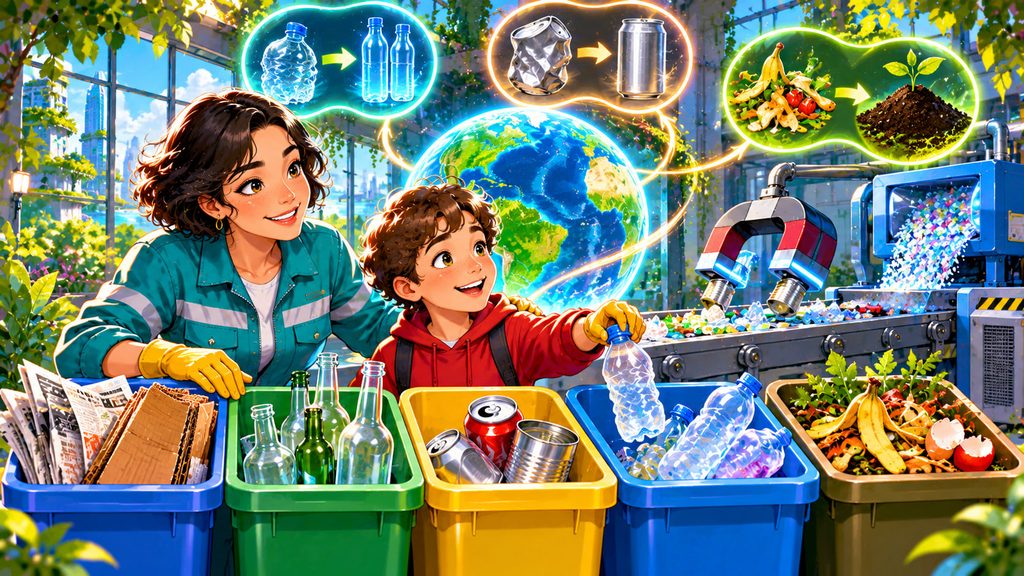
A glass jar, a cardboard box, a banana peel, and a dead battery may all end up in the same household trash bag. Yet these objects have very different futures. One could become a new bottle, another could be made into packaging, and food scraps could help enrich soil. The battery, meanwhile, needs special handling to prevent pollution or fires.
That is the simple idea behind waste sorting: separating discarded materials so they can be handled safely and given the best possible second life. It is a small daily habit with consequences far beyond the kitchen. Sorting conserves raw materials and keeps hazardous substances out of ordinary trash. It also connects individual choices with a much larger environmental system.
What Exactly Is Waste Sorting?
Waste sorting means separating discarded items into groups according to their materials and the way they should be treated. Common categories include paper, glass, metals, plastic packaging, food scraps, and hazardous or electronic waste. At home or work, this is called source separation. Different locations use different systems, so the correct bin always depends on local collection rules.
Sorting does not automatically mean everything collected will be recycled. Materials still require processing and buyers. Some items cannot be recycled locally. Good sorting improves the chances of recovery, but it is one stage of a much larger process.
Why the World’s Waste Problem Is Growing
According to the United Nations Environment Programme, the world generated approximately 2.1 billion tonnes of municipal solid waste in 2023. Without major changes, annual generation could reach roughly 3.8 billion tonnes by 2050. This category includes everyday waste from homes and similar sources, not all industrial or agricultural waste. Growing cities and consumption strain collection systems.
When waste is poorly managed, it can accumulate in open dumps, reach waterways, or expose people to hazardous materials. Disposal sites require land and monitoring. Sorting makes it easier to recover useful materials before they are lost in mixed waste. Sorting cannot solve excessive consumption, but it helps reduce the environmental burden.
What Happens Inside a Recycling Facility?
Collected recyclables often travel to a materials recovery facility, where machines and workers separate them into marketable streams. Screens can divide flat paper from containers, magnets capture steel, and devices called eddy-current separators push nonmagnetic metals such as aluminum away from other materials. Optical sensors can identify some plastics. Workers remove objects that disrupt machinery.
After sorting, materials may be baled and sent to specialized recyclers. Paper is pulped, glass remelted, and metals reprocessed. Many plastics require additional separation, washing, shredding, and melting. Results depend on product design, cleanliness, technology, and markets.
Why Recycling Aluminum Is So Valuable
Recycling aluminum avoids much of the energy-intensive work required to produce new metal from ore. The International Aluminium Institute reports that secondary aluminum production can save around 95% of the energy associated with primary production. Aluminum drink cans are therefore particularly valuable when collected in clean recycling streams. Unlike some materials, aluminum can be remelted repeatedly without inherently losing its metallic properties.
Steel and copper also have recovery markets. Separating metal from food improves recovery. However, mixed-material products may be much harder to disassemble than simple cans. Product design determines how easily metals return to use.
Paper and Cardboard: Why Cleanliness Matters
Paper recycling recovers plant fibers that can be used in cardboard, tissues, and new paper products. Fibers weaken with repeated processing, so fresh fibers are sometimes needed. Dry cardboard and ordinary paper are commonly collected, although local rules differ. Food-soaked packaging may be unsuitable for recycling because grease and residues interfere with processing.
A clean shipping box can usually be flattened for collection. By contrast, a heavily greasy food container may belong in residual waste or an organics system, depending on local rules. Separating food waste protects recovered fibers. Home sorting affects how much fiber reaches mills.
Can All Plastic Packaging Be Recycled?
Plastic is a family of materials rather than a single substance. Bottles made from polyethylene terephthalate (PET) and certain high-density polyethylene containers have established recycling pathways in many places. Flexible films, black trays, foam packaging, and multi-layer pouches can be more difficult to process. A number inside a triangular symbol identifies a resin type; it does not guarantee that an item is accepted by your local recycling service.
Plastics can also lose quality through repeated heating and processing, depending on their composition. Some become packaging; others become different products. Food residues reduce recovered material quality. Buying fewer unnecessary single-use items remains important even when recycling options exist.
Why Food Scraps Need Their Own Stream
A banana peel and a plastic bottle behave very differently after disposal. Food waste breaking down in oxygen-poor landfills can generate methane, a powerful greenhouse gas. Through composting, microorganisms decompose suitable organic material in the presence of oxygen, producing a soil-improving material. Some municipalities instead use anaerobic digestion, which generates biogas under controlled oxygen-free conditions.
Food scraps can become resources through local facilities. Ordinary home compost systems cannot necessarily process meat, dairy, or certified compostable packaging safely. Preventing food waste saves the resources used to produce it. Planning portions and using leftovers belong in the same environmental conversation as sorting.
Why Batteries and Electronics Should Never Be Mixed In
Damaged lithium-ion batteries can overheat and cause fires inside collection trucks or sorting facilities. Other batteries and electronic devices may contain substances requiring specialized treatment. In 2022, the world generated approximately 62 million tonnes of electronic waste, yet only 22.3% was documented as formally collected and recycled. Valuable metals are lost when electronics are simply discarded.
Phones, chargers, batteries, and small appliances should go through authorized collection or take-back programs where available. Local instructions may specify covering exposed battery terminals or keeping certain battery types separate. These steps protect workers and facilities. Repairing or donating equipment can extend its life.
What About Glass, Clothing, and Hazardous Products?
Glass bottles and jars can often be recycled repeatedly, but window glass, ceramics, and drinking glasses may have different compositions and processing requirements. Clothing in usable condition is generally better donated or repaired than treated as disposable waste. Paints, solvents, and certain cleaning chemicals should follow designated hazardous-waste collection procedures. Misplacing them can contaminate recyclables or damage equipment.
The Bigger Picture: A Circular Economy
Recycling is only one part of the circular economy, an approach that aims to keep products and materials useful for longer. The Ellen MacArthur Foundation has helped popularize this idea by emphasizing durability, repair, reuse, and better product design. Repeatedly refilling a bottle prevents packaging waste. The preferred sequence is often to prevent waste first, reuse what already exists, and recycle what cannot reasonably be reused.
How to Start Sorting Waste at Home
Start by checking your municipality’s current collection guidance and choosing containers that match the materials it accepts. A small space for dry recyclables, another for permitted food scraps, and a safe place for batteries can make routines manageable. Empty packaging and follow local instructions about rinsing, lids, and flattening boxes. Avoid wishcycling, putting uncertain items in recycling simply because you hope they belong there.
Consistency matters more than an elaborate system. A clear routine helps everyone in a household understand what goes where, and checking rules occasionally prevents mistakes when services change. Less packaging also makes sorting easier. Which material is hardest to sort where you live—plastic, food scraps, glass, or something else? Share your experience in the comments.
Interesting Facts
- Global municipal solid waste could rise to approximately 3.8 billion tonnes annually by 2050 without major changes.
- Recycling aluminum can save around 95% of the energy required to produce it from raw materials.
- A plastic resin identification number does not guarantee local recyclability.
- Modern recovery facilities can use magnets, optical sensors, and eddy currents to identify materials.
- Food waste in oxygen-poor landfills can generate methane, while controlled composting uses oxygen.
- Only 22.3% of global electronic waste generated in 2022 was documented as formally collected and recycled.
Glossary
- Source Separation — Sorting discarded materials where they are produced, before collection.
- Municipal Solid Waste — Everyday waste collected from households and similar sources.
- Materials Recovery Facility — A facility where mixed recyclables are separated into material streams.
- Eddy-Current Separator — Equipment using changing magnetic fields to separate nonferrous metals.
- Polyethylene Terephthalate (PET) — A plastic commonly used in beverage bottles and food packaging.
- Composting — Controlled decomposition of organic materials in the presence of oxygen.
- Anaerobic Digestion — Decomposition of organic matter without oxygen, often producing biogas.
- Electronic Waste — Discarded electrical and electronic equipment and its components.
- Circular Economy — An approach centered on reducing waste and extending the use of products and materials.
- Wishcycling — Placing unacceptable items in recycling in the hope that they can be recycled.