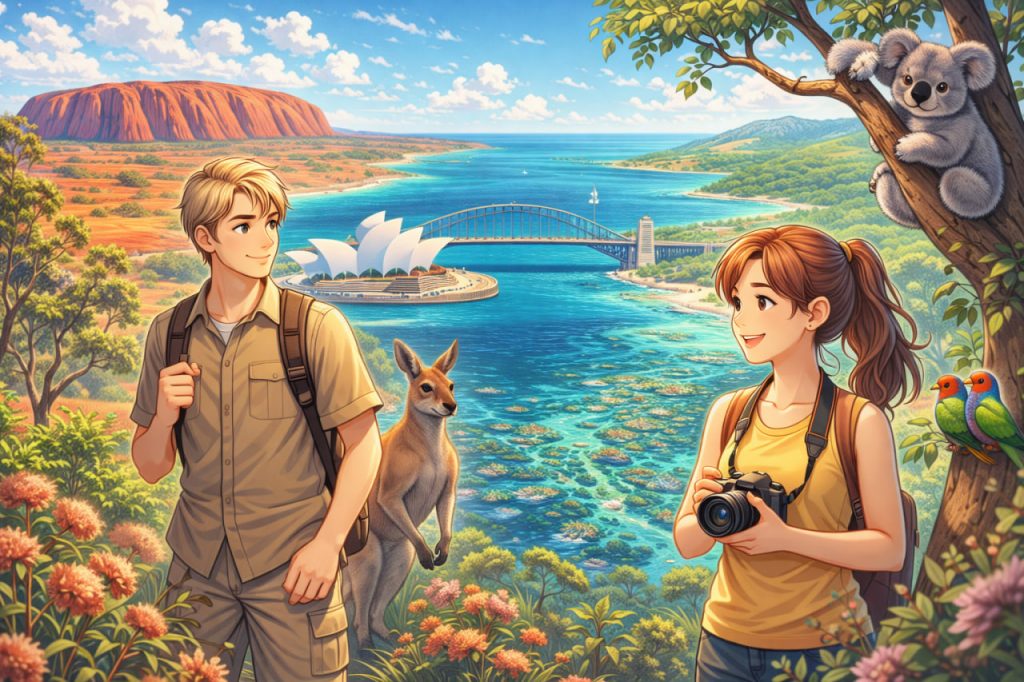
Australia is one of the most distinctive regions on Earth, unique in being both a sovereign country and an entire continent. Its isolation over millions of years shaped landscapes, ecosystems, and cultures found nowhere else. From arid deserts and tropical rainforests to coral reefs and temperate coastlines, Australia displays striking natural contrasts. At the same time, it is a modern, technologically advanced society with globally connected cities and institutions. Understanding Australia means understanding how ancient nature and contemporary life coexist on a vast and fragile land.
Geography and Natural Contrasts
Australia is the sixth-largest country in the world and one of the driest inhabited continents. Much of its interior consists of deserts and semi-arid regions collectively known as the Outback. In contrast, the northern areas experience tropical climates, while the southern regions are temperate. Along the eastern coast lies the Great Barrier Reef, the largest coral reef system on Earth. These geographic extremes strongly influence biodiversity, climate patterns, and human settlement across the continent.
Wildlife Found Nowhere Else
Australia’s long geographic isolation allowed many species to evolve independently. As a result, a large proportion of its wildlife is endemic, meaning it exists nowhere else. Marsupials such as kangaroos, koalas, and wallabies dominate the mammal population, while monotremes like the platypus and echidna represent rare evolutionary paths. Many species evolved without large predators, making them highly specialized but also vulnerable to environmental change. Protecting this biodiversity is a major scientific and ecological priority.
Indigenous Peoples and Ancient Continuity
Humans have lived in Australia for more than 60,000 years, making Aboriginal and Torres Strait Islander cultures among the oldest continuous cultures on the planet. Indigenous Australians developed complex social systems, languages, and land-management practices adapted to local environments. Their worldview emphasizes a deep spiritual connection between people, land, and ancestry, often described through the concept of the Dreaming. These traditions remain central to Australia’s cultural identity, despite a history of displacement and marginalization.
European Settlement and National Development
European settlement began in the late 18th century with British colonization. This period dramatically reshaped Australia’s population, economy, and landscapes. While it led to the development of modern cities and institutions, it also caused severe harm to Indigenous communities. Over time, Australia evolved into an independent democratic nation. Today, it is a multicultural society shaped by migration from Europe, Asia, and the Pacific, reflected in its languages, cuisine, and cultural life.
Modern Cities and Lifestyle
Most Australians live in coastal urban areas, particularly cities such as Sydney, Melbourne, and Brisbane. These cities are known for high living standards, strong public services, and access to nature. Outdoor activities are deeply embedded in everyday life, supported by favorable climates and extensive coastlines. Australian society places strong value on social equality, work–life balance, and public health, contributing to consistently high quality-of-life rankings.
Environmental Challenges and Responsibility
Australia faces significant environmental challenges, including prolonged droughts, severe bushfires, and coral reef degradation. Climate variability has a strong impact on ecosystems and agriculture. As a result, environmental research, conservation, and sustainable resource management are critical national concerns. Australia serves as a global case study in balancing economic development with ecological responsibility.
Australia’s Role in the World
Despite its relatively small population, Australia plays an influential role in global science, education, and environmental research. Its geographic position makes it a key participant in the Asia–Pacific region. Australian researchers contribute to studies in climate science, marine biology, astronomy, and medicine. The country’s future influence depends largely on how it protects its natural heritage while adapting to global change.
Interesting Facts
- Australia is the only nation that occupies an entire continent.
- More than 80% of plant and animal species are endemic.
- Indigenous cultures in Australia date back over 60,000 years.
- The Great Barrier Reef is the largest living structure on Earth.
- Most Australians live within 50 kilometers of the coast.
Glossary
- Outback — remote inland regions of Australia with low population density.
- Endemic Species — organisms found only in a specific geographic area.
- Dreaming — Indigenous Australian belief system connecting land, people, and ancestors.
- Great Barrier Reef — the world’s largest coral reef ecosystem.
- Biodiversity — the variety of living organisms within an ecosystem.