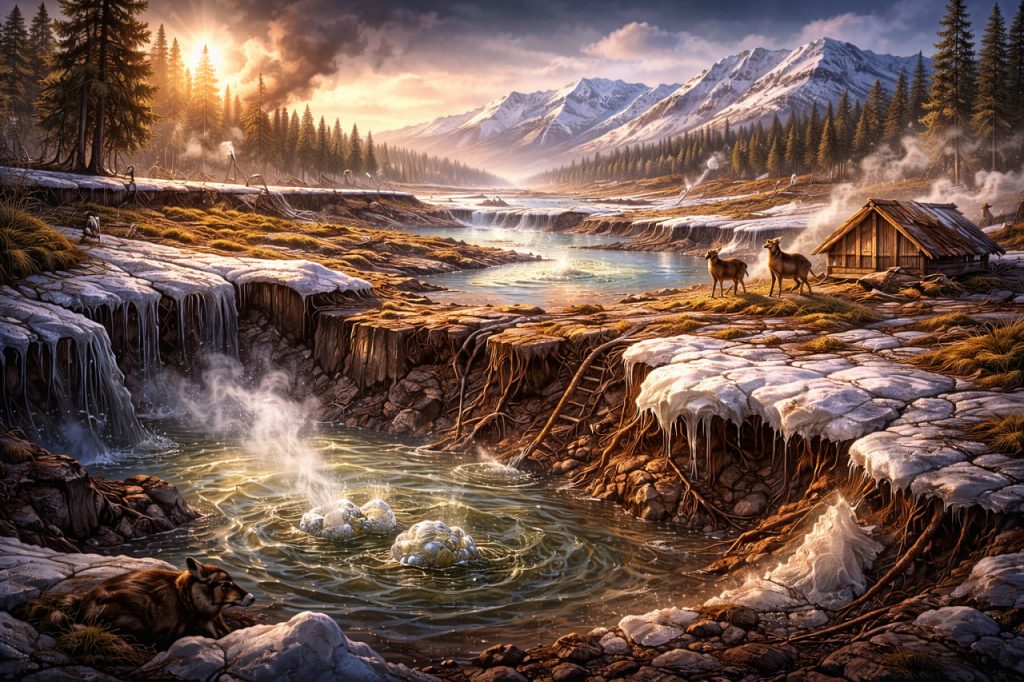
Permafrost—ground that remains frozen for at least two consecutive years—covers vast regions of the Arctic, particularly in Canada and Siberia. For thousands of years, it has acted as a stable foundation for ecosystems, infrastructure, and even entire communities. However, rising global temperatures are accelerating permafrost thaw, transforming what was once permanently frozen soil into unstable terrain. This thaw does not simply affect landscapes; it releases greenhouse gases, damages infrastructure, and exposes long-dormant biological material. Scientists increasingly describe permafrost as a “sleeping giant” of climate change because its destabilization can amplify global warming. Understanding the scale and risks of permafrost thaw is critical for both environmental and economic planning.
What Is Permafrost and Why It Matters
Permafrost consists of soil, rock, and organic material that has remained frozen for years or even millennia. In northern regions, it forms the structural base beneath forests, roads, pipelines, and settlements. When permafrost remains stable, it provides reliable ground support. Climate scientist Dr. Elena Petrov explains:
“Permafrost is not just frozen dirt.
It is a vast carbon reservoir locked in ice.”
When thawing occurs, organic material trapped within begins decomposing, releasing carbon dioxide and methane—powerful greenhouse gases that contribute to further warming.
Greenhouse Gas Release
One of the most serious concerns is the release of methane and carbon dioxide from thawing soils. Methane is particularly potent, trapping far more heat than carbon dioxide over short time scales. As permafrost melts, ancient plant material decomposes and emits these gases into the atmosphere. This creates a feedback loop: warming causes thaw, thaw releases greenhouse gases, and those gases intensify warming. Researchers estimate that Arctic permafrost stores enormous amounts of carbon accumulated over thousands of years.
Infrastructure and Economic Risks
Thawing ground poses immediate practical challenges. Buildings, roads, pipelines, and railways constructed on frozen soil can shift or collapse when the ground softens. In parts of Siberia and northern Canada, communities are already experiencing structural damage. Industrial sites, including oil and gas facilities, face increased maintenance costs and safety risks. As permafrost thaws unevenly, the ground may subside, forming depressions and damaging foundations.
Environmental and Biological Concerns
Beyond infrastructure, thawing permafrost affects ecosystems and potentially exposes ancient biological material. Microorganisms preserved for centuries can become active again once thawed. Although large-scale biological threats remain unlikely, scientists monitor these processes closely. Changes in soil structure also alter water drainage patterns, affecting forests, wetlands, and wildlife habitats. Arctic landscapes are undergoing visible transformation as frozen ground softens and reshapes.
Regional Impact: Canada and Siberia
Canada and Siberia contain some of the largest continuous permafrost zones in the world. Remote regions face logistical challenges in monitoring and mitigation. Indigenous communities, whose livelihoods depend on stable landscapes, are particularly vulnerable. In Siberia, large thaw slumps and ground collapses have reshaped terrain dramatically. In Canada, transportation routes and housing in northern territories require adaptation strategies.
Future Outlook and Mitigation
Permafrost thaw is difficult to reverse once initiated. Mitigation depends largely on reducing global greenhouse gas emissions to slow temperature rise. Engineers are exploring adaptive construction techniques, such as elevated foundations and thermal insulation barriers. Continuous satellite monitoring helps track changes across vast Arctic areas. While permafrost thaw cannot be entirely prevented under current warming trends, proactive planning can reduce its most severe impacts.
Interesting Facts
- Permafrost covers nearly one quarter of the Northern Hemisphere’s land area.
- Arctic soils contain vast amounts of stored carbon accumulated over millennia.
- Methane released from thawing ground is a highly potent greenhouse gas.
- Infrastructure damage from thawing soil is already documented in northern regions.
- Some frozen layers date back to the last Ice Age.
Glossary
- Permafrost — ground that remains frozen for at least two consecutive years.
- Methane — a powerful greenhouse gas released during organic decomposition.
- Carbon Reservoir — stored carbon within natural systems.
- Thaw Slump — a ground collapse caused by melting permafrost.
- Climate Feedback Loop — a process where warming triggers effects that cause further warming.