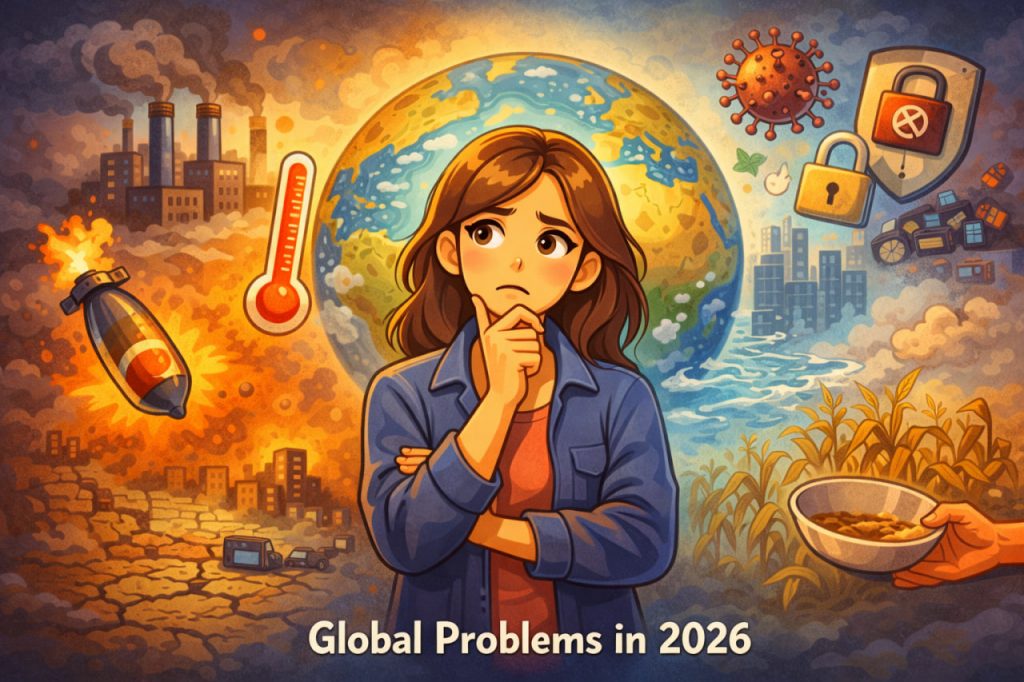
By 2026, humanity faces a set of interconnected global challenges that affect nearly every region of the world. These problems are not isolated; they influence one another, creating complex risks for societies, economies, and natural systems. Rapid technological progress exists alongside environmental degradation, social inequality, and geopolitical tension. While scientific knowledge and innovation have never been more advanced, the speed of global change often outpaces the ability of institutions to respond effectively. Understanding the main global problems of 2026 is essential for making informed decisions about the future of the planet and the well-being of its population.
Climate Change and Environmental Degradation
Climate change remains one of the most urgent global problems in 2026, affecting weather patterns, ecosystems, and human livelihoods worldwide. Rising global temperatures contribute to more frequent heatwaves, droughts, floods, and powerful storms. Melting glaciers and ice sheets accelerate sea-level rise, threatening coastal cities and island nations. At the same time, deforestation, biodiversity loss, and pollution weaken natural systems that help regulate the climate. According to climate researcher Dr. Laura Bennett:
“Climate change is no longer a distant threat.
Its effects are shaping economies, migration patterns, and food security right now.”
The challenge lies not only in reducing emissions but also in adapting societies to unavoidable environmental changes.
Resource Scarcity and Food Security
As the global population continues to grow, pressure on water, food, and energy resources intensifies. Many regions experience water shortages due to overuse, pollution, and changing rainfall patterns. Agricultural systems face stress from extreme weather, soil degradation, and supply-chain disruptions. Food insecurity remains a major concern, particularly in vulnerable regions, where millions lack reliable access to nutritious food. Technological solutions exist, but unequal distribution and economic barriers limit their impact. Ensuring sustainable resource management is one of the defining challenges of this decade.
Global Health Risks and Pandemic Preparedness
Although medical science has advanced significantly, global health risks remain a critical issue in 2026. The world has learned that infectious diseases can spread rapidly across borders, overwhelming healthcare systems. Beyond pandemics, chronic illnesses, mental health disorders, and antibiotic resistance pose long-term threats. Healthcare inequality means that access to treatment varies widely between countries and even within societies. Public health experts emphasize prevention, early detection, and international cooperation as key tools for reducing future risks.
Technological Risks and Digital Inequality
Technology shapes nearly every aspect of modern life, but it also introduces new global challenges. Artificial intelligence, automation, and digital surveillance raise concerns about privacy, employment, and ethical decision-making. At the same time, digital inequality leaves large portions of the global population without access to education, information, or economic opportunities. Cybersecurity threats, misinformation, and data misuse undermine trust in institutions and democratic processes. Managing technological progress responsibly has become as important as developing the technology itself.
Geopolitical Tensions and Global Security
In 2026, geopolitical instability continues to affect global cooperation and security. Conflicts, power rivalries, and economic competition strain international relationships. These tensions complicate efforts to address shared problems such as climate change, migration, and public health. Military conflicts also cause humanitarian crises, forcing millions of people to flee their homes. Political analysts warn that without dialogue and cooperation, global risks may intensify rather than diminish.
Social Inequality and Demographic Pressures
Economic inequality remains a persistent global issue, shaping access to education, healthcare, and economic mobility. Rapid urbanization places pressure on housing, infrastructure, and social services. Aging populations in some regions contrast sharply with youthful demographics in others, creating imbalances in labor markets and social support systems. Social inequality often amplifies other global problems, making societies more vulnerable to crises. Addressing these disparities is essential for long-term global stability.
Interesting Facts
- More than half of the world’s population lives in urban areas, increasing pressure on cities and infrastructure.
- Climate-related disasters affect hundreds of millions of people each year worldwide.
- Digital access remains uneven, with billions lacking reliable internet connectivity.
- Global health systems face growing strain from mental health disorders and chronic diseases.
- Many global problems share common roots, such as inequality and resource mismanagement.
Glossary
- Climate Change — long-term shifts in temperature and weather patterns caused primarily by human activity.
- Food Security — reliable access to sufficient, safe, and nutritious food.
- Digital Inequality — unequal access to digital technologies and the internet.
- Geopolitical Tension — conflict or rivalry between nations that affects global stability.
- Sustainability — meeting present needs without compromising future generations.