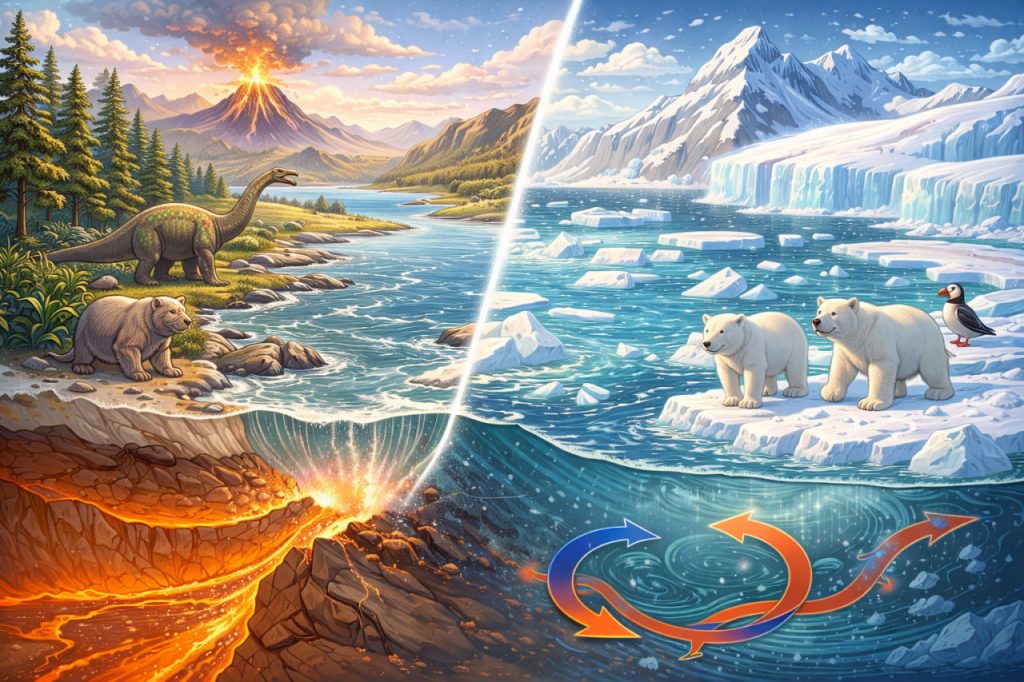
The Arctic is one of the most extreme and scientifically fascinating regions on Earth. Today it is known for vast ice sheets, permafrost, polar seas, and unique ecosystems. However, the Arctic was not always frozen. Its formation is the result of millions of years of plate tectonics, climate evolution, and ocean circulation changes. Understanding how the Arctic emerged helps scientists reconstruct Earth’s climatic history and predict future environmental shifts. The region’s development reflects the dynamic nature of our planet’s geological processes.
The Role of Plate Tectonics
The Arctic basin began forming more than 100 million years ago as tectonic plates gradually shifted. Movements of the North American, Eurasian, and Greenland plates reshaped ancient oceans and continents. Over time, seafloor spreading created the Arctic Ocean basin. Geologist Dr. Erik Johansen explains:
“The Arctic is not a static block of ice.
It is the outcome of continental drift and oceanic expansion over geological time.”
These tectonic processes defined the boundaries of the modern Arctic region.
From Warm Seas to Polar Ice
Surprisingly, the Arctic was once much warmer. Fossil evidence indicates that during certain prehistoric periods, forests and diverse wildlife thrived in high northern latitudes. Over tens of millions of years, global cooling trends altered atmospheric composition and ocean currents. The opening and closing of ocean gateways changed heat distribution across the planet. Eventually, colder conditions allowed permanent ice formation.
Formation of the Arctic Ice Cap
Permanent Arctic sea ice began developing during the late Cenozoic era as global temperatures declined. The formation of large ice sheets was influenced by reduced greenhouse gas concentrations and changes in Earth’s orbit. The polar ice cap expanded and contracted during ice ages, shaping coastlines and influencing global sea levels. Repeated glacial cycles carved landscapes across northern continents.
Ocean Circulation and Climate Influence
The Arctic plays a critical role in global ocean circulation. Cold, dense water sinks in the North Atlantic, driving thermohaline circulation that redistributes heat worldwide. This process connects the Arctic to global climate systems. The region’s reflective ice surface also influences planetary temperature by reflecting solar radiation back into space.
Modern Arctic Dynamics
Today, the Arctic continues to evolve. Sea ice extent varies seasonally, and long-term warming trends are altering its landscape. Permafrost thaw, shifting ecosystems, and changing ocean currents demonstrate that the Arctic remains a dynamic system. Scientists monitor these changes closely because the region acts as a sensitive indicator of global climate shifts.
Why the Arctic Matters
The Arctic is not only a remote icy frontier but also a key regulator of Earth’s climate balance. Its formation and evolution reflect interactions between geology, atmosphere, and oceans. By studying its history, researchers gain insight into planetary processes that extend far beyond the polar circle.
Interesting Facts
- The Arctic was once warm enough to support forests.
- Plate tectonics shaped the Arctic Ocean basin.
- Ice ages expanded and reduced Arctic ice repeatedly.
- The Arctic influences global ocean circulation.
- Polar ice reflects sunlight, helping regulate global temperature.
Glossary
- Plate Tectonics — movement of Earth’s outer shell plates.
- Seafloor Spreading — formation of new ocean crust through tectonic activity.
- Thermohaline Circulation — global ocean circulation driven by temperature and salinity differences.
- Permafrost — ground that remains frozen for at least two years.
- Glacial Cycle — alternating periods of ice advance and retreat.