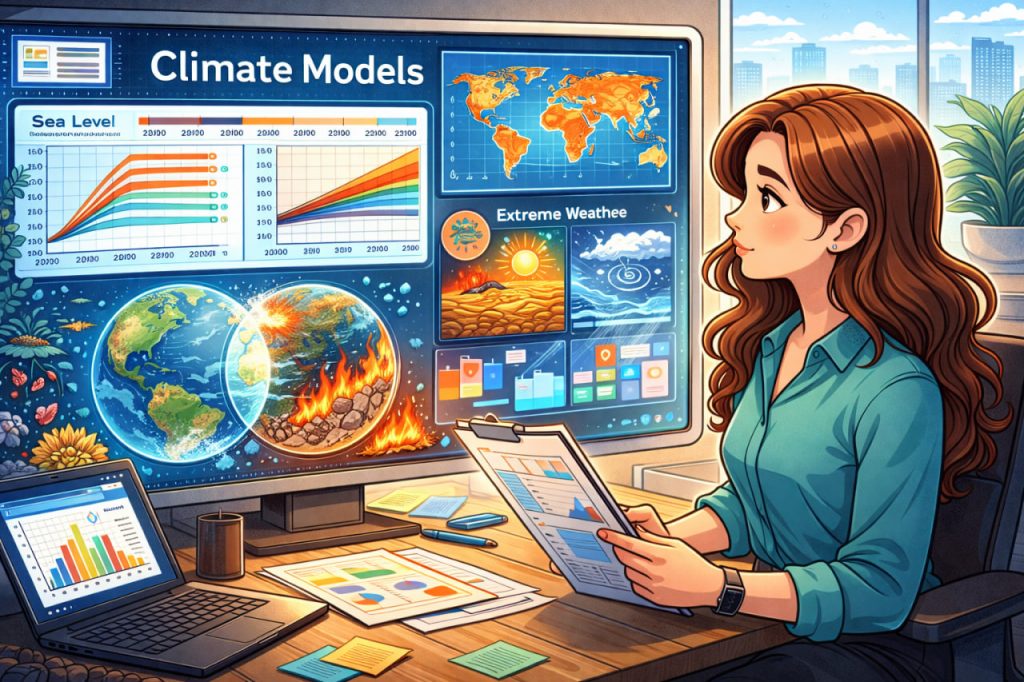
Climate models are powerful scientific tools used to simulate Earth’s atmosphere, oceans, land surface, and ice systems. They help researchers understand how different factors—such as greenhouse gas emissions, solar radiation, and ocean currents—interact over time. Rather than guessing the future, climate models use mathematical equations based on the laws of physics to calculate possible outcomes. These systems divide the planet into three-dimensional grids and simulate how energy and matter move between them. By analyzing different emission scenarios, scientists can estimate temperature changes, sea-level rise, and extreme weather trends. Climate models are essential for policymakers and researchers planning for long-term environmental stability.
How Climate Models Work
At their core, climate models rely on equations describing fluid dynamics, thermodynamics, and radiative transfer. The Earth is divided into thousands or millions of grid cells, each representing a portion of the atmosphere or ocean. The model calculates how heat, moisture, and momentum move between these cells over time. Supercomputers perform billions of calculations per second to simulate years or even centuries of climate activity. According to climate physicist Dr. Laura Mendes:
“Climate models do not predict a single fixed future.
They simulate a range of outcomes based on different human choices.”
This means results depend on emission scenarios and environmental variables.
The Role of Data and Observations
Climate models are constantly tested and improved using real-world observations. Scientists compare model simulations with historical temperature records, satellite measurements, and ocean data. If a model successfully reproduces past climate trends, confidence in its future projections increases. Continuous updates refine how clouds, aerosols, and ocean circulation are represented. The integration of observational data ensures that models remain scientifically grounded and progressively more accurate.
Scenarios and Future Projections
To explore possible futures, researchers use emission scenarios that reflect different levels of greenhouse gas output. Some scenarios assume rapid emission reductions, while others project continued fossil fuel use. Each scenario produces distinct temperature and precipitation outcomes. Models also estimate the probability of extreme events such as heatwaves, droughts, or heavy rainfall. Instead of offering certainty, climate models provide probability ranges that guide planning and adaptation strategies.
Strengths and Limitations
Climate models are among the most sophisticated simulation systems ever built, but they are not perfect. Some small-scale processes—such as local cloud formation—remain challenging to represent precisely. Uncertainty also depends on unpredictable human decisions about energy use and policy. However, models consistently agree on large-scale trends, including global warming under rising greenhouse gas concentrations. According to environmental systems analyst Dr. Martin Alvarez:
“Uncertainty in climate modeling does not mean ignorance.
It defines the range within which future outcomes are likely.”
Understanding these ranges helps societies prepare responsibly.
Why Climate Models Matter
Climate models inform international agreements, infrastructure planning, and disaster preparedness strategies. Governments use projections to design flood defenses, manage water resources, and plan agricultural systems. Businesses rely on long-term forecasts to assess climate risk. As computational power increases, models continue to improve in resolution and accuracy. Ultimately, climate models are not crystal balls—they are scientifically grounded simulations that help humanity make informed decisions about the planet’s future.
Interesting Facts
- Modern climate models run on supercomputers performing trillions of calculations per second.
- Many models simulate climate changes hundreds of years into the future.
- Historical climate data from ice cores help validate model accuracy.
- Different research institutions operate independent models that often produce similar large-scale trends.
- Climate modeling combines physics, chemistry, mathematics, and computer science.
Glossary
- Climate Model — a computer-based simulation that represents Earth’s climate system.
- Radiative Transfer — the process by which energy moves through the atmosphere in the form of radiation.
- Emission Scenario — a projected pathway of greenhouse gas output used in simulations.
- Fluid Dynamics — the study of how liquids and gases move.
- Supercomputer — a high-performance computer capable of complex large-scale calculations.