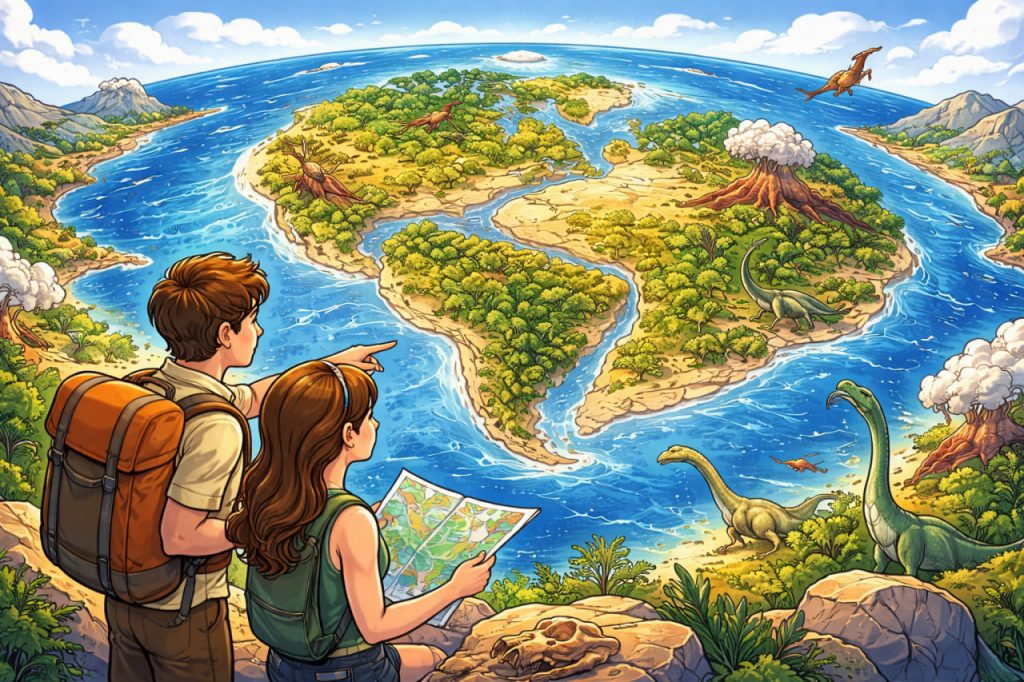
Earth’s surface has not always looked the way it does today. Millions of years ago, the continents were joined together into a single massive landmass known as Pangaea. This supercontinent existed during the late Paleozoic and early Mesozoic eras, roughly 335 to 175 million years ago. Scientists discovered its existence by studying fossil distributions, matching rock formations, and the puzzle-like fit of continental coastlines. The idea of a unified continent revolutionized geology and led to the development of the modern theory of plate tectonics. Understanding why this supercontinent formed—and why it later broke apart—helps explain earthquakes, mountain formation, and the distribution of life across the planet.
The Formation of Pangaea
Pangaea formed as a result of slow but powerful tectonic movements driven by heat from Earth’s interior. The planet’s outer shell is divided into large slabs called tectonic plates, which float on the semi-fluid mantle beneath them. Over hundreds of millions of years, these plates gradually moved toward one another, closing ancient oceans and colliding to form mountain ranges. Geological evidence shows that continents such as North America, Africa, and Europe were once tightly connected. Paleontologist Dr. Ingrid Solberg explains:
“The rocks themselves tell the story.
Identical fossil species and mountain belts appear on continents now separated by vast oceans.”
These clues strongly support the idea that the continents were once united.
Why the Supercontinent Broke Apart
The breakup of Pangaea began due to forces deep within Earth’s mantle. Heat rising from the interior created convection currents that exerted stress on the overlying crust. Over time, this stress caused cracks and rifts to form, splitting the supercontinent into smaller landmasses. Magma rose through these rifts, creating new oceanic crust and gradually widening the gaps between continents. This process eventually formed the Atlantic Ocean and separated Africa from South America. The breakup was not sudden; it unfolded over tens of millions of years. As tectonic plates continued to drift, they shaped the continents into their present positions.
Plate Tectonics and Ongoing Movement
The theory of plate tectonics explains not only the breakup of Pangaea but also the constant movement of Earth’s surface today. Plates continue to shift at rates of a few centimeters per year—about as fast as fingernails grow. When plates collide, mountains may form; when they separate, new oceans emerge; when they slide past each other, earthquakes occur. This continuous motion means that Earth’s continents are temporary configurations. Scientists predict that in hundreds of millions of years, a new supercontinent could form again as tectonic cycles continue.
Evidence Supporting Continental Drift
Multiple lines of evidence confirm the existence of a single ancient continent. Fossils of identical land-dwelling animals have been found on continents now separated by oceans. Geological formations and mineral deposits align when continents are digitally reassembled. Climate records preserved in rocks indicate regions that were once located near the equator or the poles before drifting to new positions. According to geophysicist Dr. Martin Alvarez:
“Continental drift is not speculation.
It is supported by seismic data, magnetic signatures in ocean floors, and direct satellite measurements.”
Modern GPS systems now measure plate movement in real time, confirming what earlier scientists proposed based on geological clues.
What This Means for Earth’s Future
The story of Pangaea reminds us that Earth is dynamic and constantly changing. The continents we recognize today are only a temporary stage in a long geological cycle. Over immense timescales, oceans open and close, climates shift, and ecosystems adapt to new land configurations. By studying past supercontinents, scientists gain insight into long-term climate evolution, biodiversity patterns, and natural resource distribution. The breakup of Pangaea was not a disaster, but a natural phase in Earth’s geological rhythm—one that continues to shape our world today.
Interesting Facts
- Pangaea means “all lands” in ancient Greek.
- The supercontinent was surrounded by a vast global ocean called Panthalassa.
- The Atlantic Ocean continues to widen by several centimeters each year.
- Some scientists predict a future supercontinent sometimes called Pangaea Proxima.
- Magnetic patterns on the ocean floor provide direct evidence of seafloor spreading.
Glossary
- Pangaea — the ancient supercontinent that combined nearly all of Earth’s landmasses.
- Plate Tectonics — the scientific theory describing the movement of Earth’s crustal plates.
- Tectonic Plate — a large section of Earth’s outer shell that moves slowly over the mantle.
- Seafloor Spreading — the process by which new oceanic crust forms at mid-ocean ridges.
- Convection Currents — heat-driven movements within Earth’s mantle that drive plate motion.