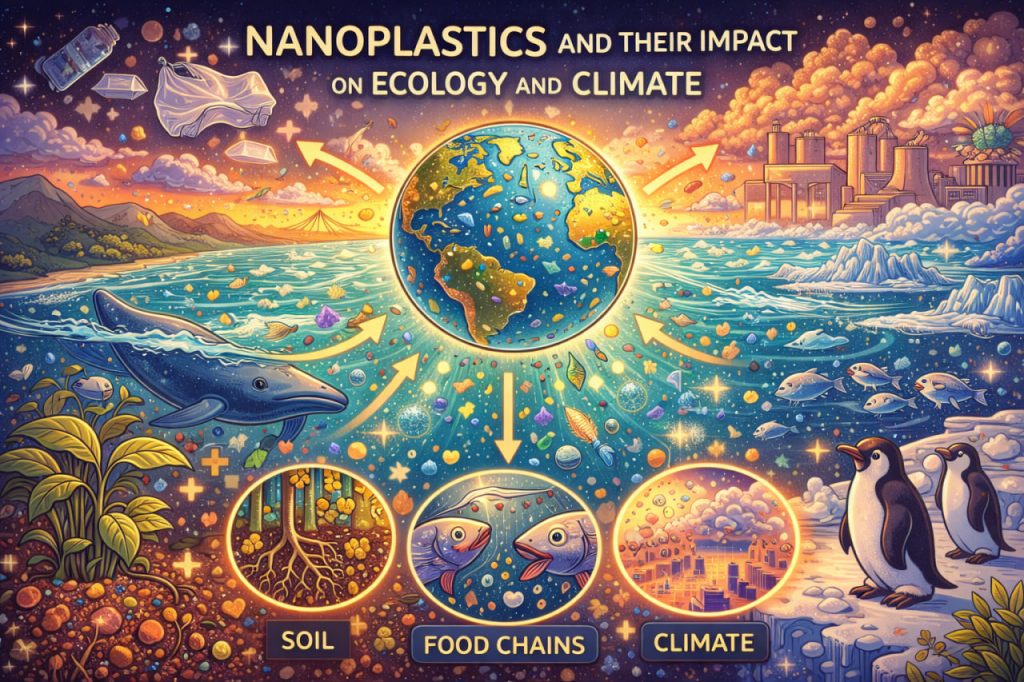
Nanoplastics—tiny plastic particles smaller than 1 micrometer—have become an emerging concern in environmental science due to their ability to spread widely and interact with ecosystems in complex ways. Unlike larger plastic debris, nanoplastics are nearly invisible and can penetrate deep into soil, water, and living organisms, making their impact difficult to detect and control. Recent research suggests that these particles may influence not only ecosystems but also broader climate processes, affecting everything from ocean chemistry to atmospheric dynamics. As plastic pollution continues to grow globally, understanding the role of nanoplastics is becoming increasingly important for predicting long-term environmental change. Their small size allows them to interact with biological and physical systems in ways that were previously underestimated.
How Nanoplastics Spread Through the Environment
Nanoplastics originate from the breakdown of larger plastic materials or are produced directly in industrial processes. Due to their extremely small size, they can be transported by wind, water currents, and even precipitation, allowing them to travel across continents and oceans. They have been found in remote environments such as deep-sea sediments and polar ice, indicating their global distribution. This widespread presence makes them a persistent and difficult-to-manage pollutant.
Impact on Ecosystems and Food Chains
Nanoplastics can be absorbed by microorganisms, plants, and animals, entering the food chain at its very base. Once inside organisms, they may interfere with cellular processes, reduce growth, or cause stress responses. These effects can accumulate as nanoplastics move up the food chain, potentially impacting larger species and ecosystem stability. According to environmental scientist Dr. Elena Varga:
“Nanoplastics are small enough to enter the foundation of ecosystems,
meaning their effects can ripple through entire food webs.”
This cascading impact raises concerns about biodiversity and long-term ecological health.
Effects on Soil and Plant Life
In terrestrial environments, nanoplastics can alter soil structure and fertility, affecting water retention and nutrient cycles. Studies suggest that they may influence root development and reduce plant growth in some cases. Since plants form the basis of many ecosystems and agricultural systems, these effects could have far-reaching consequences for food production and ecosystem balance.
Influence on Climate Processes
Nanoplastics may also play a role in climate regulation. In oceans, they can interact with plankton—organisms that are crucial for carbon absorption and oxygen production. Disruptions to plankton populations could affect the carbon cycle, potentially reducing the ocean’s ability to absorb carbon dioxide. In the atmosphere, nanoplastics can act as particles that influence cloud formation and radiation balance. Although research is still developing, these interactions suggest that nanoplastics could contribute to climate change in indirect but significant ways.
Challenges in Detection and Research
One of the biggest challenges in studying nanoplastics is their invisibility and complexity. Detecting and measuring such small particles requires advanced technology, and their behavior varies depending on environmental conditions. As a result, many aspects of their impact remain uncertain. Ongoing research aims to better understand how nanoplastics interact with ecosystems and climate systems over time.
Interesting Facts
- Nanoplastics are smaller than 1 micrometer, making them nearly impossible to see.
- They have been found in remote regions like the Arctic and deep oceans.
- Nanoplastics can travel through the atmosphere via wind and rain.
- They may interfere with plankton, which play a key role in carbon absorption.
- Scientists are still developing methods to detect and measure them accurately.
Glossary
- Nanoplastics — extremely small plastic particles less than 1 micrometer in size.
- Food Chain — the sequence of organisms through which energy and nutrients are transferred.
- Carbon Cycle — the movement of carbon through the atmosphere, oceans, and living organisms.
- Plankton — microscopic organisms that form the base of marine ecosystems.
- Ecosystem — a community of living organisms interacting with their environment.