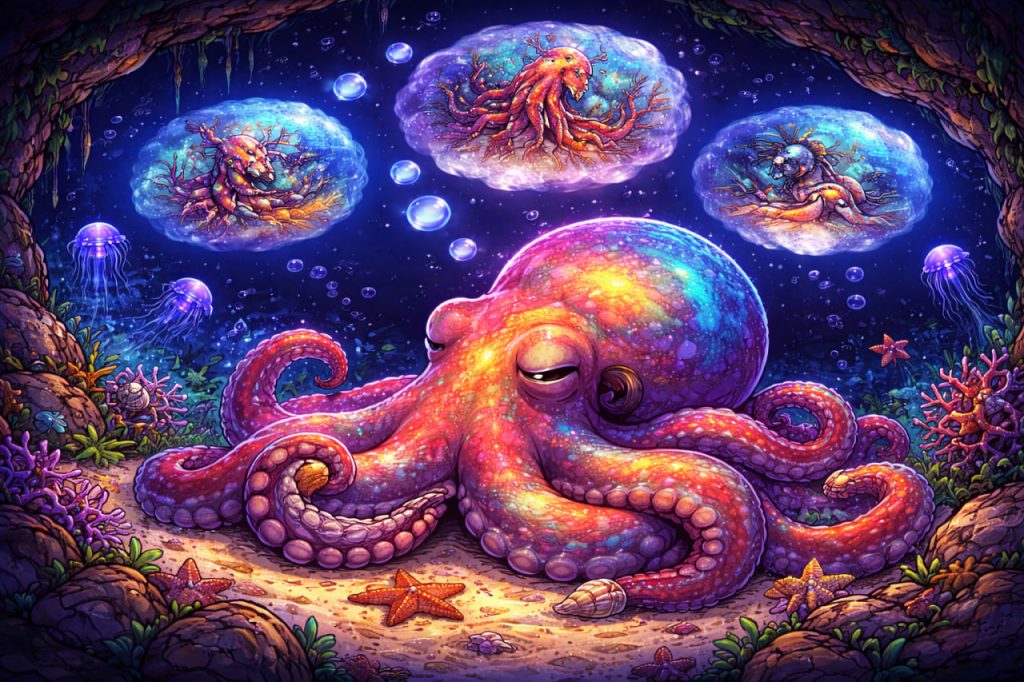
Octopuses are among the most intelligent creatures on Earth, possessing complex nervous systems, remarkable problem-solving abilities, and behaviors that often seem almost alien. Recent research suggests that these fascinating animals may also experience sleep cycles similar to dreaming, raising profound questions about consciousness beyond humans and mammals. Observations of octopuses during rest reveal rapid changes in skin color, texture, and body movement—patterns that resemble the REM (rapid eye movement) sleep seen in humans. These findings hint that octopuses might be processing memories or experiences while asleep. Understanding whether octopuses dream not only expands our knowledge of animal cognition but also challenges our assumptions about the nature of awareness and intelligence.
Sleep Patterns in Octopuses
Octopuses exhibit two distinct types of sleep: a quiet, inactive phase and a more dynamic phase where their bodies become active. During this active phase, their skin rapidly shifts colors and patterns, their eyes move, and their arms twitch. These changes strongly resemble REM sleep, the stage in humans associated with vivid dreaming. Scientists believe this phase may play a role in memory consolidation and learning. According to marine biologist Dr. Sofia Mendes:
“When an octopus sleeps, its body tells a story —
flashes of color and motion that may reflect internal experiences.”
This behavior suggests that sleep in octopuses is not simply rest but a complex neurological process.
The Role of Chromatophores
One of the most striking aspects of octopus sleep is the activity of chromatophores, specialized cells that allow them to change color instantly. During the active sleep phase, these cells fire in rapid sequences, producing patterns that resemble those used during hunting, camouflage, or communication. This has led scientists to speculate that octopuses might be “replaying” experiences while asleep, similar to how humans process memories in dreams. The connection between visual patterns and neural activity provides a unique window into how their brains function.
A Unique Type of Intelligence
Unlike vertebrates, octopuses have a highly distributed nervous system, with a large portion of their neurons located in their arms. This means their intelligence is not centralized in a single brain but spread throughout their body. Studying sleep and possible dreaming in such a system offers valuable insights into alternative forms of cognition. It suggests that dreaming—or something similar—may not be limited to animals with brains structured like ours.
Why Dreaming Might Matter
If octopuses do dream, it could serve important biological functions such as learning, adaptation, and memory processing. Dreams may help them refine hunting strategies, improve camouflage responses, or process complex interactions with their environment. This would indicate that dreaming is a fundamental process shared across very different forms of life, rather than a uniquely human experience.
What Scientists Still Don’t Know
Despite growing evidence, scientists cannot yet confirm exactly what octopuses experience during their active sleep phase. While their behavior strongly suggests dreaming, there is no direct way to measure subjective experiences in animals. Ongoing research continues to explore brain activity, behavior, and environmental interactions to better understand these mysterious processes.
Interesting Facts
- Octopuses have three hearts and blue blood.
- Their nervous system is partly located in their arms, not just the brain.
- They can change color in milliseconds using chromatophores.
- Some octopuses can solve puzzles and open containers.
- Their sleep cycles include phases similar to REM sleep.
Glossary
- REM Sleep — a sleep phase associated with dreaming and rapid eye movement.
- Chromatophores — cells that allow octopuses to change color and patterns.
- Nervous System — the network that controls behavior and bodily functions.
- Cognition — the process of thinking, learning, and understanding.
- Camouflage — the ability to blend into the environment for protection or hunting.