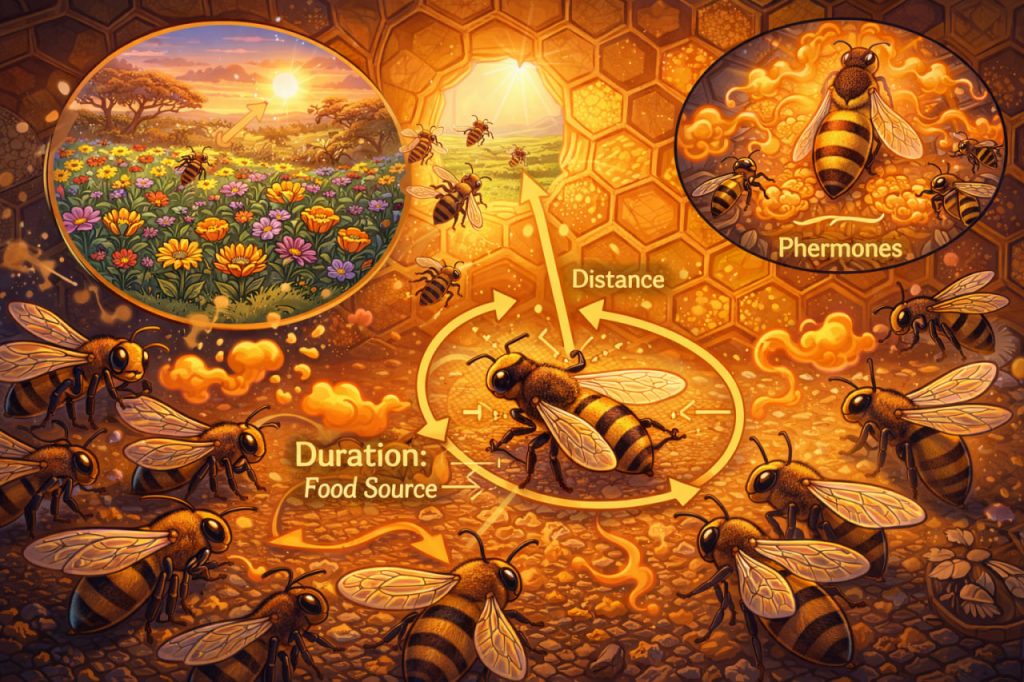
Bees are small creatures, yet they possess one of the most sophisticated communication systems in the animal kingdom. Instead of using sounds or signals we might expect, bees rely on movement, vibration, and chemical cues to share information with each other. Their communication is essential for the survival of the colony, allowing them to locate food sources, coordinate tasks, and respond to threats. One of the most remarkable aspects of bee behavior is the ability to transmit precise information about distance and direction through a form of symbolic movement. This system, often referred to as the “language of bees,” demonstrates a level of complexity that rivals many forms of animal communication. Studying it has helped scientists better understand intelligence, cooperation, and collective behavior in nature.
The Waggle Dance: A Moving Message
The most famous form of bee communication is the waggle dance, performed by worker bees inside the hive. When a bee discovers a rich source of nectar, it returns and performs a specific pattern of movement that encodes information about the location. The angle of the dance relative to gravity represents the direction of the food source in relation to the sun, while the duration of the “waggle” phase indicates distance. According to entomologist Dr. Martin Keller:
“The waggle dance is a living map —
a way for bees to describe the world beyond the hive using motion.”
Other bees observe this dance and use the information to find the same location, often with impressive accuracy.
Chemical Communication and Pheromones
In addition to movement, bees rely heavily on pheromones, which are chemical signals used to communicate within the colony. These substances can signal danger, mark trails, or regulate social structure. For example, the queen releases pheromones that maintain order and cohesion within the hive. Worker bees can release alarm pheromones when threatened, alerting others to defend the colony. This chemical communication operates continuously, even when bees are not actively dancing.
Vibrations and Sound Signals
Bees also use subtle vibrations and sounds to communicate. These signals can influence the behavior of other bees, such as encouraging activity or signaling changes within the hive. Vibrational communication is especially important in the dark environment of the hive, where visual cues are limited. These signals complement the waggle dance and pheromones, creating a multi-layered communication system.
Collective Intelligence of the Hive
The language of bees is not just about individual communication—it reflects the collective intelligence of the colony. Decisions about where to forage or when to move are often made through a process involving multiple bees sharing information. Over time, the colony reaches a consensus, demonstrating a form of group decision-making that is both efficient and adaptive. This collective behavior allows bees to respond quickly to changes in their environment.
Why Bee Communication Matters
Understanding how bees communicate has important implications beyond biology. It provides insights into distributed systems, robotics, and even human communication networks. Additionally, since bees play a critical role in pollination, studying their behavior helps protect ecosystems and agriculture. The language of bees is not just a curiosity—it is a key to understanding how complex systems function in nature.
Interesting Facts
- A waggle dance can communicate distances of up to several kilometers.
- Bees adjust their dance based on the position of the sun throughout the day.
- Pheromones can influence the behavior of entire colonies instantly.
- A single hive can contain tens of thousands of bees.
- Bees are responsible for pollinating a large portion of the world’s crops.
Glossary
- Waggle Dance — a movement-based communication method used by bees to indicate food location.
- Pheromones — chemical signals used for communication between individuals of the same species.
- Colony — a structured community of bees living and working together.
- Pollination — the transfer of pollen that enables plant reproduction.
- Collective Intelligence — the shared decision-making ability of a group.