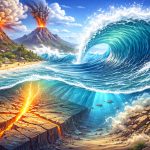
Tsunamis are capable of producing some of the most extreme natural disasters ever recorded, with waves that can reshape coastlines and impact entire regions within hours. While many tsunamis are relatively small, a few in history have reached extraordinary heights and caused catastrophic destruction. These massive waves are typically triggered by powerful earthquakes, volcanic eruptions, or landslides, each capable of displacing enormous volumes of water. The scale of a tsunami depends not only on the initial event but also on the shape of the coastline, ocean depth, and underwater topography. Studying the largest tsunamis helps scientists better understand their behavior and improve warning systems for the future. Some of these events were so powerful that they remain unmatched even today.
1958 Lituya Bay Megatsunami (USA)
The largest tsunami ever recorded occurred in Lituya Bay, Alaska, in 1958. A massive landslide, triggered by an earthquake, sent millions of tons of rock crashing into the narrow bay. This sudden displacement of water created a wave that reached an astonishing height of about 524 meters, the tallest ever documented. The wave stripped trees and vegetation from the surrounding mountainsides, leaving a visible scar that can still be seen today. Because the bay is isolated, the damage was limited compared to ocean-wide tsunamis, but the event demonstrated the extreme potential of localized megatsunamis.
2004 Indian Ocean Tsunami
One of the deadliest tsunamis in history occurred in 2004, following a powerful magnitude 9.1 earthquake off the coast of Sumatra. The tsunami spread across the Indian Ocean, affecting multiple countries including Indonesia, Thailand, Sri Lanka, and India. Waves reached heights of up to 30 meters in some areas and traveled thousands of kilometers. The disaster resulted in over 230,000 fatalities, making it one of the most devastating natural events ever recorded. This tragedy led to the development of improved international tsunami warning systems.
2011 Tōhoku Tsunami (Japan)
In 2011, a massive earthquake off the coast of Japan triggered a powerful tsunami that struck the northeastern region of the country. Waves reached heights of up to 40 meters in some coastal areas, overwhelming sea defenses and flooding entire cities. The event caused widespread destruction and led to the Fukushima nuclear disaster, highlighting the cascading risks associated with large-scale tsunamis. Japan’s advanced warning systems helped reduce casualties, but the scale of the event showed how difficult it is to fully prepare for such extreme forces.
1883 Krakatoa Eruption Tsunami
The eruption of the Krakatoa volcano in Indonesia in 1883 generated one of the most violent tsunamis ever recorded. The collapse of the volcanic island and explosive activity displaced huge amounts of water, producing waves up to 40 meters high. Coastal communities were devastated, and the event was heard thousands of kilometers away due to its explosive force. This tsunami demonstrated how volcanic activity can be just as dangerous as earthquakes in generating massive waves.
1960 Chile Tsunami
The 1960 Valdivia earthquake in Chile, the strongest earthquake ever recorded (magnitude 9.5), triggered a powerful tsunami that traveled across the Pacific Ocean. Waves struck not only Chile but also Hawaii, Japan, and other distant coastlines. In some regions, wave heights reached over 25 meters, causing widespread destruction far from the original event. This tsunami highlighted how far-reaching these waves can be and the importance of global monitoring systems.
Interesting Facts
- The tallest tsunami ever recorded (Lituya Bay) was over 500 meters high, far exceeding typical ocean waves.
- Tsunami waves can cross entire oceans in less than a day.
- Some tsunamis travel so fast in deep water that they move at speeds comparable to jet aircraft.
- The 2004 tsunami helped establish modern global warning systems used today.
- Not all tsunamis are caused by earthquakes—landslides and volcanoes can be equally powerful triggers.
Glossary
- Megatsunami — an extremely large tsunami, often caused by landslides rather than earthquakes.
- Epicenter — the point on Earth’s surface directly above an earthquake’s origin.
- Magnitude — a measure of the energy released by an earthquake.
- Wave Height — the vertical distance between the crest and trough of a wave.
- Tectonic Plates — large sections of Earth’s crust that move and interact.