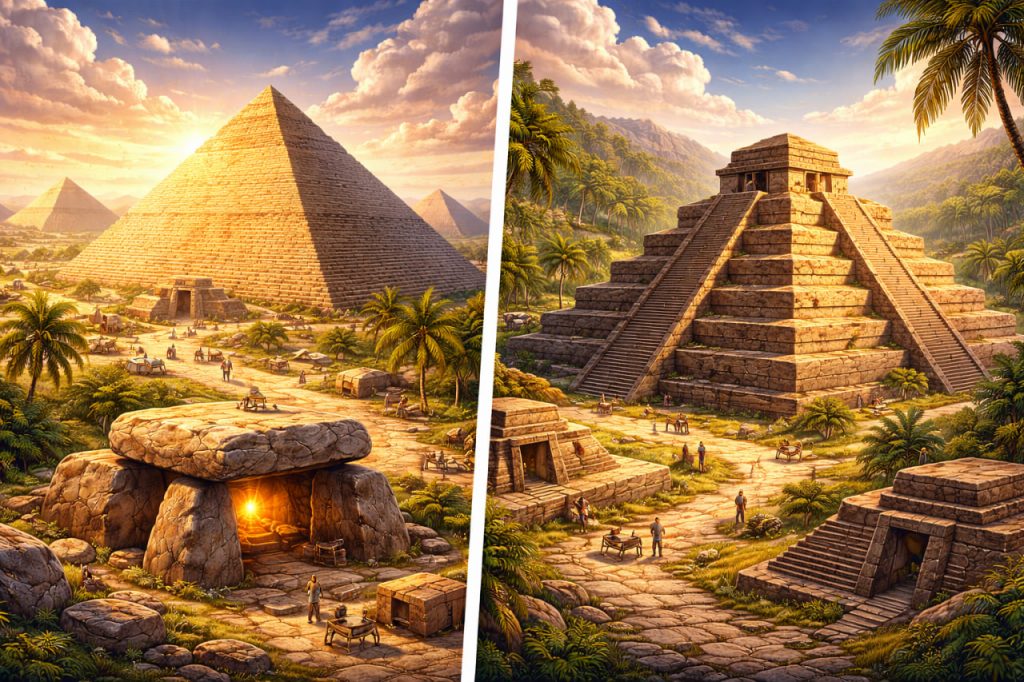
Pyramids are among the most recognizable architectural forms in human history, yet not all structures called “pyramids” are the same. In archaeology, a distinction is often made between true pyramids, which follow a precise geometric design with smooth sides meeting at a single apex, and step or transitional pyramids, sometimes informally called “false pyramids.” These differences reflect stages in architectural development, cultural variation, and construction techniques. Across civilizations, pyramid-like structures were built for religious, ceremonial, and symbolic purposes, often representing a connection between Earth and the sky. Understanding the difference between these forms helps clarify how ancient engineering evolved over time. Rather than being “incorrect,” so-called false pyramids represent important steps in the progression toward more refined designs.
What Are True Pyramids
A true pyramid is defined by its smooth, continuous sides that rise from a square base and meet at a single point at the top. This design requires careful planning, precise alignment, and advanced construction methods. The most well-known examples are found in ancient Egypt, where pyramids reached their peak development. These structures were often built with finely cut stone blocks and aligned with remarkable accuracy to cardinal directions. Their smooth surfaces were originally covered with polished casing stones, giving them a bright, reflective appearance. The transition to true pyramids marks a significant advancement in architectural precision and large-scale organization.
Step Pyramids and Transitional Forms
Before true pyramids were developed, earlier structures took the form of step pyramids, consisting of stacked layers or terraces. These designs resemble giant staircases rather than smooth-sided monuments. One of the earliest examples shows how builders experimented with height and stability by gradually adding layers. Over time, these stepped designs evolved into more refined forms as construction techniques improved. Step pyramids are sometimes called “false pyramids,” but this term can be misleading—they are intentional and functional designs, not mistakes. They represent an important stage in architectural evolution rather than a lesser form.
Global Variations of Pyramid Structures
Pyramid-like structures appear in many parts of the world, including Mesoamerica, Asia, and Africa. In regions such as Central America, pyramids were often built with flat tops to support temples or ceremonial platforms. These differ from the pointed apex of Egyptian true pyramids but still follow geometric principles. Each culture adapted pyramid construction to its own materials, environment, and religious practices. This diversity shows that pyramid building was not a single invention but a recurring architectural solution developed independently by different civilizations.
Construction Techniques and Precision
Building large pyramids required advanced knowledge of engineering, mathematics, and organization. Workers had to transport massive stone blocks, align structures precisely, and ensure stability over long periods. Step pyramids allowed builders to experiment with height and load distribution, while true pyramids demanded more refined techniques to maintain smooth surfaces and structural integrity. The shift from stepped to smooth designs reflects improvements in planning, tools, and coordination. Many pyramids also demonstrate precise orientation to cardinal directions, suggesting careful observation and measurement.
Symbolism and Purpose
Regardless of their form, pyramids carried deep symbolic and cultural meaning. In many cases, they were associated with burial practices, religious rituals, or representations of cosmic order. The upward shape of a pyramid often symbolized a connection between the earthly world and the heavens. Step pyramids may have emphasized ascent through levels, while true pyramids represented a unified, complete form. These structures were not only architectural achievements but also expressions of belief systems and social organization.
Interesting Facts
- Early pyramids began as step structures before evolving into smooth-sided forms.
- Some pyramids were originally covered in polished stone, making them shine in sunlight.
- Pyramid structures appeared independently in different parts of the world.
- Many pyramids are aligned with cardinal directions with high precision.
- Step pyramids were often used as foundations for temples or rituals.
Glossary
- True Pyramid — a pyramid with smooth sides that meet at a single apex.
- Step Pyramid — a pyramid made of layered platforms or steps.
- Apex — the highest point of a pyramid.
- Casing Stones — outer stones used to create a smooth surface.
- Cardinal Directions — north, south, east, and west.