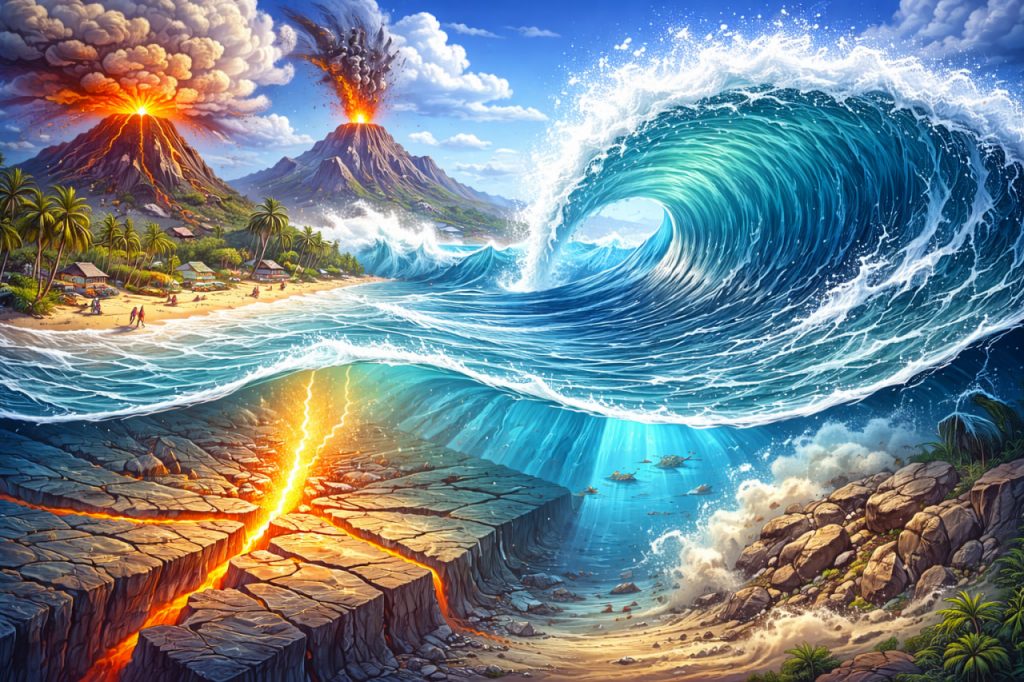
Tsunamis are among the most powerful and destructive natural phenomena on Earth, capable of traveling across entire oceans and causing devastating impacts when they reach coastlines. Unlike regular ocean waves generated by wind, tsunamis are caused by sudden displacement of large volumes of water, usually triggered by geological events beneath the ocean floor. These waves can move at incredible speeds—up to the speed of a jet aircraft in deep water—while remaining almost invisible in the open ocean. It is only when they approach shallow coastal areas that they rise dramatically in height and unleash their full destructive force. Understanding how tsunamis form is essential for improving early warning systems and reducing risks for vulnerable coastal populations. Their formation involves a complex interaction between Earth’s crust, ocean dynamics, and energy transfer on a massive scale.
Underwater Earthquakes as the Main Cause
The most common cause of tsunamis is underwater earthquakes, particularly those that occur in subduction zones where one tectonic plate slides beneath another. When stress builds up between plates, it can be released suddenly in a powerful seismic event, causing the seafloor to shift vertically. This movement displaces the water above it, initiating a series of waves that spread outward in all directions. The greater the vertical displacement, the more energy is transferred into the water, increasing the potential size of the tsunami. Not all underwater earthquakes generate tsunamis—only those with significant vertical motion and sufficient magnitude. This is why scientists closely monitor seismic activity in ocean regions known for tectonic instability.
Volcanic Eruptions and Tsunamis
Another important cause of tsunamis is volcanic activity, especially when eruptions occur near or beneath the ocean. Explosive eruptions can push large amounts of water outward, while the collapse of volcanic structures—such as a crater or island flank—can also trigger massive waves. In some cases, entire sections of a volcano can slide into the sea, displacing water rapidly. These events are less frequent than earthquake-generated tsunamis but can be equally destructive. Volcanic tsunamis are particularly dangerous because they can occur with little warning and may involve multiple waves generated by ongoing activity.
Underwater Landslides
Submarine landslides are another mechanism that can generate tsunamis. These occur when large masses of sediment or rock suddenly move down slopes on the ocean floor. Landslides may be triggered by earthquakes, volcanic activity, or gradual weakening of underwater structures. When the material shifts, it displaces water and creates waves that propagate outward. Although typically smaller than those caused by major earthquakes, landslide-generated tsunamis can still be highly dangerous, especially in enclosed or coastal regions where wave energy is concentrated.
Wave Behavior in the Open Ocean
In deep ocean waters, tsunami waves behave very differently from normal waves. They have extremely long wavelengths, sometimes hundreds of kilometers, and relatively low wave heights, often less than a meter. Because of this, ships at sea may not even notice a tsunami passing beneath them. However, these waves carry enormous amounts of energy across vast distances with minimal loss. As they travel, they maintain high speeds due to the depth of the ocean, allowing them to cross entire ocean basins in a matter of hours.
Why Tsunamis Become Dangerous Near the Coast
The true danger of a tsunami becomes evident when it approaches shallow coastal waters. As the depth decreases, the wave slows down, but its energy is compressed into a smaller volume, causing the wave height to increase dramatically. This process, known as wave shoaling, can transform a barely noticeable wave into a towering wall of water. In addition, the shape of the coastline and seafloor can amplify the impact, focusing wave energy into specific areas. This is why some regions experience much higher tsunami waves than others, even during the same event.
Interesting Facts
- Tsunami waves can travel at speeds of over 800 km/h in deep ocean water.
- The word “tsunami” comes from Japanese and means “harbor wave.”
- A tsunami is not just one wave but a series of waves, sometimes lasting for hours.
- The first wave is not always the strongest—later waves can be more destructive.
- In the open ocean, tsunami waves may be barely noticeable, despite carrying massive energy.
Glossary
- Tsunami — a series of ocean waves caused by sudden displacement of water, usually from geological events.
- Subduction Zone — a region where one tectonic plate moves beneath another.
- Wave Shoaling — the process by which a wave increases in height as it enters shallow water.
- Seafloor Displacement — vertical movement of the ocean bottom that pushes water upward.
- Submarine Landslide — a sudden movement of sediment or rock on the ocean floor.