Mass extinctions are among the most dramatic events in Earth’s history, marked by the rapid loss of a large percentage of species in a relatively short geological time. These events have reshaped life on the planet multiple times, clearing ecological space for new species to evolve. Scientists have identified at least five major mass extinctions, often called the “Big Five,” each caused by a combination of environmental and geological factors. The idea that these events might occur in a cyclical pattern has been debated for decades. Understanding whether mass extinctions follow a predictable rhythm is crucial for interpreting Earth’s past and assessing future risks. While patterns have been proposed, the reality is more complex than a simple repeating cycle.
The “Big Five” Mass Extinctions
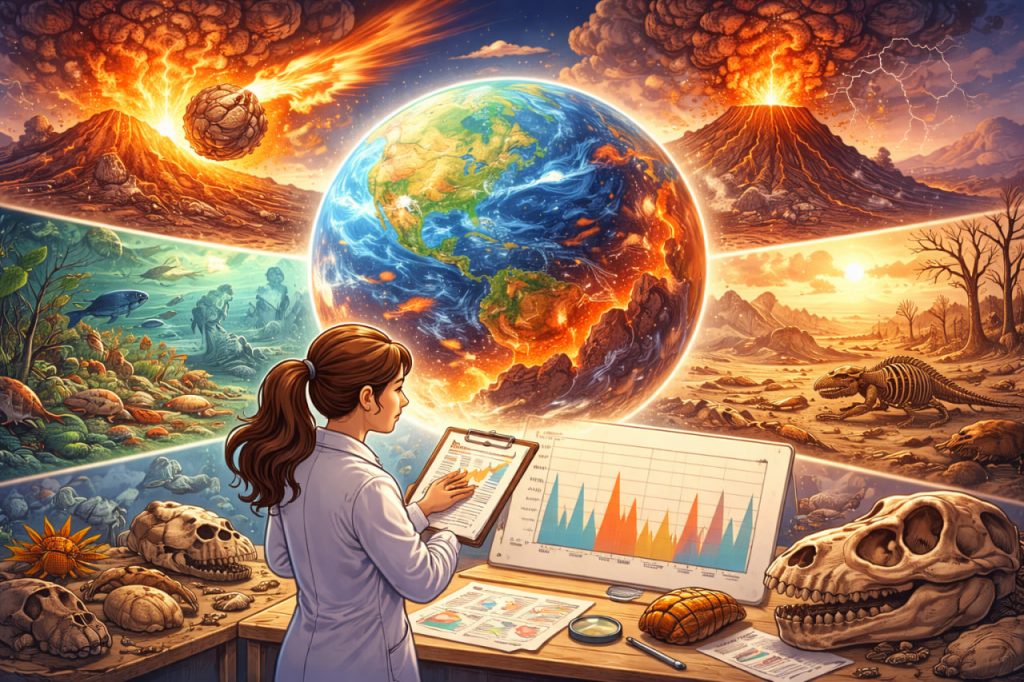
The five major mass extinctions include the Ordovician–Silurian, Late Devonian, Permian–Triassic, Triassic–Jurassic, and Cretaceous–Paleogene events. Each of these led to the loss of a significant portion of global biodiversity. The most severe, the Permian–Triassic extinction, eliminated up to 90% of marine species. Causes varied widely, including volcanic activity, climate shifts, ocean anoxia, and asteroid impacts. These differences suggest that mass extinctions do not arise from a single repeating cause. Instead, they result from complex interactions within Earth systems.
The Idea of Cycles
Some researchers have proposed that mass extinctions occur in roughly periodic intervals, sometimes estimated at around 20–30 million years. This hypothesis is based on statistical analysis of fossil records and extinction rates. Possible explanations include astronomical cycles, such as the movement of the solar system through regions of the galaxy, or periodic increases in volcanic activity. However, the fossil record is incomplete, and dating uncertainties make it difficult to confirm exact timing. As a result, the idea of strict cycles remains controversial and unproven.
Natural Causes and Triggers
Mass extinctions are typically driven by multiple overlapping factors rather than a single cause. Large-scale volcanic eruptions can release vast amounts of gases, altering climate and ocean chemistry. Asteroid impacts can trigger sudden environmental changes, including global cooling and darkness. Changes in sea level, oxygen levels, and temperature also play critical roles. These triggers do not follow a consistent schedule, which challenges the concept of regular cycles. Instead, extinctions appear to occur when several stress factors align.
Patterns Without Predictability
Although some patterns can be observed in the timing of extinctions, they do not form a perfectly regular sequence. Geological and biological systems are influenced by random and interconnected processes, making precise prediction difficult. Apparent cycles may emerge from limited data or statistical interpretation rather than true periodic behavior. Scientists continue to refine models and analyze new fossil evidence to better understand these patterns. At present, the consensus is that mass extinctions are not strictly cyclical, even if certain long-term trends exist.
Are We in a New Mass Extinction?
Some researchers argue that Earth may currently be experiencing a sixth mass extinction, driven largely by human activity. Unlike past events, this one is linked to habitat destruction, climate change, pollution, and overexploitation of species. The rate of species loss today is significantly higher than natural background levels. While this does not follow a natural cycle, it highlights how rapidly biodiversity can decline under certain conditions. This modern context adds urgency to the study of past extinctions.
What Science Concludes Today
Current scientific understanding suggests that mass extinctions are irregular events influenced by a combination of internal Earth processes and external factors. While some researchers continue to explore possible periodic influences, there is no strong evidence for a fixed cycle. Instead, each extinction event appears unique in its causes and timing. This perspective emphasizes the complexity of Earth’s systems and the challenges of predicting large-scale changes. Mass extinctions are best understood not as repeating patterns, but as rare and complex disruptions in the history of life.
Interesting Facts
- The Permian–Triassic extinction is often called “The Great Dying.”
- Around 75% of species disappeared during the extinction that ended the age of dinosaurs.
- Mass extinctions can occur over thousands to millions of years, not instantly.
- Some species survive and later become dominant in new ecosystems.
- The fossil record is incomplete, making exact timing difficult to determine.
Glossary
- Mass Extinction — a rapid and widespread loss of species.
- Biodiversity — the variety of life in a particular ecosystem or on Earth.
- Anoxia — a condition where water or environments lack oxygen.
- Asteroid Impact — a collision between Earth and a large space object.
- Fossil Record — preserved remains or traces of ancient life used for study.