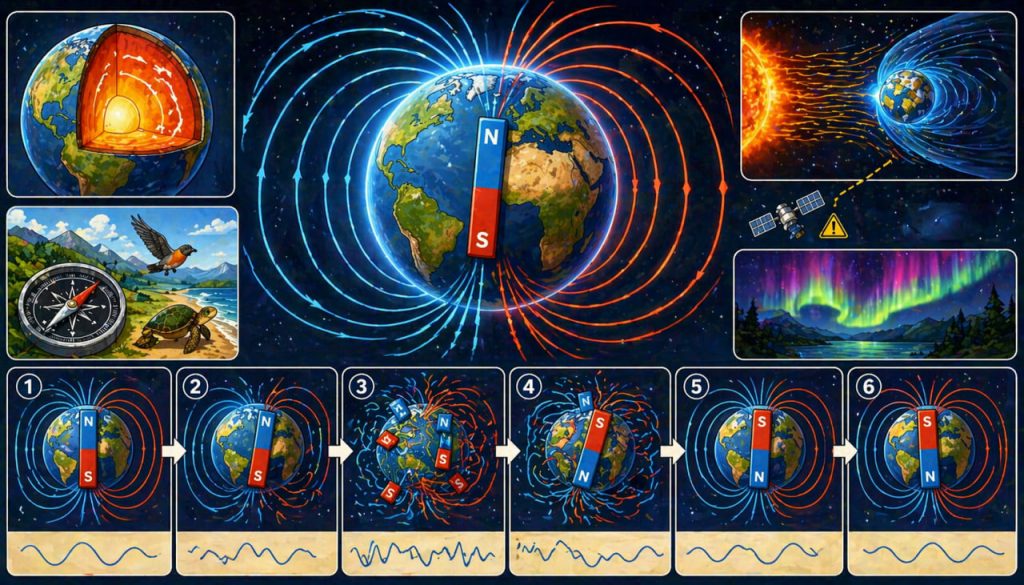
Earth’s magnetic field is one of the planet’s most important yet often overlooked natural systems. It protects life from harmful solar radiation, helps animals navigate, and even supports modern technologies. However, this magnetic field is not permanent—it has flipped many times throughout Earth’s history. The question scientists continue to study is: when will it reverse again?
What Is Earth’s Magnetic Field?
Earth’s magnetic field is generated deep within the planet’s core. The outer core consists of molten iron and nickel, constantly moving due to heat from the inner core. This movement creates electric currents, which in turn generate a magnetic field—a process known as the geodynamo.
This field extends far into space and forms the magnetosphere, which shields Earth from solar wind and cosmic radiation.
Key functions of the magnetic field:
- Protects the atmosphere from solar particles
- Enables compass navigation
- Guides migratory animals such as birds and sea turtles
- Reduces harmful radiation reaching Earth’s surface
Without it, life on Earth would be significantly more vulnerable.
What Is a Magnetic Pole Reversal?
A magnetic pole reversal occurs when the North and South magnetic poles swap places. This does not happen suddenly but over thousands of years.
During a reversal:
- The magnetic field weakens
- Multiple temporary poles may appear
- The field becomes unstable before stabilizing again
Importantly, this is a natural geological process that has happened many times in Earth’s history.
How Often Do Reversals Happen?
Magnetic reversals are irregular. On average, they occur every 200,000 to 300,000 years, but this timing is highly unpredictable.
The last full reversal, known as the Brunhes–Matuyama reversal, happened approximately 780,000 years ago. This means Earth is technically “overdue” compared to the average—but that does not guarantee an imminent reversal.
Scientists emphasize that:
- There is no fixed schedule
- Gaps between reversals can vary widely
- Some periods last millions of years without a reversal
Are We Heading Toward a Reversal Now?
There are signs that Earth’s magnetic field is changing:
- The magnetic field has weakened by about 10% over the last 150 years
- The magnetic North Pole is moving faster than before
- A region called the South Atlantic Anomaly shows unusually weak magnetic strength
However, these changes do not necessarily mean a reversal is imminent.
Geophysicist Dr. Richard Holme explains:
“A weakening magnetic field does not automatically mean a reversal is coming. Similar fluctuations have occurred in the past without leading to a full flip.”
In other words, Earth’s magnetic field is dynamic, and current changes may simply be part of natural variation.
What Happens During a Magnetic Reversal?
If a reversal does occur, it would unfold slowly over thousands of years—not overnight.
Possible effects include:
- Temporary weakening of the magnetic field
- Increased exposure to solar radiation in upper atmosphere
- Disruptions to satellites and GPS systems
- More visible auroras at lower latitudes
However, there is no evidence that past reversals caused mass extinctions or catastrophic global events.
Life on Earth has survived many reversals without major disruption.
Impact on Humans and Technology
While ancient life adapted naturally, modern society depends heavily on technology that could be affected.
Potential impacts:
- Satellite damage from increased radiation
- Power grid disruptions
- Navigation system inaccuracies
- Communication interference
Scientists are actively studying these risks to improve preparedness.
Could a Reversal Be Dangerous?
For humans on the ground, the direct danger is relatively low. Earth’s atmosphere still provides strong protection against radiation.
The main concerns are technological rather than biological.
Experts agree:
- No evidence links reversals to extinction events
- Risks are manageable with modern technology
- Preparation and monitoring reduce potential disruptions
How Scientists Study Magnetic Reversals
Researchers use several methods to understand past and future reversals:
- Studying volcanic rocks that record magnetic orientation
- Analyzing ocean floor patterns
- Monitoring satellite data
- Running computer simulations of Earth’s core
These tools help scientists track long-term trends and predict possible scenarios.
When Will the Next Reversal Happen?
The honest answer is: no one knows.
It could happen:
- Thousands of years from now
- Tens of thousands of years later
- Or not for millions of years
Despite ongoing research, predicting the exact timing remains impossible due to the complexity of Earth’s core dynamics.
Interesting Facts
- Earth’s magnetic field has reversed hundreds of times in the past.
- During a reversal, the magnetic field does not disappear completely.
- Mars lost its magnetic field billions of years ago, which contributed to atmospheric loss.
- Magnetic reversals are recorded in ocean floor rocks like a timeline.
- Animals may adapt their navigation systems during gradual changes.
Glossary
- Magnetic Field — the invisible force field generated by Earth’s core that protects the planet.
- Magnetosphere — the region around Earth influenced by its magnetic field.
- Geodynamo — the process generating Earth’s magnetic field through fluid motion in the core.
- Magnetic Reversal — the switching of Earth’s magnetic north and south poles.
- South Atlantic Anomaly — a region where the magnetic field is unusually weak.