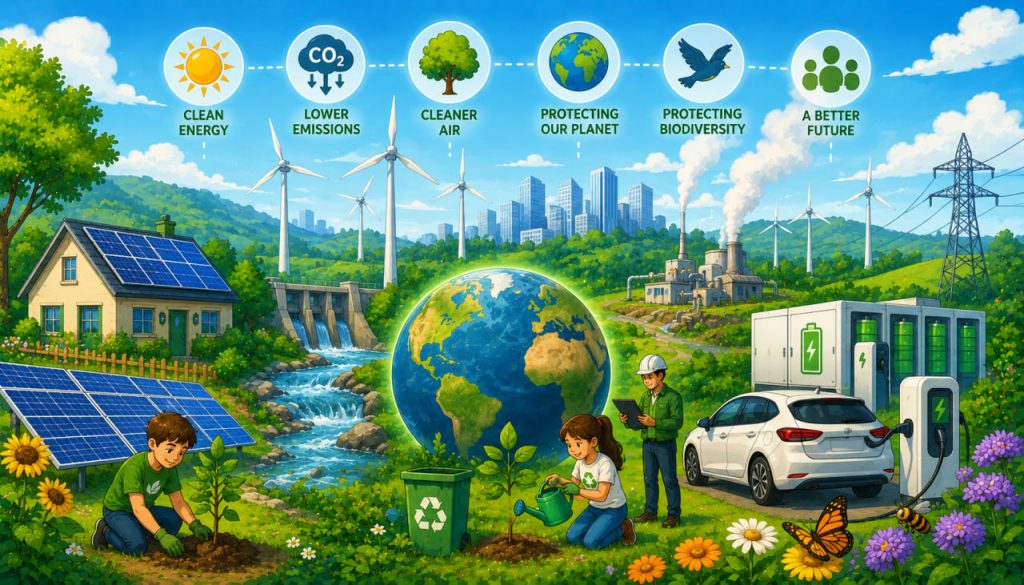
Green energy has become one of the central topics of the 21st century. As climate change, air pollution, and environmental degradation intensify, countries around the world are investing heavily in renewable energy technologies. Solar panels, wind turbines, hydroelectric systems, geothermal plants, and bioenergy are increasingly replacing fossil fuels in many regions.
Supporters of green energy argue that renewable technologies may help humanity reduce greenhouse gas emissions and slow global warming. However, scientists also emphasize that renewable energy systems themselves have environmental impacts that must be understood carefully.
The relationship between green energy, climate, and ecology is therefore complex. Renewable technologies may significantly reduce environmental damage compared to fossil fuels, but no large-scale energy system is completely free from ecological consequences.
Understanding both the benefits and limitations of green energy is essential for building a sustainable future.
What Is Green Energy?
Green energy usually refers to energy produced from renewable natural sources with relatively low environmental impact.
Major types include:
- Solar energy
- Wind power
- Hydroelectric energy
- Geothermal energy
- Biomass energy
Unlike fossil fuels, renewable systems rely on naturally replenishing resources such as:
- Sunlight
- Wind
- Water cycles
- Earth’s internal heat
This reduces dependence on coal, oil, and natural gas.
Fossil Fuels and Climate Change
Traditional fossil fuels release large amounts of carbon dioxide during combustion.
The simplified combustion process can be represented as:
C+O2→CO2C + O_2 \rightarrow CO_2C+O2→CO2
Carbon dioxide is a major greenhouse gas contributing to global warming.
Scientists link rising greenhouse gas concentrations to:
- Increasing global temperatures
- Melting glaciers
- Sea-level rise
- Extreme weather events
- Ecosystem disruption
Renewable energy aims to reduce these emissions significantly.
How Green Energy Helps the Climate
Renewable energy systems generally produce far lower greenhouse gas emissions than fossil fuels during operation.
For example:
- Solar panels generate electricity without combustion
- Wind turbines use moving air rather than fuel burning
- Hydroelectric systems use flowing water
This may reduce:
- Atmospheric pollution
- Carbon emissions
- Climate-related environmental stress
Climate scientist James Hansen stated:
“Continued reliance on fossil fuels risks pushing Earth’s climate system beyond stable conditions.”
Renewable energy is increasingly viewed as a critical tool for climate stabilization.
Solar Energy and Environmental Impact
Solar power is among the fastest-growing renewable technologies.
Advantages include:
- No direct emissions during operation
- Low operating costs
- Scalability from homes to large solar farms
However, solar systems also involve environmental considerations:
- Mining raw materials
- Manufacturing energy usage
- Land occupation
- Panel disposal challenges
Scientists continue improving solar recycling technologies and material efficiency.
Wind Energy and Ecology
Wind power produces electricity using moving air.
Modern wind turbines significantly reduce fossil fuel dependence, but ecological concerns still exist.
Potential environmental issues include:
- Bird and bat collisions
- Habitat disruption
- Visual landscape impact
- Noise concerns in some areas
However, researchers generally conclude that wind energy causes far fewer environmental harms than fossil fuel extraction and combustion.
Careful placement and modern turbine design may reduce wildlife risks.
Hydroelectric Power: Benefits and Challenges
Hydropower is one of the oldest renewable energy systems.
Large dams can generate enormous amounts of electricity while producing relatively low operational emissions.
However, dams may also affect ecosystems through:
- River disruption
- Fish migration barriers
- Flooded habitats
- Sediment flow changes
Some large hydro projects significantly altered regional ecosystems and displaced communities.
As a result, modern ecological planning is becoming increasingly important.
Biomass and Carbon Neutrality Debate
Biomass energy uses organic materials such as:
- Wood
- Agricultural waste
- Plant material
Some experts classify biomass as renewable because plants absorb carbon dioxide during growth:
6CO2+6H2O+light→C6H12O6+6O26CO_2 + 6H_2O + light \rightarrow C_6H_{12}O_6 + 6O_26CO2+6H2O+light→C6H12O6+6O2
However, biomass remains scientifically debated because:
- Combustion still releases emissions
- Deforestation risks may increase
- Carbon neutrality depends on land management
Sustainable biomass practices are therefore essential.
Green Energy and Air Quality
One major advantage of renewable energy involves reduced air pollution.
Burning fossil fuels releases:
- Sulfur dioxide
- Nitrogen oxides
- Fine particles
- Toxic chemicals
These pollutants contribute to:
- Respiratory disease
- Cardiovascular problems
- Premature deaths
Renewable systems may significantly improve urban and regional air quality.
Mining and Resource Challenges
Green technologies require large amounts of materials.
Important resources include:
- Lithium
- Copper
- Rare earth elements
- Nickel
- Cobalt
Mining these materials can create:
- Habitat destruction
- Water pollution
- Social conflicts
Scientists and engineers are working on:
- Recycling systems
- Alternative battery chemistries
- Sustainable mining methods
The future of green energy partly depends on solving these resource challenges responsibly.
Green Energy and Biodiversity
Renewable systems may both help and affect biodiversity.
Positive effects may include:
- Reduced climate stress
- Lower pollution levels
- Less fossil fuel extraction
However, poorly planned projects may still damage habitats.
Balancing energy production with ecological protection remains critically important.
Environmental impact assessments help reduce potential harm.
The Role of Energy Storage
Renewable energy systems often depend on:
- Batteries
- Grid storage
- Smart energy management
Because sunlight and wind vary naturally, energy storage technologies are becoming increasingly important for stable electricity systems.
Future innovations may greatly improve renewable reliability.
Can Green Energy Fully Replace Fossil Fuels?
This remains one of the largest global questions.
Many scientists believe large-scale renewable expansion is technically possible, especially when combined with:
- Energy efficiency
- Smart grids
- Storage systems
- Electrification
However, the transition requires enormous infrastructure investment and international cooperation.
Why Green Energy Matters
Green energy is not a perfect solution, but most scientific evidence suggests it offers major environmental advantages compared to fossil fuels.
The future challenge is not only producing clean energy, but doing so while:
- Protecting ecosystems
- Reducing pollution
- Conserving biodiversity
- Building sustainable economies
Humanity’s energy choices during the next century may strongly influence Earth’s climate and ecological stability for generations.
Interesting Facts
- Solar energy reaching Earth each hour exceeds global human energy usage for an entire year.
- Wind turbines can generate electricity without fuel combustion.
- Hydroelectric dams are among the world’s oldest renewable energy systems.
- Battery technology is rapidly improving renewable energy storage.
- Renewable energy expansion is occurring worldwide at historic speed.
Glossary
- Renewable Energy — Energy generated from naturally replenishing sources.
- Greenhouse Gas — A gas trapping heat in Earth’s atmosphere.
- Photovoltaic Panel — A device converting sunlight into electricity.
- Carbon Neutrality — Balancing carbon emissions with carbon removal or offsetting.
- Biodiversity — The variety of living organisms within ecosystems.