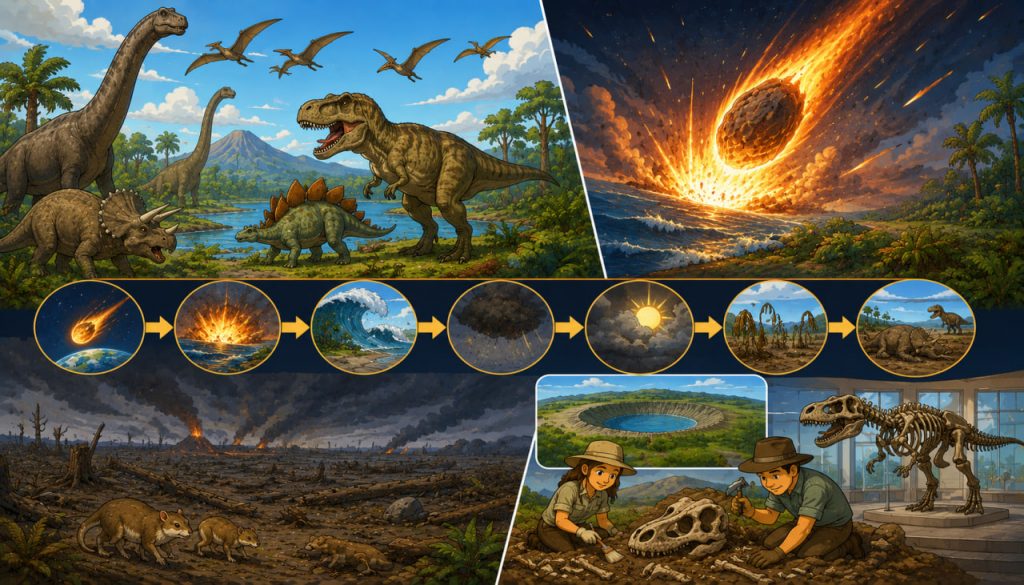
Dinosaurs ruled Earth for more than 160 million years. They dominated forests, plains, rivers, and coastal ecosystems long before humans existed. Some species grew to enormous sizes, while others evolved into fast predators, armored herbivores, or highly adaptive hunters. Yet despite their incredible success, most dinosaurs suddenly disappeared around 66 million years ago during one of the most dramatic extinction events in planetary history.
For centuries, scientists wondered what could destroy creatures so powerful and widespread. Modern geology, paleontology, and space science eventually revealed that the answer likely involved a catastrophic global disaster triggered by an asteroid impact — although additional environmental factors may also have contributed.
The extinction of dinosaurs remains one of the most important scientific discoveries because it changed the course of evolution and ultimately made human existence possible.
What Were Dinosaurs?
Dinosaurs were a diverse group of reptiles that first appeared during the Triassic Period.
Over millions of years they evolved into many forms, including:
- Giant herbivores
- Fast carnivores
- Feathered species
- Small agile hunters
Dinosaurs occupied ecosystems across nearly every continent.
Importantly, not all dinosaurs disappeared completely.
Modern birds are now considered direct descendants of certain dinosaur groups.
In a scientific sense, birds are living dinosaurs.
The World Before the Extinction
Before the extinction event, dinosaurs dominated Earth successfully for an enormous period of time.
The planet looked very different:
- Continents were arranged differently
- Climate conditions were warmer
- Sea levels varied greatly
- Flowering plants were expanding rapidly
Dinosaurs coexisted with:
- Early mammals
- Flying reptiles
- Marine reptiles
- Vast prehistoric forests
Then, near the end of the Cretaceous Period, global conditions changed suddenly.
The Asteroid Impact Theory
The most widely accepted explanation involves a massive asteroid impact.
Around 66 million years ago, a giant asteroid struck Earth near the modern Yucatán Peninsula in Mexico.
The impact created the enormous Chicxulub crater.
Scientists estimate the asteroid may have been around 10–15 kilometers wide.
The collision released unimaginable energy.
Physicist Luis Alvarez, one of the scientists who helped develop the asteroid theory, argued that the impact triggered a global environmental catastrophe.
Today, most paleontologists support this explanation.
How Powerful Was the Impact?
The asteroid impact generated:
- Massive shockwaves
- Global earthquakes
- Tsunamis
- Wildfires
- Atmospheric debris clouds
The energy release was vastly greater than modern nuclear weapons combined.
Material blasted into the atmosphere likely blocked sunlight worldwide.
This disrupted global climate systems and photosynthesis.
Why Sunlight Was So Important
Plants depend on sunlight for photosynthesis.
If sunlight decreases dramatically:
- Plants die
- Food chains collapse
- Herbivores starve
- Predators lose prey
Scientists believe this “impact winter” may have lasted months or years.
Large dinosaurs likely struggled to survive such rapid ecological collapse.
Global Climate Chaos
The asteroid probably caused severe short-term climate disruption.
Possible effects included:
- Extreme cooling
- Acid rain
- Atmospheric dust clouds
- Wildfires
- Ocean chemistry changes
The rapid environmental changes may have overwhelmed ecosystems unable to adapt quickly enough.
Large animals with high food requirements were especially vulnerable.
Volcanoes May Have Contributed
Some scientists believe massive volcanic eruptions also played a role.
The Deccan Traps in present-day India erupted around the same period.
These eruptions released:
- Carbon dioxide
- Sulfur gases
- Ash
Volcanic activity may have already stressed ecosystems before the asteroid impact occurred.
Some researchers think the extinction resulted from a combination of:
- Long-term volcanic stress
- Sudden asteroid catastrophe
rather than a single cause alone.
Why Some Species Survived
Interestingly, not all life disappeared.
Many organisms survived, including:
- Small mammals
- Birds
- Crocodilians
- Turtles
- Insects
Scientists believe smaller species had survival advantages because they:
- Needed less food
- Reproduced faster
- Adapted more easily
- Could shelter underground
Large dinosaurs may simply have been too specialized for rapidly changing conditions.
How Scientists Discovered the Extinction Evidence
Modern extinction research combines multiple scientific fields:
- Paleontology
- Geology
- Chemistry
- Physics
- Astronomy
One key discovery involved a global layer rich in iridium, a rare element more common in asteroids than Earth’s crust.
This layer appears worldwide in rocks dating to the extinction period.
The Chicxulub crater later provided additional strong evidence.
Dinosaurs and Evolution
The extinction event dramatically reshaped life on Earth.
After dinosaurs disappeared:
- Mammals expanded rapidly
- New ecosystems developed
- Primates eventually evolved
Without the extinction event, mammals — including humans — might never have become dominant.
Some scientists therefore describe the extinction as a turning point in evolutionary history.
Are Dinosaurs Truly Gone?
Although most dinosaur species vanished, birds survived.
Modern birds preserve many dinosaur traits:
- Hollow bones
- Feathers
- Egg-laying reproduction
- Certain skeletal structures
This means dinosaurs never disappeared completely.
Every pigeon, eagle, or sparrow represents a distant continuation of the dinosaur lineage.
What the Dinosaur Extinction Teaches Us
The extinction demonstrates how vulnerable life can be to planetary-scale events.
It also highlights:
- Climate sensitivity
- Ecological interdependence
- Evolutionary adaptation
- Environmental instability
Scientists study ancient extinctions partly to better understand modern environmental risks.
Interesting Facts
- Dinosaurs ruled Earth for more than 160 million years.
- Birds are considered living descendants of dinosaurs.
- The Chicxulub crater remains visible today beneath parts of Mexico.
- The asteroid impact likely caused global wildfires and darkness.
- Mammals expanded rapidly after dinosaur extinction.
Glossary
- Cretaceous Period — The final geological period of the dinosaur age.
- Extinction Event — A period when large numbers of species disappear.
- Chicxulub Crater — The massive impact crater linked to dinosaur extinction.
- Photosynthesis — The process plants use to convert sunlight into energy.
- Paleontology — The scientific study of ancient life through fossils.