Autonomous cleaning robots were once considered futuristic gadgets seen mainly in science fiction films. Today, however, robotic cleaners have become increasingly common in homes, offices, warehouses, airports, hospitals, and industrial facilities worldwide. Advances in artificial intelligence, sensors, navigation systems, and battery technology transformed simple automated vacuum devices into sophisticated machines capable of operating with minimal human supervision.
Modern cleaning robots can:
- Navigate rooms independently
- Avoid obstacles
- Map environments
- Detect dirt levels
- Recharge automatically
- Coordinate with smart home systems
As automation expands across society, autonomous cleaning robots represent one of the clearest examples of how robotics is entering everyday life.
At the same time, scientists and engineers continue exploring how these systems may influence:
- Labor markets
- Smart cities
- Domestic life
- Industrial efficiency
- Human-robot interaction
The rise of autonomous cleaning systems is therefore part of a much larger technological transformation.
What Are Autonomous Cleaning Robots?
Autonomous cleaning robots are machines capable of performing cleaning tasks with limited or no direct human control.
These robots typically combine:
- Sensors
- Cameras
- Artificial intelligence
- Navigation software
- Electric motors
- Rechargeable batteries
Different types of robotic cleaners include:
- Robotic vacuum cleaners
- Floor scrubbers
- Window-cleaning robots
- Industrial sanitation robots
- Pool-cleaning robots
Some advanced systems operate continuously in large commercial spaces.
How Cleaning Robots Navigate
One of the most important technological challenges involves navigation.
Modern robots use combinations of:
- Infrared sensors
- Cameras
- LiDAR systems
- Ultrasonic sensors
- AI mapping software
These technologies allow robots to:
- Detect walls
- Avoid stairs
- Identify obstacles
- Create room maps
Some systems use simultaneous localization and mapping (SLAM) algorithms to understand their surroundings dynamically.
This enables more efficient cleaning routes.
Artificial Intelligence and Smart Cleaning
Modern robotic cleaners increasingly rely on artificial intelligence.
AI systems may help robots:
- Learn room layouts
- Adapt cleaning patterns
- Detect highly dirty areas
- Optimize battery usage
Some systems can distinguish between:
- Carpets
- Tiles
- Hardwood floors
This allows automatic adjustment of suction power or cleaning methods.
Robotics engineer Rodney Brooks once noted:
“The real revolution in robotics comes when machines interact intelligently with the physical world.”
Cleaning robots represent one practical example of this shift.
Why Cleaning Robots Became Popular
Several factors accelerated adoption.
These include:
- Falling hardware costs
- Improved AI systems
- Smart home integration
- Growing interest in automation
- Busy modern lifestyles
For many households, robotic cleaners offer:
- Convenience
- Time savings
- Automated maintenance
Commercial facilities also value labor efficiency and consistent cleaning performance.
Autonomous Robots in Hospitals
Hospitals increasingly use robotic cleaning systems for sanitation.
Some robots utilize:
- UV light disinfection
- Automated floor sterilization
- Air purification systems
These technologies became especially important during infectious disease outbreaks.
Automated sanitation may reduce:
- Human exposure to pathogens
- Cross-contamination risks
- Cleaning inconsistencies
Healthcare robotics continues expanding rapidly.
Industrial and Commercial Cleaning Robots
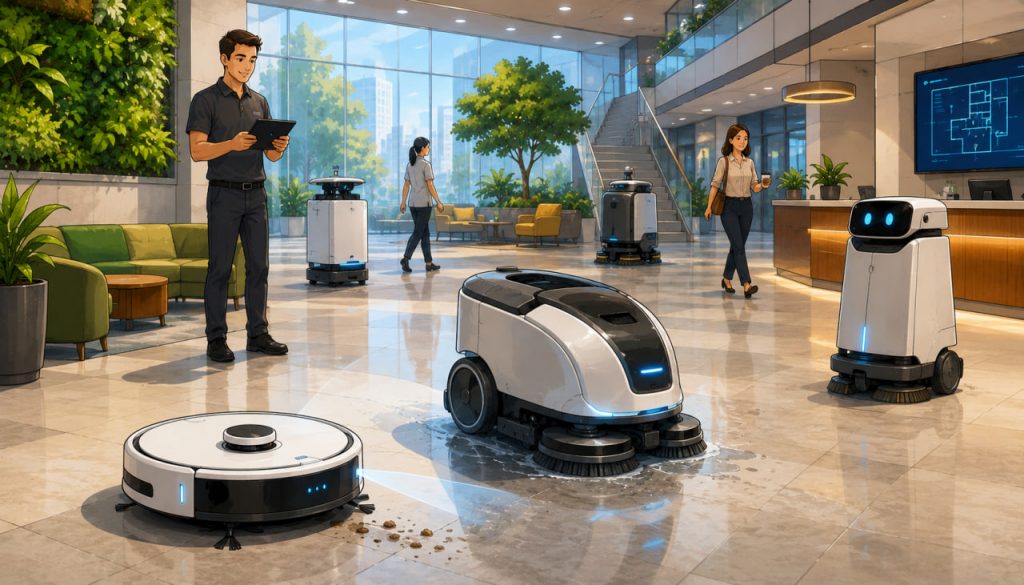
Large-scale cleaning robots now operate in:
- Airports
- Shopping centers
- Warehouses
- Factories
- Office buildings
Industrial systems often work autonomously during nighttime hours.
Advantages include:
- Reduced labor costs
- Continuous operation
- Predictable maintenance
- High cleaning consistency
Some industrial robots are large enough to clean entire warehouse floors independently.
Battery Technology and Energy Efficiency
Battery improvements played a major role in robotic development.
Modern lithium-ion batteries provide:
- Longer operation times
- Faster charging
- Higher energy density
Some robots automatically return to charging stations when battery levels drop.
After recharging, they may resume cleaning exactly where they stopped.
This creates near-continuous autonomous operation.
Smart Homes and Connected Systems
Many robotic cleaners integrate into smart home ecosystems.
Users may control robots through:
- Smartphone apps
- Voice assistants
- Automated schedules
- Cloud-based systems
Some systems even generate digital maps of homes.
This integration reflects the broader growth of the Internet of Things (IoT), where household devices communicate and coordinate automatically.
Challenges and Limitations
Despite impressive progress, cleaning robots still face limitations.
Common challenges include:
- Complex cluttered environments
- Stairs and uneven surfaces
- Small object detection
- Battery limitations
- Navigation errors
Highly unpredictable environments remain difficult for fully autonomous systems.
Human supervision is still often necessary.
Privacy and Data Concerns
Some robotic systems collect environmental data using cameras and sensors.
This raises concerns about:
- Data security
- Home mapping privacy
- Cloud storage risks
Manufacturers increasingly focus on cybersecurity protections and privacy policies.
As smart home technology expands, digital security becomes increasingly important.
Will Robots Replace Human Cleaners?
Automation may reduce some routine cleaning jobs, especially repetitive industrial tasks.
However, many experts believe humans will still remain important for:
- Complex cleaning situations
- Maintenance
- Oversight
- Customer interaction
Instead of total replacement, robotics may increasingly support human workers by automating physically repetitive tasks.
The Future of Autonomous Cleaning
Future robotic cleaners may include:
- Advanced AI reasoning
- Better object recognition
- Multi-room coordination
- Self-emptying waste systems
- Improved energy efficiency
Some futurists imagine entire smart buildings maintained largely through autonomous robotic systems.
As artificial intelligence improves, robots may become increasingly adaptive and independent.
Why Autonomous Cleaning Robots Matter
Cleaning robots represent more than convenient household gadgets.
They demonstrate how:
- Artificial intelligence
- Robotics
- Sensors
- Automation
- Smart systems
are gradually reshaping everyday life.
The technologies developed for robotic cleaners may eventually influence many other industries, from healthcare to transportation and urban infrastructure.
Interesting Facts
- Some robotic vacuums create detailed digital maps of homes.
- LiDAR technology used in robots is also used in self-driving cars.
- Hospital robots may use ultraviolet light for disinfection.
- Modern robotic cleaners can automatically recharge themselves.
- Industrial cleaning robots may operate continuously overnight.
Glossary
- Autonomous Robot — A machine capable of operating independently with minimal human control.
- LiDAR — A laser-based technology used for mapping and distance measurement.
- Artificial Intelligence (AI) — Computer systems designed to perform tasks requiring intelligent decision-making.
- SLAM — Simultaneous Localization and Mapping, a navigation technique used by robots.
- Internet of Things (IoT) — A network of connected smart devices communicating digitally.