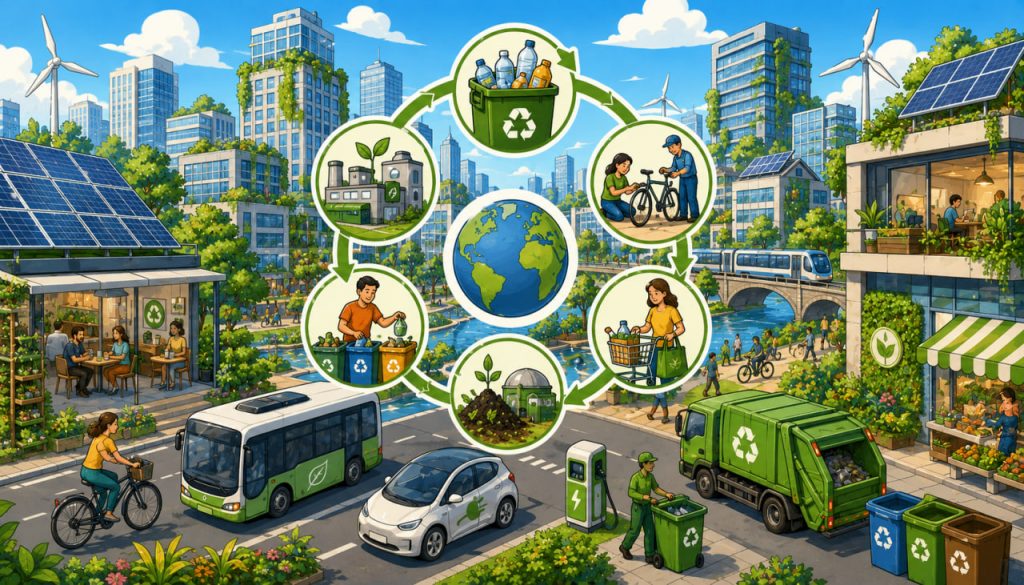
Modern cities consume enormous amounts of resources every day. Food, water, energy, electronics, construction materials, clothing, and transportation systems constantly flow through urban environments. Traditional economic systems usually follow a “linear” model:
- Extract resources
- Produce goods
- Use products
- Discard waste
This approach created massive environmental challenges, including:
- Landfill growth
- Pollution
- Resource depletion
- Greenhouse gas emissions
To address these problems, many cities are experimenting with a different model known as the circular economy.
The circular economy aims to reduce waste by keeping materials, products, and resources in use for as long as possible through:
- Recycling
- Repair
- Reuse
- Sharing systems
- Renewable energy
- Sustainable design
Today, cities around the world are becoming real-world laboratories for circular economic systems.
What Is the Circular Economy?
The circular economy is an economic model designed to minimize waste and maximize resource efficiency.
Instead of constantly producing and discarding products, circular systems attempt to:
- Extend product life
- Recover materials
- Reuse resources
- Reduce pollution
The idea contrasts with the traditional “take-make-dispose” system.
Circular systems often focus on:
- Product durability
- Repairability
- Recycling infrastructure
- Renewable materials
Environmental economist Walter Stahel, one of the pioneers of circular economy theory, argued:
“The more we reuse existing materials, the less we need to extract new resources.”
This principle lies at the center of circular urban systems.
Why Cities Are Important
Cities consume enormous quantities of resources.
Urban areas generate:
- Large waste streams
- Heavy energy demand
- Massive transportation needs
- Significant carbon emissions
Because cities concentrate population and infrastructure, they also provide opportunities for efficient resource management.
Circular systems may work especially well in dense urban environments where:
- Recycling networks are centralized
- Shared infrastructure is possible
- Transportation distances are shorter
Recycling Systems in Real Cities
One of the most visible parts of circular economies involves recycling.
Many cities now separate:
- Plastic
- Paper
- Glass
- Organic waste
- Metals
- Electronics
Advanced recycling centers recover materials for reuse in manufacturing.
Some cities use smart technologies to optimize waste collection through:
- Sensor-equipped bins
- AI sorting systems
- Automated logistics
However, recycling alone is not enough for a fully circular system.
Food Waste and Organic Recycling
Food waste represents a major urban problem.
Many cities now convert organic waste into:
- Compost
- Biogas
- Fertilizer
Organic decomposition may produce methane. Methane is a powerful greenhouse gas.
By processing organic waste properly, cities may reduce emissions while creating useful products.
Some urban farms even use compost generated directly from city food waste.
Shared Mobility and Transportation
Transportation systems are also becoming more circular.
Modern cities increasingly promote:
- Public transportation
- Bike-sharing systems
- Electric vehicle sharing
- Car-sharing networks
These systems reduce:
- Resource consumption
- Traffic congestion
- Vehicle production demand
Instead of every person owning rarely used vehicles, shared mobility improves overall efficiency.
Circular Construction and Buildings
Construction produces enormous waste globally.
Circular urban planning encourages:
- Recycled building materials
- Modular architecture
- Reusable components
- Energy-efficient buildings
Some modern buildings are designed specifically for future disassembly and material recovery.
This approach may significantly reduce:
- Construction waste
- Raw material extraction
- Carbon emissions
Renewable Energy and Circular Systems
Many circular cities integrate renewable energy into urban infrastructure.
Common systems include:
- Solar power
- Wind energy
- District heating
- Energy storage networks
Renewable electricity reduces dependence on fossil fuels. Reducing carbon emissions is one major goal of circular urban systems. Smart energy grids increasingly help cities balance energy demand efficiently.
Water Recycling in Cities
Water management is another important area.
Some cities now recycle wastewater for:
- Irrigation
- Industrial cooling
- Non-drinking urban applications
Advanced filtration technologies help recover water resources while reducing stress on freshwater systems.
As climate change increases drought risk in many regions, water recycling becomes increasingly important.
Examples of Circular Cities
Several cities are becoming known for circular economy initiatives.
Examples include:
- Amsterdam
- Copenhagen
- Singapore
- Seoul
- San Francisco
These cities experiment with:
- Zero-waste policies
- Smart infrastructure
- Sustainable mobility
- Renewable energy systems
Each city adapts circular principles differently depending on geography, economy, and infrastructure.
Challenges of the Circular Economy
Despite its advantages, circular transformation is difficult.
Major obstacles include:
- High infrastructure costs
- Consumer habits
- Complex supply chains
- Political resistance
- Technological limitations
Some products remain difficult to recycle economically.
Global manufacturing systems also still rely heavily on linear production models.
Technology and Smart Cities
Digital technology increasingly supports circular urban systems.
Cities use:
- Artificial intelligence
- Sensors
- Data analytics
- IoT networks
to optimize:
- Waste collection
- Energy use
- Traffic systems
- Resource distribution
Smart cities and circular economies often develop together.
Why the Circular Economy Matters
The circular economy is not simply about recycling. It represents a broader attempt to redesign how modern civilization uses resources.
Scientists believe circular systems may help:
- Reduce pollution
- Lower emissions
- Preserve ecosystems
- Improve urban sustainability
- Reduce waste generation
As urban populations continue growing, efficient resource management may become one of the defining challenges of the 21st century.
Interesting Facts
- Cities generate most of the world’s waste and carbon emissions.
- Some modern buildings are designed for future material reuse.
- Food waste can be converted into biogas and fertilizer.
- Smart waste bins may use sensors to optimize collection routes.
- Circular economy systems aim to minimize landfill usage.
Glossary
- Circular Economy — An economic system focused on reuse, recycling, and waste reduction.
- Biogas — Gas produced from decomposing organic material.
- Smart City — An urban system using digital technologies for efficient management.
- Renewable Energy — Energy generated from naturally replenishing sources.
- Resource Efficiency — Using materials and energy with minimal waste.


Fantastic sit yyou havce hrre butt I waas wantihg to kjow iif yyou kknew off aany forum tuat cover the sasme topics talked agout here?
I’d reallyy like too bbe a part off commuity wher I ccan gett responsess
fdom othsr expperienced people that share the same interest.
If yyou have any suggestions, pleaee lett mee know.
Thanks!