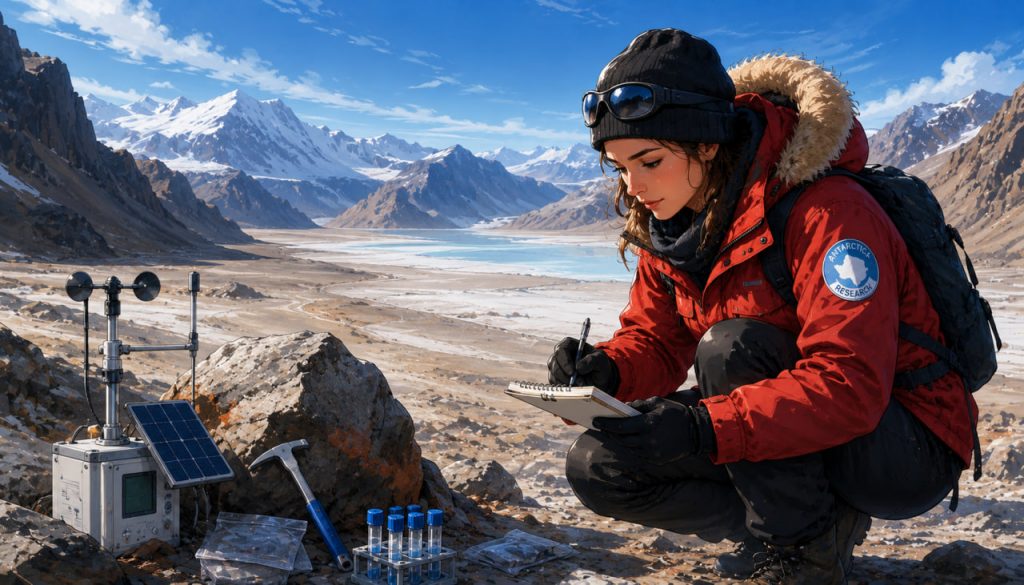
When most people imagine Antarctica, they picture endless snowfields, towering glaciers, and freezing temperatures. Surprisingly, one of the continent’s most remarkable regions contains almost no snow or ice at all. Hidden among the Transantarctic Mountains are the McMurdo Dry Valleys, often described as the driest and one of the most Mars-like environments on Earth.
These valleys have fascinated scientists for decades because they preserve an ancient landscape largely untouched by rain, rivers, or vegetation. Their barren terrain, extreme cold, and exceptionally dry conditions make them an invaluable natural laboratory for studying climate change, the limits of life, and even the possibility of life on Mars.
What Are Antarctica’s Dry Valleys?
The McMurdo Dry Valleys are a series of ice-free valleys located along the coast of Antarctica near the Ross Sea.
Unlike most of the continent, these valleys are almost completely free of permanent snow cover.
Their unique appearance results from a combination of:
- Extremely low precipitation
- Powerful dry winds
- Very low humidity
- Freezing temperatures
- Minimal snowfall accumulation
Some areas of the Dry Valleys have remained largely ice-free for millions of years, making them one of Earth’s oldest continuously exposed landscapes.
Why Are They So Dry?
Although Antarctica contains about 70% of Earth’s freshwater stored as ice, the Dry Valleys receive almost no precipitation.
Annual precipitation is typically less than 50 millimeters (2 inches) of water equivalent, with some locations receiving virtually none.
The main reason is the presence of katabatic winds.
These powerful downslope winds form when cold, dense air flows from the Antarctic Plateau toward the coast.
As the air descends:
- It accelerates dramatically.
- It becomes warmer through compression.
- Its humidity drops even further.
- Snow evaporates or sublimates before accumulating.
Wind speeds can exceed 300 km/h (190 mph) during the strongest events.
These winds continuously remove moisture from the valleys, creating one of the driest climates on Earth.
A Landscape That Resembles Mars
Scientists often compare the Dry Valleys to Mars because both environments share several characteristics.
These include:
- Extremely low humidity
- Cold temperatures
- Sparse surface water
- Rocky desert terrain
- High levels of ultraviolet radiation
- Limited biological activity
The valleys contain bare rock, gravel plains, frozen lakes, and permanently frozen ground called permafrost.
Their appearance closely resembles images returned by Mars rovers.
For this reason, NASA and other space agencies frequently use the Dry Valleys as an analog environment for testing instruments and studying how life might survive on other planets.
Can Anything Live There?
Despite the harsh conditions, life does exist.
Scientists have discovered specialized organisms capable of surviving in one of Earth’s most extreme environments.
These include:
- Microorganisms
- Bacteria
- Microscopic fungi
- Algae
- Nematodes
- Mosses in limited locations
Many organisms spend much of their lives dormant, becoming active only when tiny amounts of liquid water become available during brief summer melting.
Their survival demonstrates the extraordinary adaptability of life.
The Dry Valleys help scientists understand how life can persist under conditions once thought to be completely uninhabitable.
The Mysterious Blood Falls
One of the Dry Valleys’ most famous natural wonders is Blood Falls.
This striking reddish waterfall flows from the front of Taylor Glacier.
Its unusual color comes from iron-rich briny water emerging from beneath the glacier.
When the dissolved iron reaches the surface, it reacts with oxygen and forms iron oxides—the same chemical process that creates rust.
For many years the phenomenon puzzled researchers.
Today, Blood Falls provides valuable insights into:
- Subglacial ecosystems
- Ancient groundwater systems
- Microbial survival
- Geochemistry beneath glaciers
Scientists believe the trapped brine has remained isolated beneath the glacier for thousands of years.
Frozen Lakes That Never Completely Freeze
Several lakes within the Dry Valleys remain permanently covered by thick layers of ice.
Examples include:
- Lake Vanda
- Lake Bonney
- Lake Hoare
Although their surfaces remain frozen year-round, liquid water exists beneath the ice.
These unusual lakes are highly stratified, meaning different water layers possess different temperatures and salt concentrations.
Some deeper waters remain liquid because dissolved salts lower the freezing point.
These lakes support unique microbial ecosystems that continue functioning despite the extreme environment.
A Window into Earth’s Climate History
Because erosion occurs extremely slowly in the Dry Valleys, ancient geological features remain remarkably well preserved.
Scientists study:
- Ancient glaciers
- Lake sediments
- Permafrost
- Wind deposits
- Salt minerals
These records help reconstruct Antarctic climate over millions of years.
Understanding past environmental changes improves models used to predict future climate evolution.
The valleys also provide clues about how polar environments responded to previous periods of global warming and cooling.
Why Space Agencies Study the Dry Valleys
The similarities between the Dry Valleys and Mars make them one of the world’s most important planetary science research sites.
Researchers test:
- Mars rover equipment
- Life-detection instruments
- Autonomous exploration systems
- Geological sampling techniques
Scientists also investigate how microorganisms survive freezing, dehydration, and intense ultraviolet radiation.
These studies help prepare future missions searching for signs of past or present life on Mars.
Expert Perspective
Astrobiologist Professor Diana Wall, whose pioneering research has focused on Antarctica’s soil ecosystems, has shown that even the seemingly barren Dry Valleys support surprisingly complex microbial communities adapted to extreme cold and dryness. Her work has transformed scientific understanding of how life survives at the environmental limits of Earth’s biosphere.
NASA researchers likewise regard the McMurdo Dry Valleys as one of the best terrestrial analogs for Mars. Studies conducted there continue to improve our understanding of planetary habitability, microbial survival, and the search for life beyond Earth.
Why Antarctica’s Dry Valleys Matter
The McMurdo Dry Valleys are far more than an unusual Antarctic landscape.
They provide scientists with a unique opportunity to study:
- Extreme desert environments
- Ancient climate records
- Polar geology
- Microbial survival
- Planetary exploration
- Mars analog environments
Few places on Earth combine such exceptional geological preservation with conditions so similar to another planet.
By exploring these frozen deserts, researchers continue uncovering clues about Earth’s past, the resilience of life, and the possibility that similar life could exist elsewhere in our Solar System.
Interesting Facts
- The McMurdo Dry Valleys are considered one of the driest places on Earth, despite being located in Antarctica.
- Some parts of the valleys may have remained largely ice-free for millions of years.
- Katabatic winds in Antarctica can exceed 300 km/h (190 mph).
- Blood Falls gets its red color from iron oxidation, not from algae or microorganisms.
- The Dry Valleys contain permanently ice-covered lakes with liquid water beneath the surface.
- NASA frequently uses the region to test technologies for future Mars missions.
- Only specially adapted microorganisms and tiny invertebrates can survive in most parts of the Dry Valleys.
Glossary
- McMurdo Dry Valleys — A group of extremely cold, dry, largely ice-free valleys in Antarctica often compared to the surface of Mars.
- Katabatic Wind — A powerful downslope wind produced by cold, dense air flowing from elevated ice sheets.
- Permafrost — Ground that remains frozen continuously for at least two consecutive years.
- Sublimation — The process in which ice changes directly into water vapor without becoming liquid.
- Astrobiology — The scientific study of the origin, evolution, and possible existence of life elsewhere in the Universe.
- Mars Analog — A location on Earth whose environmental conditions resemble those found on Mars, making it useful for scientific research.
- Iron Oxidation — A chemical reaction in which iron combines with oxygen to form iron oxides, commonly known as rust.
- Microbial Community — A group of microorganisms living together and interacting within a shared environment.