Diamonds are among the most valuable and fascinating natural materials on Earth, but few people realize that they originate far deeper than ordinary volcanoes can reach. Most natural diamonds formed between 140 and 200 kilometers (87–124 miles) beneath Earth’s surface under immense pressure and extreme temperatures. Their journey to the surface was made possible by one of geology’s most remarkable phenomena: kimberlite eruptions.
Kimberlite pipes are ancient volcanic structures created by rare, explosive eruptions that transported diamonds from Earth’s deep mantle to the crust in an astonishingly short period of geological time. Without these unusual volcanoes, natural diamonds would likely remain permanently buried far beyond humanity’s reach.
What Is a Kimberlite Pipe?
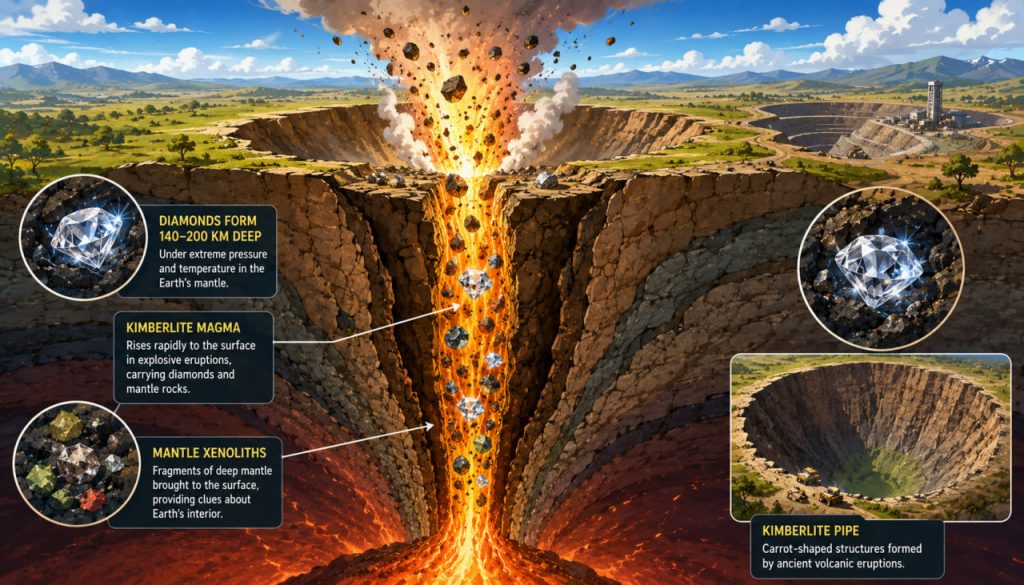
A kimberlite pipe is a vertical, carrot-shaped geological structure formed by the rapid ascent of kimberlite magma from Earth’s mantle.
Unlike ordinary volcanoes, kimberlite eruptions originate at extraordinary depths.
These eruptions transport pieces of deep mantle rock—including diamonds—to the surface before they have time to transform into graphite.
A typical kimberlite pipe consists of:
- A narrow root zone
- A vertical volcanic conduit
- A wider upper section near the surface
Over millions of years, erosion often removes the original volcanic cone, leaving only the underground pipe exposed.
Most of the world’s mined natural diamonds come from kimberlite pipes.
How Do Diamonds Form?
Diamonds are made of pure carbon, but they require exceptional conditions to crystallize.
Natural diamonds typically form at depths where:
- Pressure exceeds 45,000–60,000 atmospheres
- Temperatures reach approximately 900–1,300°C (1,650–2,370°F)
These conditions exist deep within Earth’s continental lithospheric mantle, far below the crust.
Most diamonds are believed to have formed between 1 and 3.5 billion years ago, making them much older than the dinosaurs.
After formation, they remained trapped deep underground until kimberlite eruptions carried them toward the surface.
Why Don’t Diamonds Melt or Turn into Graphite?
Diamonds are stable only under high-pressure conditions.
Near Earth’s surface, graphite is actually the more stable form of carbon.
So why do diamonds survive?
The answer lies in the incredible speed of kimberlite eruptions.
Scientists believe kimberlite magma may travel upward at speeds of tens of kilometers per hour, reaching the surface within hours.
This rapid ascent prevents diamonds from spending enough time under low-pressure, high-temperature conditions to transform into graphite.
Without such rapid transport, most diamonds would never survive the journey.
The Most Explosive Volcanoes You’ve Never Heard Of
Kimberlite eruptions are unlike typical volcanic eruptions.
Instead of producing long-lasting lava flows, they occur as extremely violent, gas-rich explosions.
The magma contains:
- Carbon dioxide
- Water vapor
- Other volatile gases
As pressure decreases during ascent, these gases expand dramatically.
The result is an explosive eruption capable of blasting deep mantle material toward the surface.
Most kimberlite eruptions occurred hundreds of millions of years ago.
Today, no historically observed kimberlite eruption has been confirmed, making them among the rarest volcanic events known to science.
Where Are Kimberlite Pipes Found?
Kimberlite pipes occur mainly within ancient continental cratons—the oldest and most stable parts of Earth’s continents.
Major diamond-producing regions include:
- South Africa
- Botswana
- Canada
- Russia
- Angola
- Namibia
- Australia
Thousands of kimberlite pipes have been identified worldwide.
However, only a small percentage contain diamonds in economically significant quantities.
Even among diamond-bearing pipes, the concentration of gem-quality diamonds varies greatly.
How Do Geologists Find Kimberlite Pipes?
Because most kimberlite pipes are deeply buried or heavily eroded, geologists rely on several exploration techniques.
These include:
- Satellite imagery
- Magnetic surveys
- Gravity measurements
- Geochemical sampling
- Indicator minerals
Certain minerals commonly associated with kimberlite help guide exploration.
Examples include:
- Garnet
- Chromite
- Ilmenite
- Chrome diopside
Finding these minerals in river sediments often points geologists toward previously undiscovered kimberlite pipes.
Are All Diamonds Found in Kimberlite?
No.
Although kimberlite pipes are the original source of most natural diamonds, erosion has transported many diamonds into river systems over millions of years.
These deposits are called alluvial diamond deposits.
Flowing water gradually separates diamonds from surrounding rock because diamonds are extremely hard and resistant to weathering.
Some famous diamond fields were discovered in river gravels long before their original kimberlite sources were identified.
What Kimberlite Pipes Reveal About Earth’s Interior
Kimberlite eruptions transport much more than diamonds.
They also bring deep mantle rocks known as xenoliths to the surface.
These samples provide scientists with direct evidence about conditions hundreds of kilometers beneath Earth.
By studying mantle xenoliths, researchers investigate:
- Mantle composition
- Earth’s thermal structure
- Plate tectonics
- Ancient continental formation
- Deep carbon cycling
In many ways, kimberlite pipes act as natural geological elevators carrying pieces of Earth’s inaccessible interior to the surface.
Expert Perspective
Geologist Dr. Stephen Haggerty, one of the world’s leading experts on diamonds and kimberlites, has emphasized that kimberlite magmas represent one of the few natural mechanisms capable of transporting diamonds rapidly enough to preserve them during their ascent from the deep mantle. His research has significantly improved scientific understanding of diamond formation, mantle processes, and kimberlite volcanism.
Organizations such as the Gemological Institute of America (GIA) also recognize kimberlite pipes as the primary geological source of most natural gem-quality diamonds found worldwide.
Why Kimberlite Pipes Matter
Kimberlite pipes are far more than diamond mines.
They provide unique insights into:
- Earth’s deep mantle
- Ancient geological history
- Volcanic processes
- Continental evolution
- Carbon cycling
- High-pressure mineral formation
Without these rare volcanic events, humanity would know far less about Earth’s interior, and natural diamonds would remain hidden hundreds of kilometers beneath our feet.
These extraordinary geological structures continue to help scientists explore one of the least accessible regions of our planet while supplying some of nature’s most remarkable gemstones.
Interesting Facts
- Most natural diamonds formed billions of years before dinosaurs appeared.
- Kimberlite magma originates much deeper than the magma feeding most volcanoes.
- Only a small fraction of known kimberlite pipes contain economically valuable diamond deposits.
- Diamonds are the hardest naturally occurring mineral on the Mohs hardness scale, with a rating of 10.
- Some kimberlite eruptions may have transported mantle material from depths approaching 200 kilometers.
- Canada became one of the world’s leading diamond producers after major kimberlite discoveries in the 1990s.
- Mantle xenoliths carried by kimberlites allow scientists to study rocks from depths that drilling cannot reach.
Glossary
- Kimberlite — A rare, volatile-rich igneous rock formed from deep mantle magma that can transport diamonds to Earth’s surface.
- Kimberlite Pipe — A carrot-shaped volcanic conduit created by explosive kimberlite eruptions.
- Diamond — A crystalline form of pure carbon formed under extremely high pressure and temperature within Earth’s mantle.
- Mantle — The thick layer of hot rock beneath Earth’s crust extending to Earth’s outer core.
- Lithospheric Mantle — The rigid upper portion of Earth’s mantle located beneath the continental crust.
- Craton — An ancient, stable part of a continent that has remained largely unchanged for billions of years.
- Xenolith — A fragment of deep rock transported to the surface within magma.
- Alluvial Deposit — A sedimentary deposit created by flowing water that may contain minerals such as diamonds transported away from their original source.