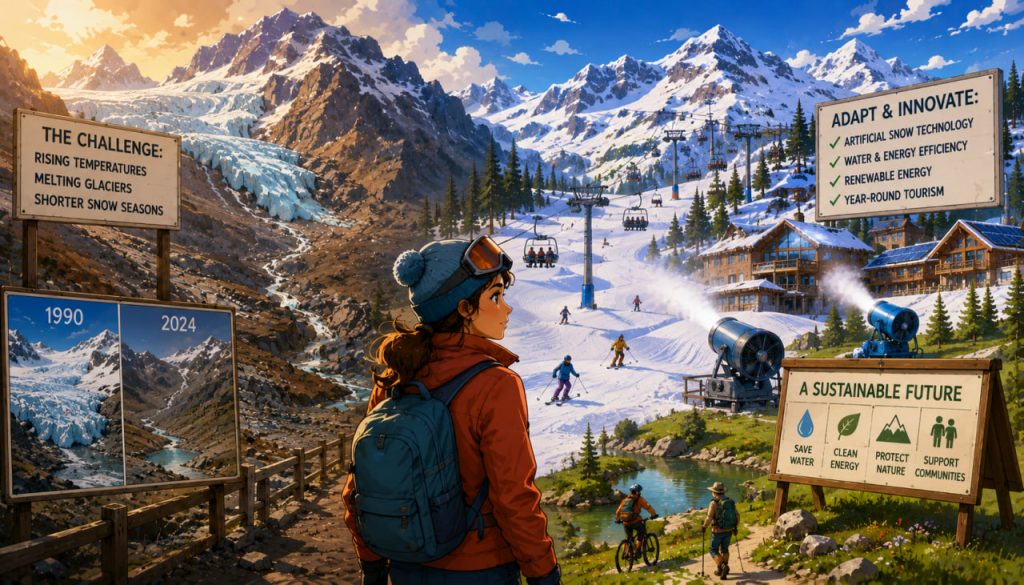
For generations, ski resorts have depended on cold winters, reliable snowfall, and healthy mountain ecosystems. Today, however, many of the world’s most famous skiing destinations face an uncertain future. Rising temperatures, shrinking glaciers, shorter snow seasons, and increasingly unpredictable weather are transforming winter tourism across Europe, North America, and other mountainous regions.
To adapt, many resorts have invested heavily in artificial snowmaking, modern infrastructure, and year-round tourism. While these innovations help maintain ski seasons, they also raise important questions about sustainability, energy use, water consumption, and the long-term future of alpine environments.
The challenge facing the ski industry is no longer simply about attracting visitors—it is about adapting to a changing climate while protecting the mountain landscapes that make skiing possible.
Why Ski Resorts Are Facing New Challenges
Snow conditions have always varied from year to year, but climate change is increasing both the frequency and intensity of unusually warm winters.
Mountain regions are experiencing:
- Shorter periods of natural snow cover
- More winter rainfall instead of snowfall
- Earlier spring snowmelt
- More frequent freeze-thaw cycles
- Retreating glaciers
- Greater weather variability
Lower-elevation ski resorts are generally the most vulnerable because temperatures there more often rise above freezing during winter.
Even a small increase in average winter temperature can significantly reduce the number of skiable days.
The Rapid Retreat of Mountain Glaciers
Glaciers are among the clearest visible indicators of climate change.
Around the world, glaciers are losing mass faster than they can be replenished by snowfall.
Scientists have documented substantial glacier retreat in regions including:
- The Alps
- The Rocky Mountains
- Scandinavia
- The Andes
- The Himalayas
- New Zealand
As glaciers shrink, they affect much more than skiing.
Glaciers help regulate freshwater supplies, support mountain ecosystems, influence river systems, and contribute to tourism.
Their disappearance represents both an environmental and economic challenge.
Artificial Snow: How Does It Work?
Artificial snow is produced by combining water and compressed air under suitable weather conditions.
Snowmaking machines spray tiny water droplets into cold air, where they freeze before reaching the ground.
Modern snowmaking systems include:
- Snow guns
- Fan-powered snow cannons
- Pumping stations
- Water reservoirs
- Weather monitoring systems
- Automated snow production controls
Today’s technology is significantly more efficient than earlier generations, allowing resorts to produce snow with less water and energy under favorable conditions.
However, artificial snow still depends on temperatures remaining sufficiently cold—usually below freezing or near the wet-bulb threshold required for efficient snowmaking.
Can Artificial Snow Replace Natural Snow?
Artificial snow has become an essential tool for many ski resorts, but it has limitations.
Compared with natural snow, machine-made snow is generally:
- Denser
- Harder
- More resistant to melting
- Less fluffy
- Better suited for maintaining ski runs
However, artificial snow cannot fully recreate the ecological functions of natural snowfall.
Natural snow insulates vegetation, protects soil, supports wildlife habitats, and contributes to seasonal water storage.
Artificial snow mainly serves recreational purposes.
Snowmaking helps ski operations continue, but it is not a complete substitute for healthy winter climates.
Environmental Costs of Snowmaking
Producing artificial snow requires considerable resources.
Depending on local conditions, snowmaking may involve:
- Large volumes of water
- Significant electricity consumption
- Water storage infrastructure
- Pumping systems
- Maintenance equipment
Many resorts are now reducing environmental impacts by:
- Using renewable electricity
- Recycling water where possible
- Improving snowmaking efficiency
- Monitoring water withdrawals
- Optimizing snow production with weather forecasting
Sustainable management has become increasingly important as environmental regulations continue to evolve.
Ski Resorts Are Expanding Beyond Winter
Recognizing the uncertainty of future winters, many mountain destinations are diversifying their attractions.
Year-round tourism now includes:
- Hiking
- Mountain biking
- Rock climbing
- Zip lines
- Wellness centers
- Nature tours
- Alpine lakes
- Cultural festivals
- Wildlife watching
This diversification helps local economies become less dependent on snowfall while reducing financial risks associated with poor winter seasons.
Many resorts now view themselves as mountain recreation destinations rather than purely ski resorts.
Technology Is Helping Resorts Adapt
Modern technology plays an increasingly important role in mountain management.
Artificial intelligence and advanced forecasting help operators:
- Predict snowfall
- Optimize snowmaking schedules
- Monitor energy consumption
- Reduce water use
- Improve slope maintenance
- Enhance visitor safety
Satellite observations, drones, and weather models also provide detailed information about snow depth, glacier changes, and avalanche conditions.
These tools allow resorts to make more efficient operational decisions.
The Human Side of the Challenge
Mountain communities often depend heavily on winter tourism.
Climate-related changes affect:
- Local employment
- Hotels
- Restaurants
- Equipment rental businesses
- Ski schools
- Transportation
- Seasonal workers
For many alpine villages, adapting successfully is essential for maintaining economic stability.
Some lower-elevation resorts have already shortened their seasons or shifted toward alternative tourism models.
Others continue investing in infrastructure while planning for long-term environmental changes.
Expert Perspective
Professor Hans Pörtner, one of the leading climate scientists who has served as Co-Chair of IPCC Working Group II, has emphasized that climate adaptation and climate mitigation must work together. According to the IPCC, adaptation measures—such as improved snowmaking efficiency, diversified tourism, and better water management—can reduce some immediate risks, but they cannot fully offset continued warming over the long term.
This perspective reflects the broader scientific consensus: technological innovation helps communities adapt, but preserving mountain ecosystems ultimately depends on limiting future climate change.
What Does the Future Hold?
The future of skiing will likely vary by region.
Higher-altitude resorts may continue operating successfully for many decades, while lower-elevation areas may experience increasing challenges.
Future adaptations may include:
- More efficient snowmaking
- Renewable-powered infrastructure
- Smart water management
- Expanded four-season tourism
- Improved weather forecasting
- Environmentally sensitive development
The ski industry has repeatedly demonstrated its ability to innovate.
However, its long-term success will depend on balancing tourism, economic needs, and environmental sustainability.
Interesting Facts
- Machine-made snow is often denser than natural snow, making it more resistant to melting and heavy skier traffic.
- Some glaciers are covered with reflective protective blankets during summer to reduce seasonal ice loss in selected high-value areas.
- Modern snowmaking systems use sophisticated weather sensors to determine the most efficient time to produce snow.
- Mountain glaciers act as natural freshwater reservoirs, gradually releasing water during warmer months.
- Many ski resorts now earn significant revenue from summer activities, reducing their dependence on winter snowfall.
- Satellite monitoring allows scientists to measure glacier movement and ice loss with remarkable precision over time.
Glossary
- Artificial Snow – Snow produced by machines that spray water and compressed air into cold conditions to create frozen snow crystals.
- Glacier – A large, slow-moving mass of ice formed from accumulated snow over many years.
- Snowmaking – The technological process of producing artificial snow for ski slopes.
- Wet-Bulb Temperature – A measurement that combines air temperature and humidity, helping determine whether snowmaking conditions are suitable.
- Climate Adaptation – Actions taken to reduce the impacts of climate change on people, infrastructure, and ecosystems.
- Climate Mitigation – Efforts to reduce greenhouse gas emissions or increase carbon storage to limit future climate change.
- Avalanche – A rapid flow of snow, ice, and debris down a mountainside.
- Renewable Energy – Energy generated from naturally replenished sources such as wind, solar, hydroelectric, or geothermal power.