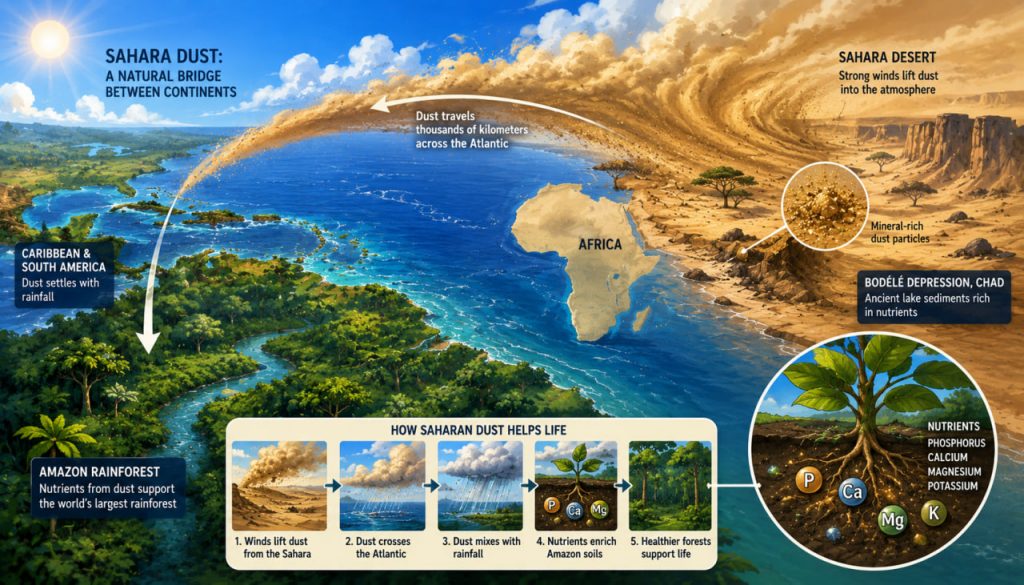
The Sahara Desert is often imagined as a vast, lifeless landscape of endless sand dunes and scorching temperatures. Yet this enormous desert plays a surprisingly important role in Earth’s climate system. Every year, hundreds of millions of tons of fine mineral dust are lifted high into the atmosphere by powerful winds, traveling thousands of kilometers across the Atlantic Ocean.
Far from being merely airborne sand, this dust carries essential nutrients that help sustain ecosystems on other continents. One of the most remarkable examples is the Amazon Rainforest, where Saharan dust replaces minerals that are constantly washed away by heavy tropical rainfall. Scientists have discovered that this natural process forms one of the world’s most extraordinary ecological connections, linking Africa and South America through the atmosphere.
This article explores how Saharan dust travels across oceans, why it fertilizes distant ecosystems, how it influences climate, and what researchers have learned about this remarkable natural cycle.
The Sahara: More Than the World’s Largest Hot Desert
Covering approximately 9 million square kilometers (3.5 million square miles), the Sahara is the largest hot desert on Earth.
Although much of its surface appears barren, it serves as one of the planet’s largest natural sources of airborne mineral dust.
Strong seasonal winds regularly lift tiny particles from dry lakebeds, exposed soils, and rocky landscapes into the atmosphere.
These dust clouds can travel astonishing distances, reaching:
- The Atlantic Ocean
- The Caribbean
- South America
- North America
- Southern Europe
- The Mediterranean
- Even parts of the Arctic under certain atmospheric conditions
The Sahara is not isolated—it is an active participant in Earth’s interconnected climate system.
How Does Dust Cross an Entire Ocean?
The journey begins when powerful winds sweep across North Africa.
During major dust events, fine particles rise several kilometers into the atmosphere.
High-altitude air currents then transport these particles westward across the Atlantic.
The entire journey may take several days to about two weeks, depending on weather patterns and wind speeds.
Modern satellites regularly capture enormous dust plumes stretching thousands of kilometers across the ocean.
Some individual dust clouds are larger than entire countries.
These atmospheric “dust highways” operate naturally year after year.
Why Does the Amazon Need African Dust?
At first glance, the Amazon Rainforest appears to have exceptionally rich soils.
In reality, many Amazon soils are surprisingly nutrient-poor.
Heavy tropical rainfall continuously washes away important minerals through a process known as leaching.
Without replenishment, nutrient levels would gradually decline.
Saharan dust helps replace many of these lost minerals, particularly:
- Phosphorus
- Calcium
- Magnesium
- Potassium
- Trace elements
Among these nutrients, phosphorus is especially important because it supports plant growth and is relatively scarce in many tropical soils.
African dust acts as a natural long-distance fertilizer for one of the world’s most productive ecosystems.
Where Does the Most Important Dust Come From?
Scientists have identified one particularly important source.
A large portion of the nutrient-rich dust originates from the Bodélé Depression in northern Chad.
Thousands of years ago, this region was covered by Lake Mega-Chad, one of Africa’s largest ancient lakes.
As the lake gradually disappeared, it left behind thick deposits of nutrient-rich sediments.
Today, strong winds regularly lift these fine particles into the atmosphere, making the Bodélé Depression one of Earth’s most active dust-producing regions.
How Much Dust Reaches South America?
The amount varies from year to year.
Satellite observations by NASA have estimated that roughly 180 million metric tons of Saharan dust are transported westward across the Atlantic annually.
Of this total, approximately 27 million metric tons may eventually reach the Amazon Basin.
Remarkably, scientists estimate that the amount of phosphorus delivered by this dust is roughly comparable to the amount lost each year through rainfall and river drainage.
This creates a remarkable example of natural nutrient recycling across continents.
Dust Also Influences Earth’s Climate
Saharan dust does more than fertilize forests.
It also affects climate in several important ways.
Airborne dust can:
- Reflect sunlight back into space
- Absorb heat
- Influence cloud formation
- Affect rainfall patterns
- Modify atmospheric temperatures
- Influence hurricane development over the Atlantic
The overall climatic effects depend on:
- Dust concentration
- Particle size
- Altitude
- Atmospheric conditions
- Cloud cover
Scientists continue studying these complex interactions to improve climate models.
Not Every Effect Is Beneficial
Although Saharan dust supports many ecosystems, it also has some negative impacts.
Large dust events may:
- Reduce air quality
- Increase respiratory irritation
- Decrease visibility
- Affect aviation
- Deposit dust on solar panels
- Influence coral reef health under certain conditions
People with asthma or chronic respiratory diseases may be particularly sensitive during intense dust episodes.
Like many natural phenomena, Saharan dust produces both beneficial and challenging effects.
Satellites Reveal Earth’s Invisible Connections
Much of what scientists know today comes from satellite observations.
Space agencies monitor dust movement using:
- Visible imagery
- Infrared sensors
- Laser instruments
- Atmospheric models
These observations help researchers:
- Track transatlantic dust transport
- Improve weather forecasts
- Study hurricane formation
- Estimate nutrient transport
- Monitor air quality
Without satellites, many of these enormous atmospheric processes would remain difficult to observe.
Expert Perspective
Atmospheric scientist Dr. Joseph M. Prospero, one of the pioneers in Saharan dust research, has spent decades studying the long-distance transport of African dust across the Atlantic Ocean. His work demonstrated that mineral dust from the Sahara reaches the Caribbean and the Americas on a regular basis, carrying nutrients while also influencing air quality, weather, and atmospheric chemistry.
Today, satellite observations from NASA and numerous international research programs continue to confirm that Saharan dust is an essential component of Earth’s interconnected climate and ecological systems.
What appears to be a simple dust storm is actually part of a global cycle linking continents, oceans, forests, and the atmosphere.
A Remarkable Example of Earth’s Interconnected Systems
The story of Saharan dust illustrates how deeply connected our planet truly is.
A windstorm in North Africa can eventually help nourish trees thousands of kilometers away in South America.
Ancient lake sediments in Chad contribute nutrients to one of the world’s richest rainforests.
Atmospheric circulation links deserts, oceans, forests, weather, and climate into one enormous natural system.
Understanding these connections helps scientists improve climate models while revealing how seemingly distant ecosystems depend on one another.
The Sahara is far more than a desert—it is an active participant in sustaining life across the planet.
Interesting Facts
- Every year, roughly 180 million metric tons of Saharan dust are transported across the Atlantic Ocean.
- The Bodélé Depression in Chad is considered one of the world’s largest natural sources of airborne mineral dust.
- Satellite images often capture Saharan dust plumes stretching thousands of kilometers across the Atlantic.
- Some Saharan dust reaches the Caribbean, Florida, Central America, and even parts of the southeastern United States.
- Phosphorus delivered by Saharan dust helps replace nutrients continuously lost from Amazon rainforest soils through heavy rainfall.
- Mineral dust also influences cloud formation, atmospheric chemistry, and hurricane activity in the Atlantic Ocean.
Glossary
- Saharan Dust – Fine mineral particles lifted from North Africa and transported long distances through the atmosphere.
- Leaching – The process by which water carries nutrients away from soil.
- Phosphorus – An essential nutrient required for plant growth, energy transfer, and cell development.
- Atmospheric Circulation – The large-scale movement of air that redistributes heat, moisture, and airborne particles around the planet.
- Aerosol – Tiny solid or liquid particles suspended in the atmosphere.
- Bodélé Depression – A dry basin in northern Chad that is one of Earth’s largest natural sources of mineral dust.
- Remote Sensing – The collection of information about Earth using satellites, aircraft, or other instruments without direct physical contact.
- Climate System – The interconnected system involving the atmosphere, oceans, land, ice, and living organisms that together determine Earth’s climate.