Dinosaurs often feel like the beginning of prehistoric life, but they were actually late arrivals in Earth’s story. Dinosaurs first appeared around 230 million years ago during the Triassic Period. By that time, life had already existed on Earth for more than 3 billion years.
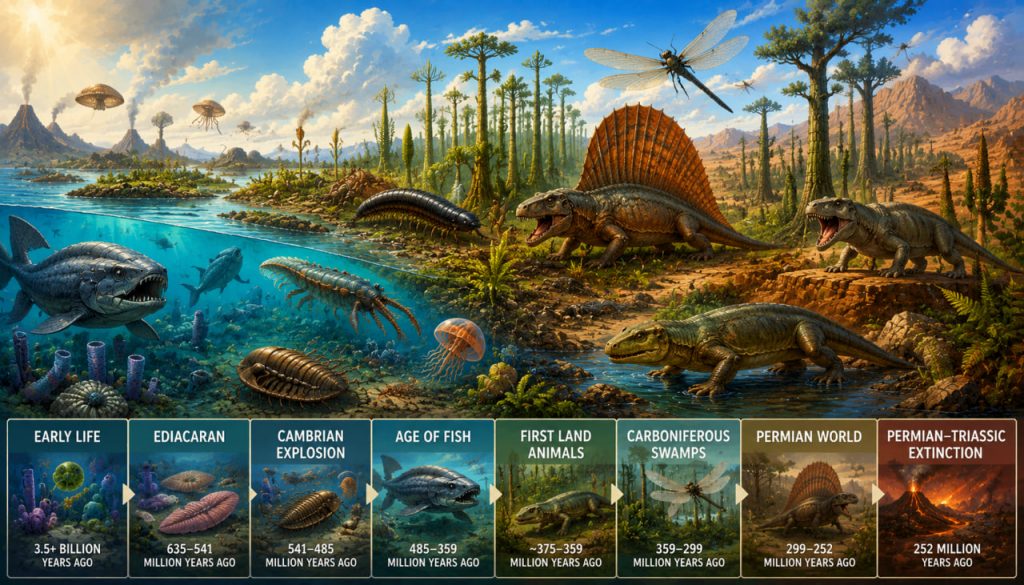
Long before Tyrannosaurus rex, Triceratops, or Brachiosaurus, the planet was home to bacteria, algae, strange sea creatures, giant insects, armored fish, early amphibians, sail-backed predators, and mammal-like reptiles.
The world before dinosaurs was not empty. It was filled with bizarre and fascinating organisms that shaped evolution long before dinosaurs became dominant.
To understand dinosaurs, we first need to understand the ancient worlds that came before them.
The First Life: Microbes Ruled the Planet
The earliest known life forms were microscopic organisms.
These simple life forms appeared billions of years before animals, plants, or fungi.
Early Earth was very different from today. There was no grass, no forests, no birds, and no mammals. The atmosphere contained little oxygen, and oceans covered much of the planet.
For a very long time, life was dominated by:
- Bacteria
- Archaea
- Microbial mats
- Cyanobacteria
Cyanobacteria were especially important because they produced oxygen through photosynthesis.
Over millions of years, oxygen gradually accumulated in the atmosphere, making complex life possible.
Without ancient microbes, animals would never have evolved.
The Ediacaran World: Earth’s First Large Organisms
Before animals with bones, teeth, or shells appeared, Earth had strange soft-bodied organisms known as Ediacaran life.
These creatures lived roughly 635 to 541 million years ago.
Many looked unlike anything alive today.
Some resembled:
- Flat discs
- Leaf-like shapes
- Quilted mats
- Soft fronds
- Strange crawling forms
Scientists still debate exactly how many Ediacaran organisms were related to modern animals.
Some may have been early animals, while others may represent extinct branches of life.
The Ediacaran Period shows that complex life began experimenting with body forms long before dinosaurs existed.
The Cambrian Explosion: When Animal Life Became Wild
Around 541 million years ago, life changed dramatically during the Cambrian Explosion.
This was not a literal explosion, but a period when many major animal groups appeared in the fossil record.
Cambrian seas were filled with unusual creatures such as:
- Trilobites
- Sponges
- Early arthropods
- Worm-like animals
- Primitive chordates
- Predatory animals like Anomalocaris
Trilobites became one of the most successful groups of early marine animals.
They had hard exoskeletons, segmented bodies, and compound eyes.
Anomalocaris, one of the top predators of the Cambrian seas, could grow much larger than most animals of its time.
Before dinosaurs ruled the land, strange armored creatures ruled the oceans.
The Age of Fish
After the Cambrian, marine life continued evolving.
During the Ordovician, Silurian, and Devonian periods, fish became increasingly diverse.
The Devonian Period is often called the Age of Fish.
Ancient oceans contained:
- Jawless fish
- Armored fish
- Early sharks
- Lobe-finned fish
- Placoderms
One of the most famous prehistoric fish was Dunkleosteus, a heavily armored predator with powerful jaws.
Some lobe-finned fish eventually gave rise to the first four-limbed vertebrates.
This transition was one of the most important moments in evolutionary history.
The ancestors of land animals came from fish that gradually adapted to shallow-water environments.
The First Animals on Land
Life did not move onto land all at once.
Plants, fungi, and arthropods began colonizing land before large vertebrates did.
Early land ecosystems included:
- Moss-like plants
- Primitive vascular plants
- Millipede-like arthropods
- Scorpions
- Early insects
- Fungi
Later, the first amphibian-like vertebrates appeared.
Animals such as Tiktaalik, Acanthostega, and Ichthyostega show important stages in the transition from water to land.
These creatures were not dinosaurs. They were early tetrapods, meaning four-limbed vertebrates.
The conquest of land began with small steps from shallow water, not with giant reptiles.
Giant Insects and Carboniferous Swamps
During the Carboniferous Period, roughly 359 to 299 million years ago, Earth was covered in vast swamp forests.
These forests contained giant clubmosses, horsetails, and early tree-like plants.
Atmospheric oxygen levels were higher than today, which may have helped some arthropods grow extremely large.
Famous Carboniferous animals included:
- Meganeura, a dragonfly-like insect with a wingspan over 60 centimeters
- Arthropleura, a giant millipede-like arthropod
- Early amphibians
- Early reptiles
These swamp forests later contributed to many of the coal deposits humans use today.
Long before dinosaurs, giant insects and amphibians lived in humid prehistoric forests.
The Permian World: Before the Great Dying
The Permian Period came just before the Triassic, when dinosaurs would eventually appear.
This was the age of many strange land animals, including synapsids, often called mammal-like reptiles.
Important Permian animals included:
- Dimetrodon
- Gorgonopsids
- Dicynodonts
- Early reptiles
- Large amphibians
Dimetrodon is often mistaken for a dinosaur, but it lived tens of millions of years before dinosaurs and was more closely related to mammals than to dinosaurs.
Many Permian predators had powerful jaws and sharp teeth.
Some herbivores had tusks and beak-like mouths.
The world before dinosaurs was dominated not by dinosaurs, but by ancient relatives of mammals and reptiles.
The Permian Extinction Changed Everything
About 252 million years ago, Earth experienced the largest mass extinction in its history.
This event is known as the Permian-Triassic extinction or the Great Dying.
It wiped out most marine species and many land animals.
Possible causes included:
- Massive volcanic eruptions
- Climate warming
- Ocean acidification
- Loss of oxygen in oceans
- Ecosystem collapse
After this extinction, surviving animals slowly diversified again.
Among them were the ancestors of dinosaurs, crocodiles, mammals, and many other later groups.
Dinosaurs rose to prominence only after earlier ecosystems were devastated and reshaped.
Expert Perspective
Paleontologist Stephen Jay Gould often emphasized that evolution is not a straight ladder leading inevitably to modern animals. Instead, it is a branching process shaped by chance, extinction, adaptation, and environmental change.
This perspective is especially useful when studying life before dinosaurs. The prehistoric world was not simply waiting for dinosaurs to arrive. It was filled with successful organisms that dominated their environments for millions of years.
Dinosaurs were one chapter in the history of life, not the beginning of the story.
Why Pre-Dinosaur Life Matters
Studying life before dinosaurs helps scientists understand how evolution works over deep time.
It reveals how life survived dramatic changes, including:
- Oxygen increases
- Ice ages
- Volcanic disasters
- Ocean changes
- Mass extinctions
- Continental shifts
These ancient organisms also explain the origins of modern life.
Fish, insects, amphibians, reptiles, mammals, plants, and ecosystems all have roots in the world before dinosaurs.
The pre-dinosaur Earth was one of the most creative and experimental periods in the history of life.
Interesting Facts
- Dinosaurs appeared only around 230 million years ago, but life on Earth is more than 3.5 billion years old.
- Trilobites survived for nearly 270 million years, far longer than dinosaurs.
- Dimetrodon is not a dinosaur and lived about 40 million years before the first dinosaurs.
- Some Carboniferous insects grew huge partly because oxygen levels were higher than today.
- The Permian-Triassic extinction was the most severe known mass extinction in Earth’s history.
- Many coal deposits formed from ancient swamp forests that existed long before dinosaurs.
- The first land plants appeared long before large land animals.
Glossary
- Dinosaur – A group of reptiles that first appeared during the Triassic Period and later dominated many land ecosystems.
- Ediacaran Life – Ancient soft-bodied organisms that lived before the Cambrian Period.
- Cambrian Explosion – A period when many major animal groups appeared rapidly in the fossil record.
- Trilobite – An extinct marine arthropod with a hard segmented body and compound eyes.
- Tetrapod – A vertebrate animal with four limbs or descended from four-limbed ancestors.
- Carboniferous Period – A prehistoric period known for vast swamp forests, giant arthropods, and early reptiles.
- Synapsid – A group of animals that includes mammals and their extinct relatives.
- Permian-Triassic Extinction – The largest known mass extinction, occurring about 252 million years ago.