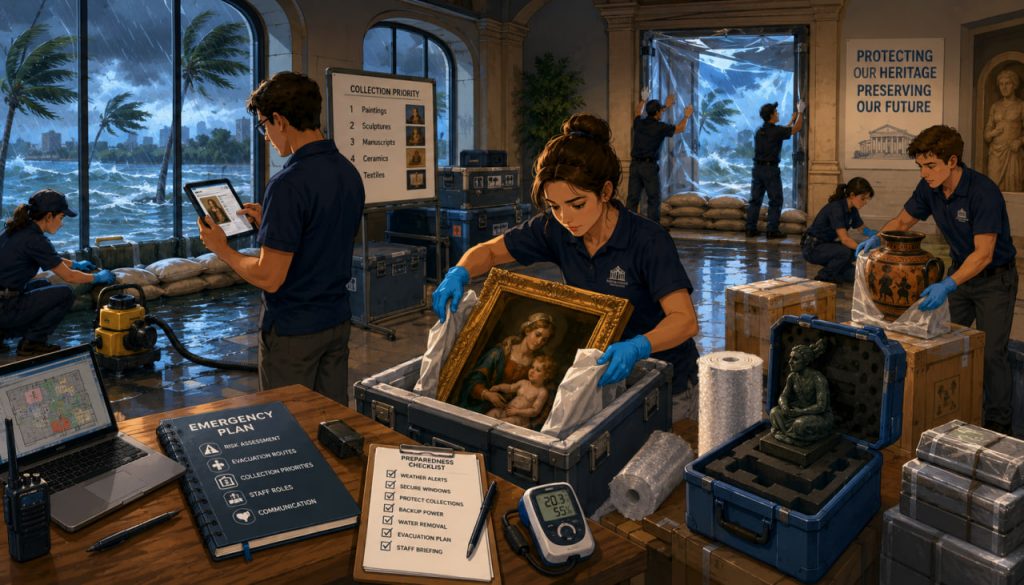
Museums are home to some of humanity’s greatest treasures—from centuries-old paintings and rare manuscripts to ancient sculptures and priceless archaeological artifacts. These collections connect us with our shared history, but they also face increasing threats from natural disasters. Floods, hurricanes, severe storms, rising sea levels, and extreme weather events have become more frequent in many parts of the world, forcing museums to rethink how they protect irreplaceable works of art.
Today, disaster preparedness has become just as important as conservation. Modern museums combine advanced technology, emergency planning, climate monitoring, and highly trained conservation teams to reduce the risks posed by natural disasters. Their goal is not only to save individual masterpieces but also to preserve cultural heritage for future generations.
This article explores how museums prepare for floods and hurricanes, the technologies they use, and why emergency planning has become an essential part of modern museum management.
Why Museums Are Vulnerable to Natural Disasters
Museum collections are often extremely fragile.
Many objects can be permanently damaged by:
- Floodwater
- High humidity
- Mold growth
- Strong winds
- Roof leaks
- Saltwater exposure
- Fire following storms
- Power failures affecting climate control
Unlike ordinary household items, many artifacts are completely irreplaceable.
A centuries-old manuscript or original Renaissance painting cannot simply be replaced if destroyed.
Preventing damage is almost always more effective than attempting restoration afterward.
Risk Assessments Begin Long Before a Storm
Professional museums continuously evaluate potential hazards.
Risk assessments consider:
- Building location
- Flood history
- Hurricane exposure
- Nearby rivers
- Drainage systems
- Roof condition
- Emergency exits
- Collection priorities
Many museums also use computer models that estimate how different disasters could affect specific galleries or storage rooms.
These assessments help staff prepare detailed emergency response plans before severe weather arrives.
Climate-Controlled Storage Protects Collections Every Day
One of the most important defenses against damage is environmental control.
Museum storage areas carefully regulate:
- Temperature
- Relative humidity
- Air circulation
- Light exposure
- Dust levels
Special climate systems help prevent:
- Mold
- Paper deterioration
- Wood cracking
- Canvas distortion
- Metal corrosion
Many museums have backup power systems to maintain climate control during electrical outages.
Stable environmental conditions protect collections not only during disasters but throughout the entire year.
Emergency Plans Prioritize the Most Valuable Objects
Not every artifact can be evacuated immediately.
For this reason, museums create priority evacuation lists.
These identify objects that should be moved first if time is limited.
Priority factors include:
- Historical importance
- Financial value
- Fragility
- Size
- Ease of transport
- Restoration difficulty
Staff regularly rehearse emergency procedures so that everyone understands their responsibilities before a real disaster occurs.
Preparation reduces confusion when every minute matters.
Specialized Storage and Protective Packaging
Museum-quality storage materials provide an additional layer of protection.
Collections may be housed in:
- Waterproof cabinets
- Fire-resistant vaults
- Acid-free archival boxes
- Shock-absorbing crates
- Custom-built transport cases
During hurricane warnings, especially valuable artworks may be placed inside reinforced protective containers before being relocated.
Some museums also elevate storage shelves well above expected flood levels.
Even simple measures like raising collections off the floor can dramatically reduce flood damage.
Moving Masterpieces During Emergencies
When evacuation becomes necessary, transporting priceless artwork requires extraordinary care.
Professional art handlers use:
- Custom shipping crates
- Vibration protection
- Climate-controlled vehicles
- GPS tracking
- Security escorts
- Condition documentation
Every movement is carefully planned.
Before transportation, conservators document the artwork’s condition using detailed photographs and written reports.
This helps identify any changes after relocation.
Digital Technology Is Transforming Disaster Preparedness
Modern museums increasingly rely on technology.
Advanced systems include:
- Flood sensors
- Water leak detectors
- Weather monitoring
- Remote environmental monitoring
- Automated alerts
- Digital collection databases
Some museums also create high-resolution digital scans of paintings, sculptures, manuscripts, and archaeological artifacts.
While digital copies cannot replace originals, they preserve valuable information for research, education, and potential restoration efforts.
Artificial intelligence is also helping museums analyze environmental risks and optimize emergency planning.
Conservators Play a Critical Role
Museum conservators are highly trained specialists responsible for preserving cultural objects.
During emergencies, they help:
- Evaluate damage
- Stabilize fragile artifacts
- Remove contaminated materials
- Dry water-damaged collections
- Prevent mold growth
- Plan long-term restoration
Rapid response is essential.
Many materials begin deteriorating within hours after water exposure.
Specialized conservation laboratories use carefully controlled drying techniques to minimize permanent damage.
International Cooperation Saves Cultural Heritage
Major disasters often require global cooperation.
Museums frequently receive assistance from:
- Conservation organizations
- Universities
- Government agencies
- Emergency management specialists
- International museum networks
Institutions also share disaster preparedness guidelines and restoration expertise.
This collaboration allows museums around the world to learn from previous disasters and continually improve emergency planning.
Protecting cultural heritage is increasingly viewed as an international responsibility rather than the task of a single institution.
Expert Perspective
According to the International Council of Museums (ICOM) and the International Centre for the Study of the Preservation and Restoration of Cultural Property (ICCROM), disaster preparedness should become an integral part of everyday museum management rather than something considered only during emergencies. These organizations emphasize that risk assessment, staff training, preventive conservation, and emergency planning together provide the strongest protection for museum collections.
Their guidance reflects a widely accepted principle in museum conservation: the most successful disaster response begins long before disaster occurs.
Climate Change Is Reshaping Museum Planning
As extreme weather becomes more frequent in many regions, museums are adapting their long-term strategies.
Many institutions are investing in:
- Elevated storage facilities
- Improved flood barriers
- Stronger roofing systems
- Backup electrical systems
- Advanced monitoring technology
- Emergency staff training
- Digital documentation
- Climate resilience planning
The future of museum conservation will increasingly depend on combining traditional preservation techniques with modern engineering and environmental science.
Protecting humanity’s greatest masterpieces now requires preparing not only for the past—but also for the changing climate of the future.
Interesting Facts
- Some museums regularly conduct full-scale emergency drills that simulate floods, hurricanes, fires, or earthquakes.
- Museum storage areas often contain far more objects than public exhibition galleries, with many institutions displaying only a small percentage of their collections at any given time.
- High-resolution digital imaging allows researchers to study artworks in extraordinary detail without handling the originals.
- Freeze-drying technology can sometimes help stabilize water-damaged books and historical documents after flooding.
- Many museums install water sensors beneath storage shelves to detect leaks before visible damage occurs.
- Conservation scientists often work alongside engineers, chemists, climatologists, and emergency management specialists to protect cultural heritage.
Glossary
- Conservation – The professional care and preservation of cultural objects to slow deterioration and maintain their condition.
- Conservator – A specialist trained to preserve, stabilize, examine, and restore artworks and historical artifacts.
- Climate Control – Systems that regulate temperature, humidity, and air quality to protect sensitive collections.
- Relative Humidity – The amount of moisture in the air compared with the maximum it can hold at a given temperature.
- Preventive Conservation – Measures taken to prevent damage before it occurs rather than repairing it afterward.
- Archival Materials – Acid-free, chemically stable storage materials designed for the long-term preservation of documents and artifacts.
- Digital Preservation – The creation and maintenance of high-quality digital records of cultural objects for research, documentation, and backup purposes.
- Risk Assessment – The systematic process of identifying potential hazards, evaluating their likelihood, and planning strategies to reduce their impact.