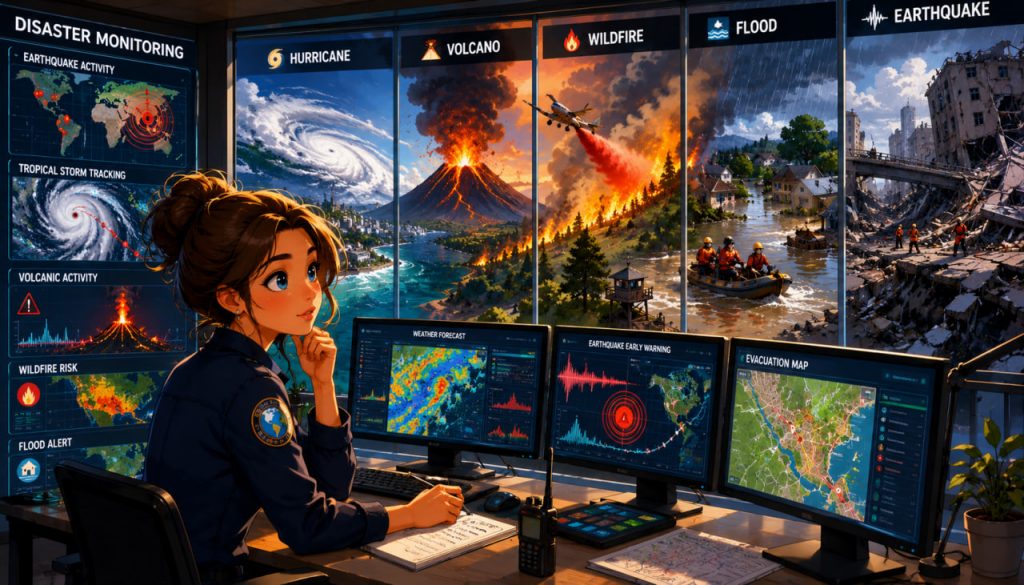
Natural disasters often seem sudden: an earthquake shakes a city, a hurricane changes direction, a wildfire spreads overnight, or a volcano erupts after weeks of unrest. But behind many disasters, scientists are watching signals long before the public notices anything. Satellites, sensors, weather models, seismic networks, river gauges, ocean buoys, drones, and artificial intelligence are making disaster forecasting more powerful than ever.
Still, there is an important difference between forecasting risk and predicting an exact event. Meteorologists can often forecast hurricanes days in advance. Hydrologists can warn of flooding when rainfall and river levels rise. Volcanologists can detect warning signs before many eruptions. But scientists cannot reliably predict the exact time, place, and magnitude of a major earthquake.
This article explains which disasters we can forecast, which ones remain difficult, how early warning systems save lives, and why prediction is only useful when people receive clear warnings and know what to do next.
Forecasting vs. Prediction: What Is the Difference?
The words “forecast” and “prediction” are often used casually, but in disaster science they are not always the same.
A forecast usually gives a probability or expected development over a period of time.
For example:
- A hurricane may reach the coast in three days.
- A river may exceed flood stage tomorrow.
- A heatwave may last five days.
- A wildfire risk may be extreme this weekend.
A precise prediction would say exactly what will happen, where, and when.
That level of certainty is possible for some systems but impossible for others.
Modern science is often better at estimating risk than naming an exact disaster moment.
Weather Disasters Are the Most Forecastable
Weather-related disasters are among the easiest to forecast because the atmosphere is continuously monitored.
Meteorologists use:
- Satellites
- Radar
- Weather balloons
- Ocean buoys
- Aircraft observations
- Ground stations
- Numerical weather models
- Artificial intelligence tools
This makes it possible to forecast many hazards, including:
- Hurricanes
- Heatwaves
- Winter storms
- Heavy rainfall
- Severe thunderstorms
- Extreme cold
- Some flood risks
The World Meteorological Organization supports the Early Warnings for All initiative, which aims to protect everyone on Earth from hazardous weather, water, and climate events through life-saving early warning systems by the end of 2027.
Weather forecasting is not perfect, but it is one of humanity’s strongest disaster prediction tools.
Hurricanes: Track Forecasts Are Better Than Intensity Forecasts
Hurricane forecasting has improved dramatically over recent decades.
Scientists can often predict the general path of a tropical cyclone several days before landfall.
The U.S. National Hurricane Center uses numerous objective forecast models to help specialists prepare official track and intensity forecasts.
However, hurricane intensity is harder to forecast than track.
A storm may suddenly strengthen if it passes over very warm ocean water, enters low wind shear, or develops a more organized inner core.
This process, called rapid intensification, can surprise communities and reduce preparation time.
We can often see where a hurricane may go before we know exactly how strong it will become.
Earthquakes: The Hardest Disaster to Predict
Earthquakes are different from weather events.
They occur deep underground, where direct observation is extremely limited.
The U.S. Geological Survey states clearly that neither the USGS nor any other scientists have ever predicted a major earthquake, and that scientists do not currently know how to do so.
This does not mean earthquake science is useless.
Scientists can still identify:
- High-risk fault zones
- Long-term earthquake probabilities
- Ground shaking hazards
- Tsunami risks after undersea earthquakes
- Building vulnerability
- Aftershock probabilities
Some earthquake early warning systems can detect the first seismic waves and send alerts seconds before stronger shaking arrives.
That is not true prediction, but even a few seconds can help people take protective action.
Earthquake science is better at reducing risk than predicting exact earthquakes.
Volcanoes Often Give Warning Signs
Volcanic eruptions can sometimes be forecast because volcanoes often show signs of unrest before erupting.
Warning signs may include:
- Small earthquakes
- Ground deformation
- Increased gas emissions
- Rising magma
- Temperature changes
- Changes in crater lakes
- New cracks or steam vents
Volcanologists monitor these signals using seismic instruments, gas sensors, thermal cameras, satellites, and field observations.
However, not every period of unrest leads to eruption.
A volcano may become active and then calm down again.
Volcano forecasting is about interpreting warning signs, not reading a guaranteed schedule.
Floods Can Often Be Forecast Early
Flood forecasting is one of the most useful forms of disaster prediction.
Scientists track:
- Rainfall intensity
- Snowmelt
- Soil moisture
- River levels
- Reservoir capacity
- Storm surge
- Drainage conditions
River floods may be forecast hours or days ahead.
Flash floods are harder because they can develop quickly after intense rainfall.
Urban flooding is especially difficult when drainage systems are overwhelmed.
Good flood forecasts must be paired with local maps, evacuation routes, and clear alerts.
A flood warning only saves lives if people understand the danger and have time to move.
Wildfires: Risk Is Forecastable, Ignition Is Harder
Wildfire forecasting works differently.
Scientists can often identify when conditions are dangerous, but predicting the exact spark is much harder.
Wildfire risk depends on:
- Temperature
- Humidity
- Wind speed
- Drought
- Vegetation dryness
- Lightning
- Human activity
- Topography
Fire weather forecasts can warn when a region is at extreme risk.
But the actual ignition may come from lightning, power lines, machinery, campfires, or arson.
Once a fire begins, models can estimate possible spread based on wind, fuel, and terrain.
Wildfire science can forecast dangerous conditions more reliably than the exact moment a fire will start.
Tsunamis: Fast Detection Matters More Than Long Prediction
Most tsunamis are triggered by undersea earthquakes, landslides, or volcanic activity.
Because earthquakes cannot be precisely predicted, tsunamis usually cannot be predicted far in advance.
However, tsunami warning systems can detect major undersea earthquakes and ocean wave changes quickly.
They use:
- Seismometers
- Deep-ocean pressure sensors
- Tide gauges
- Satellite communication
- Coastal warning networks
For distant coastlines, warnings may arrive hours before waves reach land.
For nearby coastlines, people may have only minutes.
Tsunami safety depends on rapid detection and immediate evacuation.
Artificial Intelligence Is Improving Disaster Forecasting
Artificial intelligence is increasingly used in disaster science.
AI can help analyze:
- Satellite images
- Weather patterns
- Flood maps
- Fire spread
- Infrastructure damage
- Social media emergency signals
- Historical disaster data
AI is especially useful when large amounts of data must be processed quickly.
However, AI does not remove uncertainty.
Models are only as good as their data, assumptions, and validation.
Artificial intelligence can improve forecasting, but it cannot replace scientific judgment or emergency planning.
Early Warning Systems Save Lives
The United Nations Office for Disaster Risk Reduction defines an early warning system as an integrated system of monitoring, forecasting, risk assessment, communication, and preparedness that helps people take timely action before hazardous events.
A strong early warning system includes four parts:
- Detect the hazard.
- Understand who is at risk.
- Communicate the warning clearly.
- Make sure people know what action to take.
Technology alone is not enough.
A perfect forecast is useless if warnings do not reach people or if communities lack evacuation plans.
Disaster prediction only becomes life-saving when it turns into action.
Expert Perspective
Disaster risk experts at the UNDRR emphasize that reducing disaster losses requires more than forecasting hazards. The Sendai Framework for Disaster Risk Reduction 2015–2030 is the global blueprint for preventing new disaster risk and reducing existing risk through preparedness, resilience, early warning, and better planning.
This expert approach reflects a crucial idea: the goal is not simply to predict disasters, but to reduce vulnerability before disasters happen.
A city with strong buildings, good drainage, evacuation plans, public education, and emergency communication can survive hazards much better than a city that only receives a last-minute warning.
The Future of Disaster Prediction
Future disaster forecasting will likely become more accurate as technology improves.
Important advances include:
- Better satellites
- More powerful climate models
- AI-based forecasting
- Dense sensor networks
- Real-time flood monitoring
- Improved volcanic surveillance
- Faster emergency alerts
- Digital twins of cities
- Better risk maps
But uncertainty will never disappear completely.
Some disasters involve chaotic systems, hidden underground processes, or human behavior.
That means societies must combine prediction with preparation.
The safest future is not one where every disaster is perfectly predicted, but one where communities are ready before warnings arrive.
Interesting Facts
- Scientists can forecast many weather-related disasters days in advance, but exact earthquake prediction remains beyond current science.
- Hurricane track forecasts are generally more reliable than hurricane intensity forecasts.
- Earthquake early warning systems do not predict earthquakes; they detect the beginning of shaking and send alerts before stronger waves arrive.
- Some volcanoes show warning signs for weeks or months before eruption, but unrest does not always lead to eruption.
- Wildfire forecasts can identify dangerous conditions even when the exact ignition source is unknown.
- Early warning systems are most effective when they combine science, communication, infrastructure, and public education.
- The UN-backed Early Warnings for All initiative aims to expand protection from hazardous weather, water, and climate events worldwide by the end of 2027.
Glossary
- Disaster Forecasting – The use of scientific data and models to estimate the likelihood, timing, location, or severity of hazardous events.
- Prediction – A more specific statement about what will happen, where, and when.
- Early Warning System – A system that monitors hazards, assesses risk, communicates warnings, and supports timely protective action.
- Hazard – A potentially dangerous natural or human-related event, such as an earthquake, flood, storm, or wildfire.
- Risk – The potential for harm when a hazard affects vulnerable people, buildings, or ecosystems.
- Vulnerability – The degree to which people, infrastructure, or communities can be harmed by a hazard.
- Rapid Intensification – A fast increase in storm strength over a short period.
- Seismic Waves – Energy waves produced by earthquakes that travel through Earth and cause ground shaking.