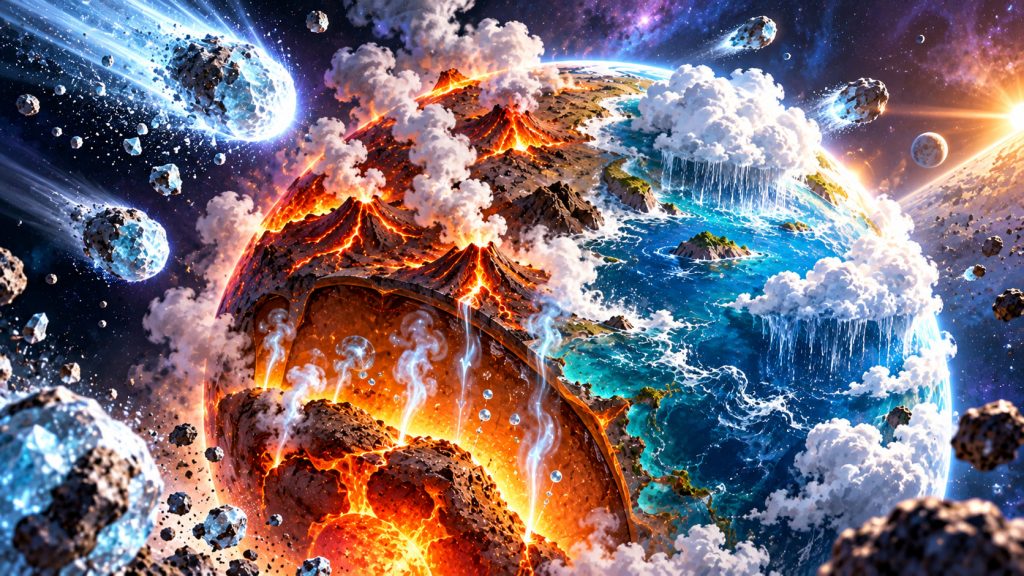
Water covers approximately 71% of Earth’s surface, filling enormous oceans, carving rivers, forming glaciers, and supporting every known form of life.
But where did all this water come from?
Earth formed about 4.54 billion years ago in a violent environment filled with colliding rocks, molten material, and extreme temperatures. Under these conditions, maintaining vast oceans would have been extraordinarily difficult.
For decades, scientists investigated whether Earth’s water arrived aboard icy comets and water-rich asteroids or was already present in the materials that formed our planet.
Modern research suggests that Earth’s water probably has multiple origins, including water-bearing planetary building materials and possibly later contributions from space.
The story begins long before Earth existed.
Water Was Born Before Our Planet
Water is made from two hydrogen atoms and one oxygen atom.
Hydrogen originated primarily during the earliest moments of the universe, while oxygen was produced inside earlier generations of stars.
When these elements became available in space, they could combine to form water molecules.
Astronomers have discovered water vapor and ice in enormous clouds of gas and dust where stars and planets develop.
These environments contain tiny dust grains on which water molecules can form and accumulate as ice.
Some of this ancient water may eventually become incorporated into emerging planetary systems.
The ingredients for Earth’s oceans existed billions of years before our planet formed.
How Did Water Reach the Young Earth?
Approximately 4.54 billion years ago, Earth began forming through planetary accretion.
This process involved smaller particles, rocks, and planetary bodies colliding and gradually combining into a growing planet.
Many of these building materials contained hydrogen-bearing minerals or other compounds capable of contributing to water formation.
However, the early Earth experienced extreme heat from repeated impacts and internal differentiation.
Some water and volatile substances were lost to space, while other materials remained trapped within the developing planet.
Scientists are investigating how much water Earth inherited during its formation and how much arrived afterward.
Asteroids May Have Delivered Enormous Amounts of Water
One longstanding explanation involves water-rich asteroids.
Many asteroids preserve ancient material from the formation of the solar system.
Some contain hydrated minerals, minerals whose structures incorporate water or hydroxyl groups.
A particularly important category is carbonaceous chondrites, primitive meteorites containing water-bearing minerals and carbon-rich compounds.
When bodies with similar compositions collided with the growing Earth, they could have contributed hydrogen and other volatile materials.
Their chemical characteristics provide important clues about the materials incorporated into our planet.
However, researchers continue investigating how large their contribution was compared with Earth’s original building materials.
Did Comets Bring Water to Earth?
Comets are sometimes described as enormous dirty snowballs.
They contain frozen gases, dust, rocky material, and various organic compounds.
As comets approach the Sun, their icy components can release gas and dust, producing spectacular tails.
Because comets contain substantial amounts of ice, scientists have long considered them potential contributors to Earth’s water.
To investigate this possibility, researchers examine the ratio of ordinary hydrogen to deuterium, a heavier form of hydrogen.
This ratio provides an important chemical fingerprint.
Some comets have water compositions that differ substantially from Earth’s oceans, while others show greater similarities.
A 2024 reanalysis of measurements from Comet 67P reopened the possibility that certain Jupiter-family comets could have contributed water to Earth.
Comets remain plausible contributors, but their precise role in creating Earth’s oceans is still being investigated.
A Major Discovery: Earth May Have Contained Water From the Beginning
In 2025, researchers at the University of Oxford reported important evidence supporting an internal origin for much of Earth’s hydrogen.
They examined a rare meteorite belonging to a group called enstatite chondrites.
These meteorites share significant chemical and isotopic similarities with materials believed to have helped form Earth.
Using advanced X-ray analysis, the researchers identified hydrogen associated with sulfur-bearing compounds inside the meteorite.
This finding suggests that Earth’s original building materials may have contained substantially more hydrogen than previously assumed.
Geoscientist James Bryson, who contributed to the research, emphasized that such findings support the possibility that Earth’s water developed naturally from the material that formed the planet.
Other geochemical models continue to indicate that water-rich material from farther out in the solar system was also important.
The emerging picture is that Earth may have inherited substantial hydrogen while receiving additional water-bearing material during its formation.
How Did Earth’s First Oceans Form?
As the young Earth evolved, volcanic activity released gases from its interior.
This process is called volcanic outgassing.
Water vapor, carbon dioxide, and other gases entered the early atmosphere.
As the planet’s surface cooled, water vapor could undergo condensation, turning into liquid droplets.
Rainfall and the accumulation of surface water helped establish early oceans.
The process was probably interrupted by large asteroid impacts and periods of intense heating.
Rather than appearing during one enormous rainstorm, Earth’s oceans likely developed through repeated interactions between the atmosphere, surface, and interior.
Scientists Have Found Evidence of Extremely Ancient Water
Some of the oldest clues about Earth’s oceans are preserved inside microscopic mineral crystals.
Researchers have discovered ancient zircon grains in the Jack Hills region of Western Australia.
Some are approximately 4.4 billion years old.
Their chemical characteristics suggest that liquid water may have interacted with Earth’s crust remarkably early in planetary history.
Additional research indicates that a functioning hydrological cycle, involving evaporation and precipitation, existed by approximately four billion years ago or earlier.
This means Earth may have developed environments containing liquid water relatively soon after its formation.
Why Didn’t Earth’s Water Disappear Into Space?
Earth retained substantial quantities of water partly because of its gravity, temperature, and atmospheric conditions.
Gravity helps prevent atmospheric gases from escaping into space.
As the planet cooled, water became stable as a liquid across large areas of the surface.
Some water also remained stored inside rocks and minerals.
Although the young Sun and major impacts caused atmospheric and water loss, these processes did not remove Earth’s entire water inventory.
Earth’s distance from the Sun also matters.
It lies within the Sun’s habitable zone, where planetary conditions can potentially support liquid surface water under a suitable atmosphere.
However, being within this zone does not guarantee that a planet will possess oceans.
How Much Water Does Earth Actually Have?
Scientists estimate that Earth contains approximately 1.386 billion cubic kilometers of water at and near its surface.
Most of it is distributed among:
- Oceans and seas: approximately 96.5%
- Glaciers and permanent ice: approximately 1.7%
- Groundwater: approximately 1.7%
- Lakes, rivers, atmospheric moisture, and other reservoirs: the small remaining fraction
Earth also contains hydrogen and water-bearing minerals deep underground.
Some mantle minerals can store hydrogen in their crystal structures under enormous pressure.
This means Earth’s internal water-related reservoirs are not limited to liquid underground lakes.
Is Earth’s Water Still Being Created?
Earth’s water constantly moves between oceans, atmosphere, land, ice, and living organisms.
Through the water cycle, water evaporates, forms clouds, falls as precipitation, and eventually returns to rivers, oceans, or underground reservoirs.
Volcanoes continue releasing water vapor from Earth’s interior.
Meanwhile, geological processes carry water-bearing minerals into deeper regions of the planet.
Small quantities of hydrogen can also escape into space.
Earth’s water inventory is dynamic, but the familiar water cycle mostly redistributes existing water rather than creating entirely new oceans.
Interesting Facts
- Earth’s oceans cover approximately 71% of its surface.
- The planet contains an estimated 1.386 billion cubic kilometers of near-surface water.
- Some water molecules in the solar system may be older than the Sun itself.
- Ancient zircon crystals suggest that liquid water existed on Earth approximately 4.4 billion years ago.
- Certain primitive meteorites contain hydrogen-bearing compounds that may resemble materials incorporated into the early Earth.
- Scientists compare hydrogen isotopes to investigate whether asteroids and comets contributed to Earth’s oceans.
- Water exists in solid, liquid, and gaseous forms naturally under Earth’s surface conditions.
- Minerals deep inside Earth’s mantle can store hydrogen within their crystal structures.
- The vast majority of Earth’s surface water is salty, while readily accessible freshwater represents only a tiny fraction.
Glossary
- Planetary Accretion — The gradual formation of planets through the accumulation and collision of smaller bodies.
- Hydrated Minerals — Minerals containing water or hydroxyl groups within their chemical structures.
- Carbonaceous Chondrites — Primitive meteorites containing carbon-rich compounds and, in many cases, water-bearing minerals.
- Deuterium — A stable isotope of hydrogen containing one proton and one neutron.
- Enstatite Chondrites — A group of primitive meteorites with chemical similarities to some of Earth’s original building materials.
- Volcanic Outgassing — The release of gases and volatile substances from a planet’s interior.
- Condensation — The transformation of a gas into a liquid.
- Zircon — A highly durable mineral capable of preserving chemical evidence from Earth’s ancient history.
- Hydrological Cycle — The circulation of water between Earth’s surface, atmosphere, and underground environments.
- Habitable Zone — The region around a star where a planet with suitable atmospheric conditions could maintain liquid surface water.
- Water Cycle — The continuous movement of water through evaporation, condensation, precipitation, and other processes.