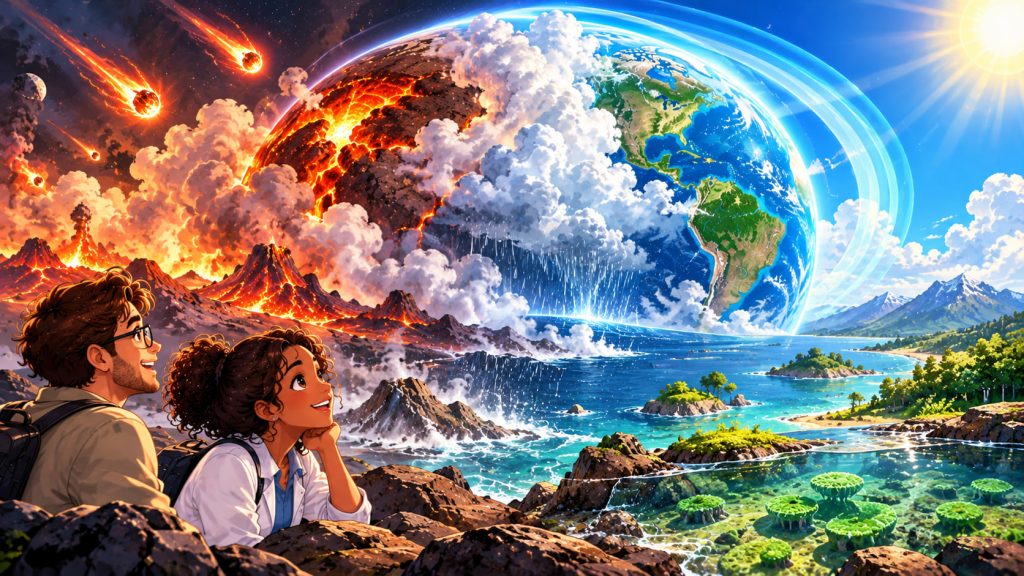
Every breath we take depends on an invisible envelope of gases surrounding Earth. The atmosphere supplies oxygen, regulates temperature, creates weather, and helps protect living organisms from dangerous radiation.
But the air we breathe today is nothing like the atmosphere that surrounded our planet billions of years ago.
Earth’s atmosphere developed through volcanic activity, chemical reactions, the formation of oceans, and the evolution of life. Its transformation took billions of years and fundamentally changed the planet.
What Was Earth Like Before Its Modern Atmosphere?
Earth formed approximately 4.54 billion years ago from material orbiting the young Sun.
During its earliest history, the planet experienced intense impacts, widespread melting, and enormous internal heat.
Earth may initially have captured a primordial atmosphere containing lightweight gases such as hydrogen and helium.
Much of this early gas was lost or transformed through powerful impacts, heating, and interactions with the young Sun.
The atmosphere we breathe developed through a long sequence of geological and biological changes.
Volcanoes Helped Create the Early Atmosphere
As early Earth cooled, gases trapped inside its interior escaped through volcanic activity.
This process is called volcanic outgassing.
Ancient volcanic activity released several important substances:
- Water vapor
- Carbon dioxide
- Nitrogen-bearing gases
- Sulfur compounds
These emissions helped build a secondary atmosphere.
Water and volatile materials delivered by asteroid impacts also contributed to Earth’s early development.
Scientists continue investigating how much each source contributed.
Unlike today’s atmosphere, this ancient mixture contained almost no free molecular oxygen.
How Did Earth’s First Oceans Form?
The early atmosphere contained substantial amounts of water vapor.
As Earth’s surface cooled sufficiently, water vapor underwent condensation, transforming from gas into liquid.
Water released from Earth’s interior and delivered by impacts helped establish early oceans.
Evidence from ancient zircon minerals suggests that liquid water may have existed approximately 4.4 billion years ago.
The atmosphere and oceans then began exchanging water, carbon dioxide, and other substances.
Large impacts may have temporarily vaporized portions of Earth’s early surface water, making ocean formation a complicated process.
What Gases Filled Earth’s Ancient Sky?
Before oxygen became abundant, Earth’s atmosphere contained nitrogen, carbon dioxide, water vapor, and varying amounts of other gases.
Carbon dioxide and methane contributed to the greenhouse effect, which warms a planet by absorbing infrared radiation.
This warming mattered because the young Sun was less luminous than today’s Sun.
Scientists call the question of how early Earth maintained liquid water under weaker sunlight the faint young Sun paradox.
Greenhouse gases likely helped keep ancient Earth warm enough for liquid water, although their exact concentrations remain uncertain.
How Did Life Begin Changing the Atmosphere?
Early microorganisms evolved in environments containing little or no free oxygen.
Eventually, certain organisms developed oxygenic photosynthesis, a process that uses sunlight, water, and carbon dioxide to produce organic matter while releasing oxygen.
Among them were cyanobacteria, microscopic organisms that played an enormous role in Earth’s biological history.
However, oxygen did not immediately accumulate in the atmosphere.
Much of it reacted with dissolved iron, volcanic gases, and other substances.
For a long time, oxygen production was balanced by processes that consumed it.
The Great Oxidation Event: When Oxygen Changed Everything
Approximately 2.4 billion years ago, Earth’s atmosphere began experiencing a major sustained increase in oxygen.
This transition is known as the Great Oxidation Event.
It transformed chemical reactions in oceans, rocks, and the atmosphere.
Oxygen reacted with dissolved iron in seawater, contributing to deposits preserved as banded iron formations.
For many organisms adapted to oxygen-free environments, increasing oxygen presented serious challenges.
However, oxygen also made highly efficient forms of energy production available to evolving organisms.
This atmospheric transformation helped establish conditions for the eventual evolution of complex life.
How Did Earth’s Protective Ozone Layer Develop?
As atmospheric oxygen increased, ultraviolet radiation helped convert some oxygen molecules into ozone.
Over geological time, these reactions established the ozone layer in the stratosphere.
Ozone absorbs much of the Sun’s biologically harmful ultraviolet radiation.
Its development improved conditions for organisms exposed to sunlight, particularly as life eventually expanded onto land.
The combination of an oxygen-rich atmosphere and protective ozone became a defining feature of Earth’s habitable environment.
Why Is Nitrogen the Most Abundant Gas Today?
Nitrogen accounts for approximately 78% of modern dry air, while oxygen makes up about 21%.
Nitrogen-bearing compounds were released from Earth’s interior, while geological and biological processes influenced atmospheric nitrogen over billions of years.
The nitrogen cycle continually transfers nitrogen between the atmosphere, oceans, soil, and living organisms.
Certain microorganisms convert atmospheric nitrogen into compounds that plants can use.
Others return nitrogen to the atmosphere.
This recycling system remains fundamental to modern ecosystems.
What Is Earth’s Atmosphere Made Of Today?
The main gases in modern dry air are:
- Nitrogen: approximately 78.08%
- Oxygen: approximately 20.95%
- Argon: approximately 0.93%
- Carbon dioxide: approximately 0.04%, with its concentration changing over time
- Other gases: small remaining quantities
Water vapor varies considerably depending on temperature, humidity, and location.
Although carbon dioxide represents only a small fraction of the atmosphere, it strongly influences Earth’s temperature.
Expert Perspective: Why Atmospheric History Matters
Geoscientist James Kasting has extensively investigated the evolution of Earth’s ancient atmosphere and the conditions that allow planets to maintain liquid water.
His atmospheric modeling research has helped explain how greenhouse warming could have supported early Earth’s climate despite weaker sunlight.
This illustrates an important principle: a planet’s atmosphere evolves through interactions between its interior, oceans, climate, and living organisms.
Is Earth’s Atmosphere Still Changing?
Earth’s atmosphere continues evolving.
Volcanoes release gases, oceans absorb and emit carbon dioxide, and organisms exchange gases through biological processes.
Human activities now significantly influence atmospheric composition through emissions of carbon dioxide, methane, and other greenhouse gases.
These changes affect Earth’s energy balance and global climate.
Earth’s atmosphere is not a finished product. It remains a dynamic planetary system shaped by geological, biological, and chemical processes.
Interesting Facts
- Earth formed approximately 4.54 billion years ago, long before its modern oxygen-rich atmosphere developed.
- Ancient zircon crystals suggest liquid water may have existed around 4.4 billion years ago.
- Photosynthetic microorganisms produced oxygen long before it accumulated substantially in the atmosphere.
- The Great Oxidation Event began approximately 2.4 billion years ago.
- Nitrogen makes up nearly four-fifths of modern dry air.
- Earth’s atmosphere has a mass of approximately 5.15 quintillion kilograms.
- About half of atmospheric mass is concentrated within the lowest 5.5 kilometers.
- The ozone layer absorbs much of the Sun’s harmful ultraviolet radiation.
Glossary
- Primordial Atmosphere — The earliest gaseous envelope associated with a newly formed planet.
- Volcanic Outgassing — The release of gases from Earth’s interior through volcanic and related geological processes.
- Condensation — The transformation of a gas into a liquid.
- Greenhouse Effect — Atmospheric warming caused by gases that absorb and emit infrared radiation.
- Faint Young Sun Paradox — The question of how early Earth maintained liquid water when the young Sun was less luminous.
- Oxygenic Photosynthesis — A biological process that uses light energy and releases oxygen from water.
- Cyanobacteria — Photosynthetic bacteria important to the history of atmospheric oxygen.
- Great Oxidation Event — A major rise in atmospheric oxygen beginning approximately 2.4 billion years ago.
- Banded Iron Formations — Ancient sedimentary rocks containing alternating iron-rich and silica-rich layers.
- Ozone Layer — A stratospheric region rich in ozone that absorbs much of the Sun’s ultraviolet radiation.
- Nitrogen Cycle — The movement and transformation of nitrogen among air, water, soil, and living organisms.