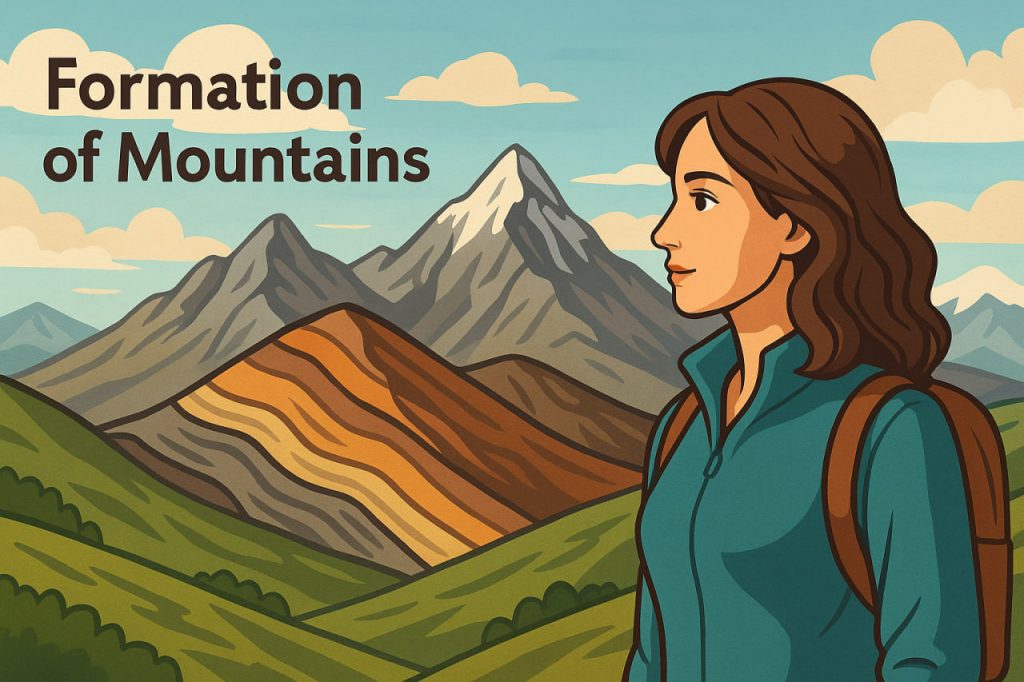
Mountains, the towering giants of our planet, stand as majestic symbols of nature’s power and geological history. They shape weather patterns, store fresh water, and provide homes for diverse ecosystems. But behind their beauty lies an extraordinary process that unfolds over millions of years. The formation of mountains—known scientifically as orogeny—is driven by powerful forces beneath Earth’s crust. These forces cause massive sections of rock to fold, fault, and uplift, sculpting the landscapes we see today. Understanding how mountains form not only reveals Earth’s dynamic nature but also helps scientists predict earthquakes, study climate history, and trace the evolution of our planet.
The Role of Tectonic Plates
At the heart of mountain formation lies the theory of plate tectonics. Earth’s outer layer, the lithosphere, is divided into several rigid plates that float on the semi-fluid mantle beneath them. These plates move slowly—just a few centimeters each year—but their interactions have monumental consequences. When two plates collide, their immense pressure forces the Earth’s crust to crumple and rise, forming mountain ranges. This process is known as convergent boundary interaction. For instance, the Himalayas, home to Mount Everest, were formed when the Indian Plate collided with the Eurasian Plate around 50 million years ago—a collision that continues to this day, causing the Himalayas to rise by several millimeters annually.
Types of Mountain Formation
Mountains form through several distinct geological processes, each resulting in unique landscapes and rock structures. The main types of mountain formation are:
- Fold Mountains — Created when tectonic plates push against each other, causing the Earth’s crust to buckle and fold. Examples include the Himalayas, the Alps, and the Rockies.
- Fault-Block Mountains — Formed when large sections of the crust crack and move along faults, lifting one side while dropping the other. The Sierra Nevada mountains in the U.S. are prime examples.
- Volcanic Mountains — Built by volcanic activity, where molten rock (magma) erupts from beneath the surface and solidifies into towering peaks. Famous examples include Mount Fuji in Japan and Mount Vesuvius in Italy.
- Dome Mountains — Formed when magma pushes upward beneath the crust but doesn’t erupt, creating a dome-like shape. The Black Hills of South Dakota are a classic example.
- Plateau Mountains — Created through erosion of elevated plateaus, leaving behind rugged and steep landscapes, such as those found in the Colorado Plateau.
Each type demonstrates the incredible variety of processes that shape our planet’s surface.
The Slow Power of Geological Time
Mountain building is a process that happens over tens of millions of years. The forces involved are massive but gradual, with changes often too slow to notice within a human lifetime. However, over geological time, these processes create immense changes in Earth’s appearance. Once mountains form, they are continually reshaped by erosion, weathering, and glaciation, which carve valleys, cliffs, and ridges. Geologist Dr. Clara Reinhardt explains, “Mountains are not permanent fixtures—they are born, transformed, and eventually worn down. They represent the heartbeat of Earth’s geological evolution.” Even as old ranges erode, new ones emerge, keeping the planet’s surface in constant motion.
The Connection Between Mountains and Climate
Mountains have a powerful influence on global and local climates. As moist air rises along mountain slopes, it cools and condenses, producing rainfall on one side while creating dry conditions on the other—known as the rain shadow effect. They also act as barriers that shape wind patterns and ocean currents. Additionally, snow-capped mountains serve as natural water reservoirs, feeding rivers and lakes during warmer months. Climate change, however, is altering these delicate systems by melting glaciers and affecting ecosystems. Dr. Jonas Patel, a climatologist, warns, “Mountain environments are among the first to reflect climate shifts. The disappearance of glaciers not only transforms landscapes but threatens water supplies for millions.”
The Human and Cultural Significance of Mountains
Mountains are deeply embedded in human culture, spirituality, and survival. Many ancient civilizations considered them sacred—symbols of closeness to the divine. In modern times, mountains attract millions for recreation, exploration, and inspiration. Economically, they provide valuable resources such as minerals, forests, and hydroelectric power. Yet they are also fragile environments that require careful stewardship. Mountain communities often live in harmony with their surroundings, preserving ecological balance through sustainable practices. The majesty of mountains reminds humanity of both nature’s power and our responsibility to protect it.
Interesting Facts
- The Himalayas are still growing by about 5 millimeters each year.
- The Andes Mountains are the longest continental mountain range in the world, stretching over 7,000 kilometers.
- Mount Everest was once part of the ocean floor before tectonic forces lifted it to its current height.
- Some mountain ranges, like the Appalachians, are older than the dinosaurs.
- Around 25% of the world’s population lives in or near mountainous regions.
Glossary
- Orogeny — The geological process of mountain formation through tectonic activity.
- Lithosphere — The rigid outer layer of Earth, consisting of the crust and upper mantle.
- Convergent boundary — A tectonic region where two plates move toward each other, often creating mountains.
- Erosion — The gradual wearing away of rock and soil by wind, water, or ice.
- Rain shadow effect — A dry area that forms on the leeward side of a mountain due to moisture loss on the windward side.

