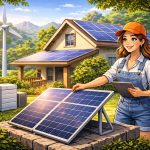
Agrivoltaics is an innovative approach that allows solar energy production and agriculture to coexist on the same land. Traditionally, large solar farms occupy areas that could otherwise be used for farming, which can create competition for land resources. Agrivoltaic systems address this challenge by integrating solar panels into agricultural landscapes in ways that allow crops or livestock to continue using the land beneath or between the panels. This approach helps maximize land productivity while supporting the transition to renewable energy. As the demand for clean electricity grows and land availability becomes increasingly limited in many regions, agrivoltaics is gaining attention as a promising solution.
How Agrivoltaic Systems Work
Agrivoltaic installations place solar panels in configurations that allow sunlight to reach the ground while still generating electricity. Panels may be mounted higher above the ground than conventional solar arrays or arranged in wider rows so that crops can grow beneath them. The electricity generated by the panels can be used locally for farm operations or supplied to the electrical grid. According to renewable energy researcher Dr. Laura Mitchell:
“Agrivoltaic systems allow farmers to produce both food and energy from the same land area.”
This dual-use strategy can improve the efficiency of land management and support rural energy production.
Benefits for Crop Production
In certain environments, partial shading from solar panels can actually benefit crops. Some plants experience stress from excessive heat or direct sunlight, especially in dry or hot climates. Solar panels can create a moderated microclimate by reducing extreme temperatures and slowing water evaporation from soil. Studies have shown that certain crops—such as leafy vegetables or berries—may perform well in these partially shaded conditions.
Energy for Agricultural Operations
Agrivoltaic systems can also provide electricity directly for farm activities. Energy produced by solar panels can power irrigation pumps, refrigeration systems, processing equipment, and farm buildings. This local energy generation helps reduce operational costs and increases energy independence for farmers.
Livestock and Solar Installations
In addition to crops, some agrivoltaic projects integrate livestock grazing. Sheep and other small animals can graze on vegetation beneath solar panels, helping maintain the area naturally while reducing the need for mechanical mowing. This combination of energy production and livestock management allows farmers to maintain agricultural activity while supporting renewable energy infrastructure.
Challenges and Design Considerations
Although agrivoltaics offers many advantages, careful system design is essential. The height, spacing, and orientation of solar panels must be optimized to ensure that crops receive sufficient sunlight. Equipment used for planting and harvesting must also be able to move easily between panel rows. Engineers and agricultural specialists often work together to design systems that balance both energy generation and agricultural productivity.
The Future of Agrivoltaics
Agrivoltaics is becoming an increasingly important concept in the development of sustainable energy systems. By allowing renewable energy infrastructure to coexist with agriculture, this approach helps address concerns about land use while supporting clean electricity production. As solar technology advances and agricultural practices adapt to new conditions, agrivoltaic systems may become a common feature in many rural landscapes.
Interesting Facts
- Agrivoltaics allows electricity generation and food production on the same land.
- Some crops benefit from partial shading provided by solar panels.
- Solar power can support irrigation and farm equipment.
- Livestock such as sheep can graze beneath solar arrays.
- Agrivoltaics helps improve land-use efficiency in rural areas.
Glossary
- Agrivoltaics — a system that combines agricultural production with solar energy generation on the same land.
- Solar Panel — a device that converts sunlight into electricity.
- Microclimate — localized environmental conditions such as temperature and humidity.
- Renewable Energy — energy produced from natural sources that are continuously replenished.
- Land-Use Efficiency — the ability to maximize productivity from a specific area of land.