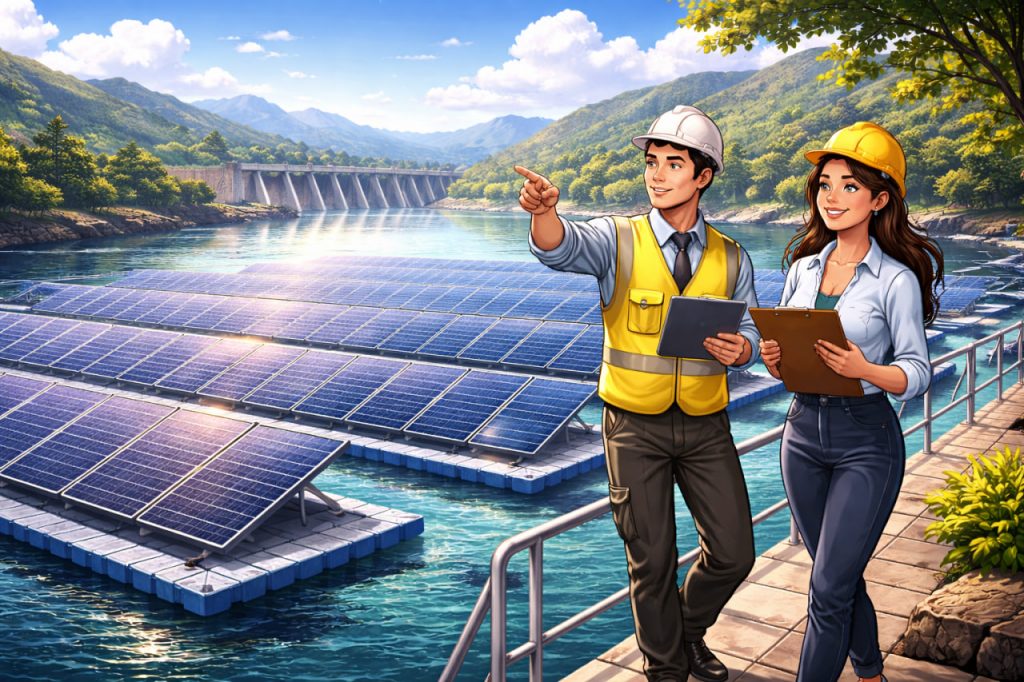
As global demand for clean energy continues to grow, countries are searching for innovative ways to expand renewable electricity generation. In regions where available land is limited or expensive, building large solar farms on the ground can be difficult. One promising solution is the development of floating solar power plants, also known as floating photovoltaic systems. These installations place solar panels on platforms that float on bodies of water such as reservoirs, lakes, or artificial basins. By using water surfaces instead of land, floating solar systems allow countries to generate renewable electricity while preserving valuable land resources for agriculture, housing, or natural ecosystems.
How Floating Solar Power Plants Work
Floating solar power plants use photovoltaic panels mounted on buoyant platforms that rest on the surface of water. These platforms are designed to remain stable while supporting solar panels, electrical wiring, and maintenance pathways. The generated electricity is transmitted through underwater cables or floating connectors to nearby power infrastructure. Energy engineer Dr. Marcus Li explains:
“Floating solar systems allow countries to expand renewable electricity generation without competing for limited land resources.”
These systems are often installed on existing water reservoirs used for hydropower or drinking water storage.
Advantages of Water-Based Solar Systems
Floating solar power plants offer several unique advantages compared with traditional ground-mounted solar installations. One key benefit is the efficient use of space. By installing panels on water surfaces, countries can increase renewable energy capacity without occupying valuable land. In addition, water helps cool solar panels naturally, which can improve their efficiency and extend their lifespan. Reduced evaporation from the water surface is another potential benefit, especially in regions where water conservation is important.
Integration With Hydropower Infrastructure
In many cases, floating solar installations are built on reservoirs that already support hydropower plants. This combination allows two renewable energy technologies to operate together. Solar panels can generate electricity during sunny hours, while hydropower systems can provide additional energy when solar production decreases. This complementary relationship helps improve the stability of renewable electricity supply.
Countries Leading Floating Solar Development
Several countries have become pioneers in the development of floating solar technology. Nations with dense populations and limited available land—such as Japan, South Korea, and Singapore—have invested heavily in these systems. Large floating solar farms are also being built in parts of Europe and Southeast Asia. As technology improves and installation costs decrease, more countries are exploring floating solar projects.
Environmental Considerations
While floating solar systems provide many benefits, researchers continue to study their potential environmental impacts. Factors such as water quality, aquatic ecosystems, and sunlight reaching underwater environments must be carefully considered. Engineers and environmental scientists work together to design systems that minimize ecological disruption while maximizing renewable energy production.
The Future of Floating Solar Technology
Floating solar power plants represent a rapidly growing segment of the renewable energy industry. As global energy demand increases and land resources remain limited in many regions, water-based solar systems may play an important role in expanding clean electricity generation. Advances in materials, anchoring systems, and energy storage technologies are likely to make floating solar installations even more efficient and widespread in the coming decades.
Interesting Facts
- Floating solar systems are also called floating photovoltaic (FPV) installations.
- Water can help cool solar panels, improving efficiency.
- Some floating solar farms cover large reservoirs or artificial lakes.
- Combining floating solar with hydropower can improve energy stability.
- Floating installations can reduce water evaporation in reservoirs.
Glossary
- Floating Photovoltaic System — a solar power installation placed on floating platforms on water surfaces.
- Photovoltaic Panel — a device that converts sunlight into electricity.
- Reservoir — a large artificial lake used to store water.
- Hydropower — electricity generated from moving water.
- Renewable Energy — energy produced from naturally replenishing sources such as sunlight or wind.