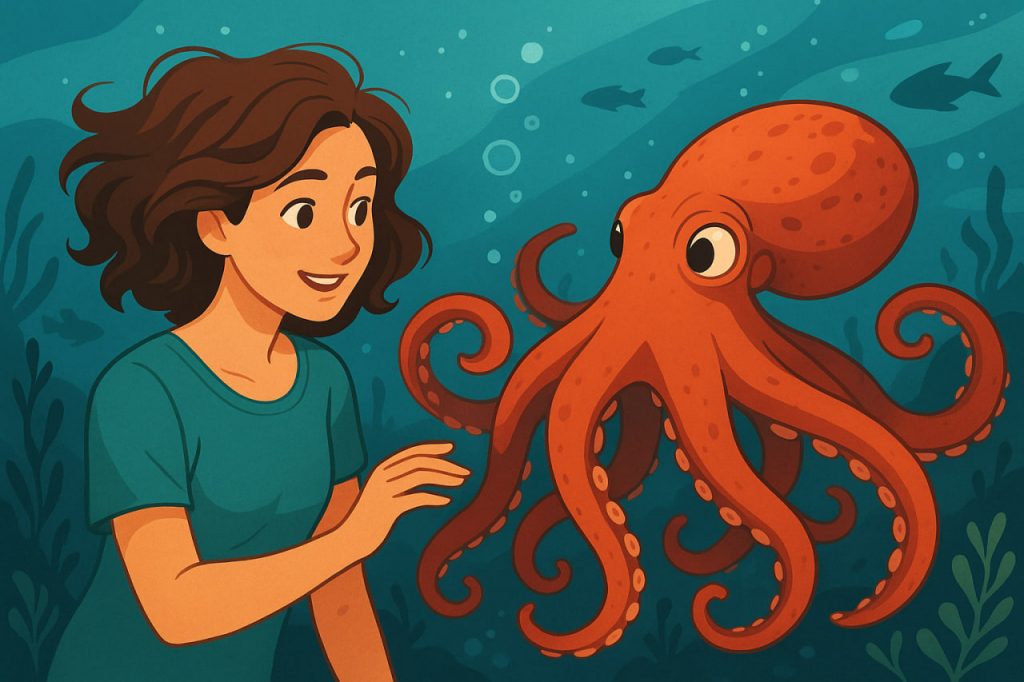
The octopus is one of the most extraordinary creatures in the animal kingdom, combining high intelligence, complex behavior, and remarkable physical abilities in a soft-bodied marine animal. Despite lacking a backbone and living relatively short lives, octopuses demonstrate problem-solving skills, memory, and adaptability that rival those of many vertebrates. Found in oceans across the world, from shallow coral reefs to the deep sea, octopuses have evolved to survive in highly competitive and dangerous environments. Their success lies in a unique blend of advanced nervous systems, flexible anatomy, and sophisticated camouflage. Studying octopuses challenges traditional ideas about intelligence and reveals that complex cognition can arise in very different biological forms. These animals are not just marine predators—they are evolutionary masterpieces.
A Decentralized Brain and Distributed Intelligence
One of the most fascinating aspects of octopus biology is its decentralized nervous system. While the octopus has a central brain, more than half of its neurons are located in its arms, allowing each limb to operate semi-independently. This enables arms to explore, grasp, and manipulate objects without constant direction from the brain. Such distributed intelligence allows octopuses to multitask efficiently, reacting quickly to threats or opportunities. Neuroscientist Dr. Julian Harper explains:
“An octopus does not think like a mammal.
Its intelligence is spread throughout its body, creating a form of cognition unlike anything on land.”
This neural structure gives octopuses extraordinary coordination and flexibility in complex environments.
Masters of Camouflage and Shape-Shifting
Octopuses are famous for their ability to change color, texture, and even body shape within seconds. Specialized skin cells called chromatophores, iridophores, and leucophores work together to reflect and absorb light, allowing near-perfect camouflage. This ability is controlled by the nervous system and responds instantly to visual input. An octopus can mimic rocks, coral, sand, or even other animals to avoid predators or ambush prey. Some species can alter the texture of their skin, forming bumps or spikes that match surrounding surfaces. Camouflage is not just a defense mechanism—it is an essential survival strategy that defines octopus behavior.
Problem-Solving and Tool Use
Octopuses are known for their remarkable problem-solving abilities. In laboratory experiments, they can open jars, navigate mazes, and remember solutions over long periods. In the wild, some species collect coconut shells or shells from other animals and use them as portable shelters. This behavior qualifies as tool use, a rare trait in the animal kingdom. Octopuses also show curiosity, exploring unfamiliar objects rather than avoiding them. These cognitive abilities suggest a high level of learning capacity and environmental awareness.
A Short but Intense Life Cycle
Despite their intelligence, most octopus species live only one to three years. Their life cycle is intense and focused on growth, reproduction, and survival. After mating, females guard their eggs continuously, often refusing to eat until the eggs hatch. Shortly after reproduction, both males and females typically die, a process known as semelparity. Scientists believe this strategy allows octopuses to invest all their energy into the next generation. This short lifespan makes their rapid learning and adaptability even more remarkable.
Ecological Role and Scientific Importance
Octopuses play a crucial role in marine ecosystems as both predators and prey. They help regulate populations of crustaceans and fish, contributing to ecological balance. From a scientific perspective, octopuses are invaluable for studying neuroscience, evolution, and behavior. Their unique nervous system offers insights into alternative paths of intelligence evolution. As ocean environments change, understanding octopus adaptability may also provide clues about resilience in marine life.
Interesting Facts
- An octopus has three hearts and blue blood due to copper-based hemocyanin.
- Each arm can taste and touch independently.
- Octopuses can squeeze through openings smaller than their own eyes.
- Some species can solve puzzles faster after observing humans.
- Octopus intelligence evolved independently from vertebrate intelligence.
Glossary
- Decentralized Nervous System — a neural structure where control is distributed rather than centralized.
- Chromatophores — pigment-containing cells that enable rapid color change.
- Tool Use — the ability to manipulate objects to achieve a specific goal.
- Semelparity — a reproductive strategy where an organism reproduces once and then dies.
- Hemocyanin — a copper-based molecule used to transport oxygen in some animals.