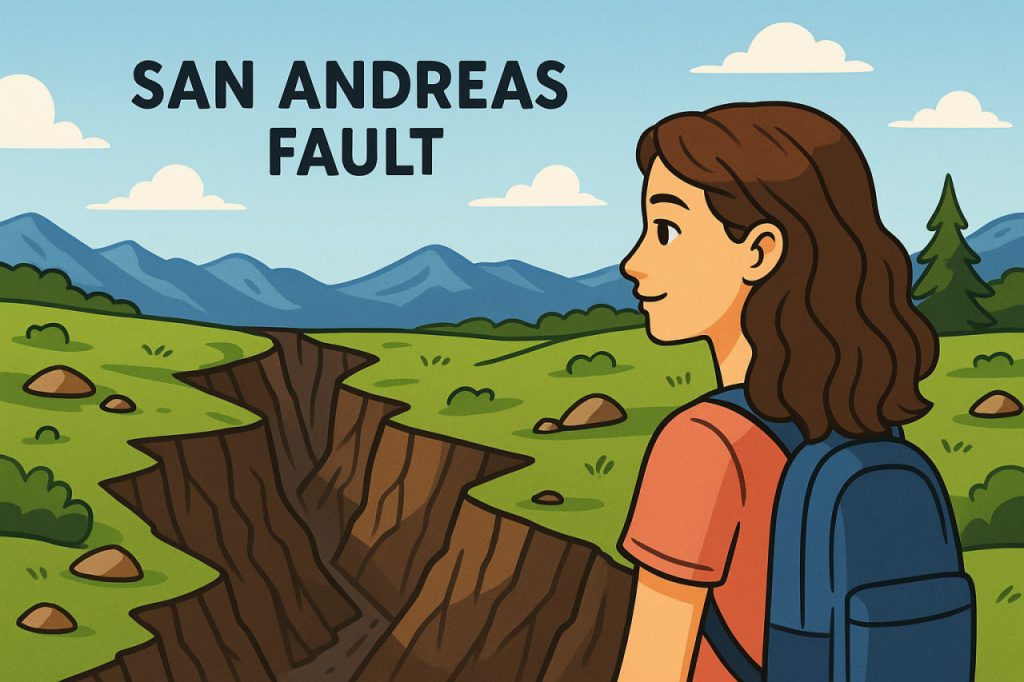
The San Andreas Fault is one of the most famous and geologically significant fractures on Earth, stretching more than 1,200 kilometers across the state of California. It marks the boundary between two massive tectonic plates—the Pacific Plate and the North American Plate—which grind past each other in a long, complex motion known as transform plate movement. This slow but relentless sliding shapes the landscape, creates mountain ranges, and generates some of the most powerful earthquakes in the region’s history. Scientists have studied the fault for decades to understand the mechanisms behind seismic activity, improve earthquake forecasting, and strengthen public preparedness. Because the San Andreas Fault passes near densely populated areas including Los Angeles and San Francisco, the processes occurring deep underground have enormous implications for millions of people. Understanding how this geological system works helps communities prepare for future seismic events and appreciate the dynamic nature of Earth’s crust.
Tectonic Forces Behind the Fault
The San Andreas Fault exists because two of Earth’s tectonic plates are moving horizontally past each other rather than colliding or pulling apart. This type of boundary, known as a transform fault, builds up enormous pressure along locked segments where the plates cannot slide smoothly. Over time, the accumulated stress becomes too great, resulting in sudden movement—an earthquake. Some sections of the San Andreas Fault creep slowly and continuously, relieving stress gradually, while others remain locked for centuries. According to seismologist Dr. Alan Reyes:
“The San Andreas Fault is not a single fracture but a vast system of interconnected breaks, each capable of storing and releasing the energy that drives California’s earthquakes.”
This complexity makes predicting the timing and size of quakes extremely challenging, although scientists track subtle geological signals using GPS networks, satellite imaging, and deep drilling.
Historic Earthquakes and Their Long-Term Impact
Several major earthquakes have occurred along the San Andreas Fault, each leaving a permanent mark on California’s development. The 1906 San Francisco earthquake, one of the most destructive in U.S. history, ruptured more than 400 kilometers of the fault and triggered fires that devastated the city. In 1857, the Fort Tejon earthquake produced one of the longest known ruptures in California, shifting the landscape by several meters. These historic events highlight the tremendous forces stored within the Earth’s crust and emphasize the need for ongoing research and preparedness. Modern building codes, emergency planning, and public education in California all evolved from lessons learned during these catastrophic events.
Geological Features Shaped by the Fault
Over millions of years, the motion of the San Andreas Fault has sculpted a diverse and dramatic landscape. The sliding plates have uplifted mountains, formed deep valleys, and shifted entire ecosystems along the fault line. Features such as Carrizo Plain, Point Reyes, and Coachella Valley bear visible evidence of past earthquakes, including offset streams, ridges, and linear valleys. These geological signatures help scientists reconstruct past movements and understand how the fault behaved long before modern monitoring existed. The San Andreas system continues to reshape California today, slowly moving cities, rivers, and mountains in measurable but gradual ways.
The “Big One”: Scientific Expectations
One of the most discussed topics surrounding the San Andreas Fault is the possibility of a major future earthquake known as “The Big One.” This hypothetical event refers to a powerful rupture along the southern segment of the fault, which has not produced a major quake since 1857. Because long intervals often indicate increasing stress, scientists believe this region may be capable of generating a very large earthquake in the future. While experts cannot predict the exact timing, they emphasize the importance of strong infrastructure, early warning systems, and community preparedness to reduce potential damage. Earthquake drills, improved construction standards, and seismic monitoring all play vital roles in mitigating risk.
Modern Technology and Earthquake Preparedness
Advances in technology have significantly improved the way scientists study and monitor the San Andreas Fault. Ground-based sensors measure even the slightest movements along the fault, while satellites track land deformation from space with extraordinary precision. Deep drilling projects provide valuable samples from inside the fault zone, giving researchers insights into temperature, pressure, and friction at depth. These tools help scientists better understand what triggers earthquakes and how seismic waves travel through the Earth. While no technology can stop earthquakes, modern systems allow earlier warnings and help communities respond faster and more effectively.
Interesting Facts
- The San Andreas Fault moves at a rate of about 2–5 centimeters per year, roughly the speed human fingernails grow.
- Parts of Los Angeles are slowly sliding toward San Francisco due to tectonic motion.
- The fault extends deep into Earth’s crust, reaching 15–20 kilometers in some sections.
- The 1906 San Francisco earthquake shifted land by up to 6 meters in a single moment.
- Despite its fame, the San Andreas is only one part of a much larger fault network throughout California.
Glossary
- Transform Fault — a boundary where tectonic plates slide horizontally past each other.
- Tectonic Plate — a large, rigid piece of Earth’s crust that moves slowly over the mantle.
- Seismic Activity — vibrations or earthquakes caused by sudden movements in Earth’s crust.
- Rupture — the sudden break or shift along a fault during an earthquake.
- Fault Creep — gradual, continuous movement along a fault that relieves stress without large earthquakes.

