Animal domestication is a long and complex evolutionary process through which wild animals gradually adapt to living alongside humans. It is not a single event, but a sequence of biological, behavioral, and social changes that can take thousands of years. Domestication reshapes how animals look, behave, and interact with their environment. Unlike taming, which affects only an individual, domestication alters entire populations across generations. This process has played a decisive role in the development of agriculture, societies, and human civilization itself. Understanding domestication reveals how deeply humans and animals have co-evolved.
The Difference Between Taming and Domestication
It is important to distinguish taming from domestication. Taming occurs when a wild animal learns to tolerate or cooperate with humans, but its offspring remain wild by nature. Domestication, in contrast, involves genetic changes passed down through generations. These changes affect temperament, stress response, reproduction, and physical traits. According to evolutionary biologist Dr. James Carter:
“Domestication is evolution under human influence,
not simply training or control.”
This distinction explains why some species can be tamed but never truly domesticated.
Natural Selection Near Human Settlements
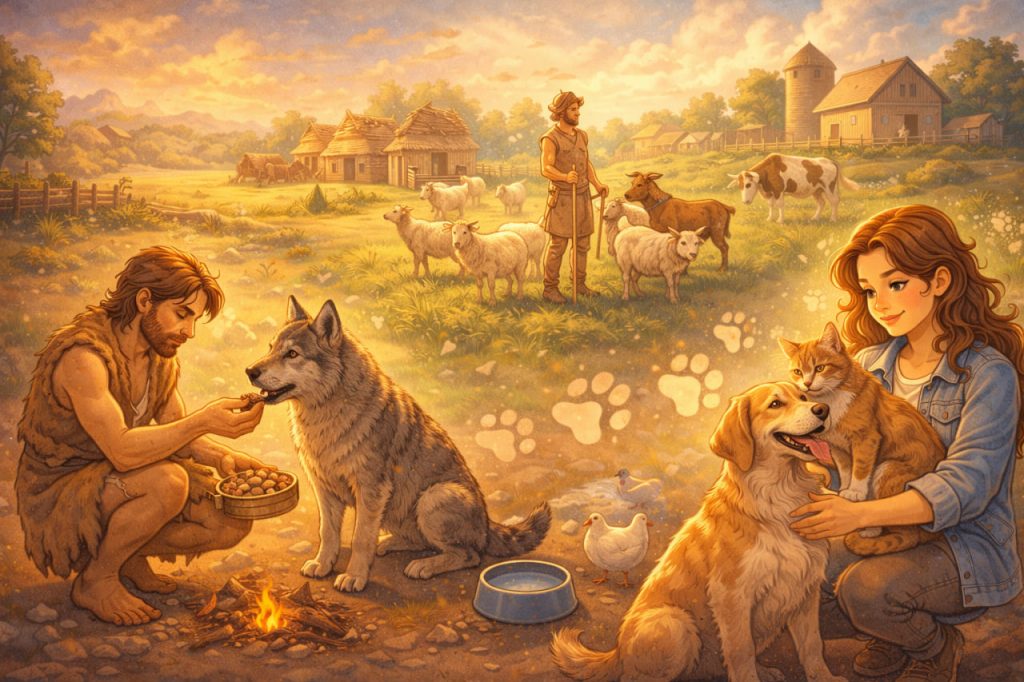
One of the main drivers of domestication is natural selection in human environments. Animals that were less fearful and more tolerant of humans gained access to food scraps, shelter, and protection. Over time, these individuals had higher survival and reproductive success. Gradually, populations shifted toward calmer temperaments. This process is often described as self-domestication, especially in early stages. The domestication of dogs from wolves is a classic example of this pathway.
Behavioral Changes Come First
Behavioral traits usually change before physical appearance. Reduced aggression, lower stress sensitivity, and increased social tolerance are among the earliest signs of domestication. These traits make animals easier to manage and more compatible with human presence. Once behavior stabilizes, physical changes such as smaller teeth, altered skull shape, and coat color variation often follow. Scientists refer to this pattern as the domestication syndrome, observed across many domesticated species.
Human Selection and Breeding
As domestication progressed, humans began actively selecting animals for specific traits. Animals were bred for usefulness, such as meat, milk, labor, guarding, or companionship. Selective breeding intensified genetic changes and accelerated divergence from wild ancestors. This stage transformed animals into specialized domestic species. However, strong selection also reduced genetic diversity, making some domesticated animals more vulnerable to disease or environmental change.
Why Only Certain Animals Were Domesticated
Not all animals are suitable for domestication. Species that thrive under domestication typically have flexible diets, social structures, and manageable temperaments. Animals that are highly aggressive, solitary, or slow to reproduce are poor candidates. These biological constraints explain why only a limited number of species were successfully domesticated despite extensive human contact. Domestication depends as much on animal biology as on human intention.
Interesting Facts
- Dogs were domesticated before agriculture emerged.
- Domesticated animals often show juvenile traits into adulthood.
- Many physical changes appear as a byproduct of behavioral selection.
- Some animals, like foxes, show domestication traits in just a few generations.
- Domestication alters hormone regulation, not just appearance.
Glossary
- Domestication — long-term genetic adaptation of animals to human environments.
- Taming — behavioral conditioning of an individual animal without genetic change.
- Selective Breeding — intentional breeding to enhance specific traits.
- Self-Domestication — natural adaptation to human presence without direct breeding.
- Domestication Syndrome — a set of common traits seen in domesticated animals.