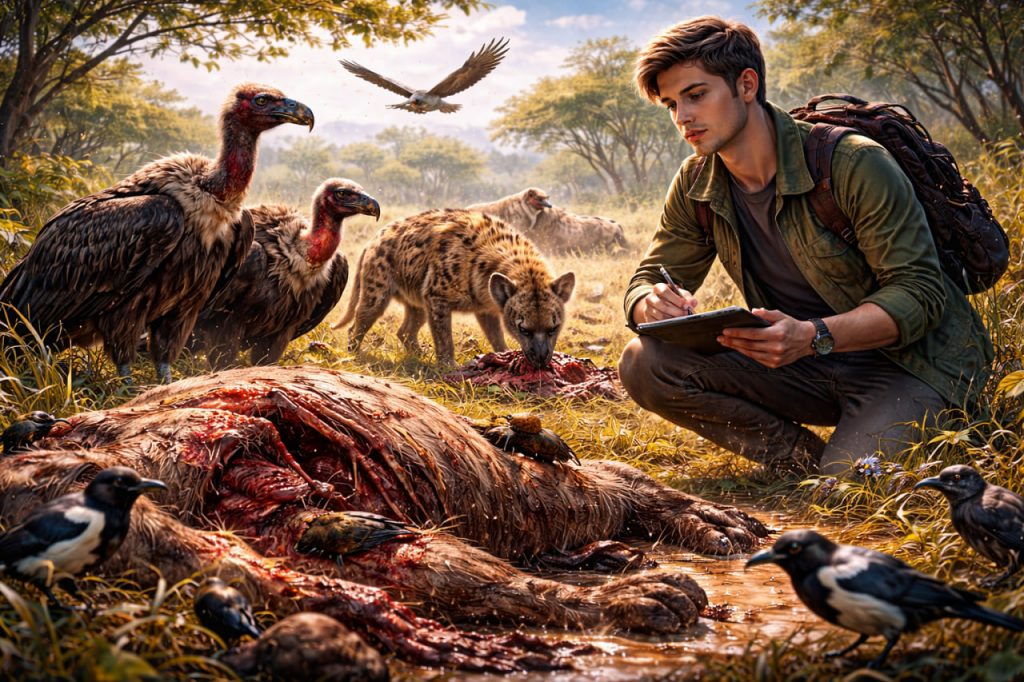
Scavengers play a crucial yet often misunderstood role in natural ecosystems, acting as nature’s cleanup specialists. While predators hunt live prey, scavengers consume dead animals, preventing the accumulation of organic waste in the environment. This process is essential for maintaining ecological balance, limiting the spread of disease, and recycling nutrients back into ecosystems. Without scavengers, landscapes would quickly become littered with carcasses, disrupting soil, water, and air quality. Despite their importance, scavengers are frequently overlooked or portrayed negatively. Understanding their role reveals why these organisms are indispensable to the health and stability of life on Earth.
Who Are Scavengers?
Scavengers include a wide range of organisms, from large animals such as vultures, hyenas, and jackals to smaller creatures like beetles, ants, and certain fungi and bacteria. Some species are obligate scavengers, relying almost entirely on carrion, while others are facultative scavengers that hunt but also consume dead animals when available. This diversity allows scavenging to occur in nearly every ecosystem on the planet. Each scavenger species occupies a specific niche, ensuring that carcasses are broken down efficiently and completely. According to ecologist Dr. Rebecca Nolan:
“Scavengers form a bridge between death and renewal,
ensuring that nutrients never remain locked away.”
This bridging role makes them fundamental to ecological cycles.
Disease Control and Environmental Health
One of the most critical functions of scavengers is disease prevention. By rapidly consuming carcasses, scavengers limit the growth of harmful bacteria and pathogens that could otherwise spread to wildlife, livestock, or humans. Vultures, for example, have highly acidic stomachs capable of neutralizing dangerous microbes. In ecosystems where scavenger populations decline, studies show increased disease transmission and environmental contamination. This makes scavengers an invisible but powerful line of defense for ecosystem and public health.
Nutrient Recycling and Soil Fertility
Scavengers accelerate the return of nutrients to the soil by breaking down organic matter. As carcasses are consumed and processed, nutrients such as nitrogen, phosphorus, and calcium re-enter the ecosystem. These elements support plant growth, which in turn sustains herbivores and higher trophic levels. In this way, scavengers help close the nutrient loop that keeps ecosystems productive. Without them, nutrient cycling would slow dramatically, reducing ecosystem efficiency and resilience.
Supporting Food Web Stability
Scavengers are integral components of food webs, interacting with predators, decomposers, and microbes. Their presence reduces competition among predators by removing leftovers and weakens the dominance of any single species. Scavengers also provide food for secondary consumers, including insects and microorganisms that rely on partially decomposed matter. Ecologist Dr. Thomas Berger explains:
“Food webs depend not only on hunters,
but on those that finish the job after death.”
This layered interaction strengthens ecosystem stability and adaptability.
Scavengers and Biodiversity
By efficiently removing dead material, scavengers create space and resources for new life. This process helps maintain species diversity by preventing habitat degradation. In some ecosystems, scavengers influence which species thrive by controlling how nutrients are redistributed across landscapes. Their absence can lead to imbalances that favor invasive species or pathogens. As a result, scavengers indirectly support biodiversity at multiple levels of the ecosystem.
Human Impact and Conservation Challenges
Human activities increasingly threaten scavenger populations through habitat loss, poisoning, pollution, and changes in land use. The decline of vultures in some regions has already demonstrated the consequences of scavenger loss, including increased disease risk and economic costs. Conservation efforts now recognize scavengers as keystone species in many ecosystems. Protecting them is not only an environmental priority, but also a practical strategy for maintaining healthy natural systems.
Interesting Facts
- Vultures can digest carcasses infected with dangerous pathogens without getting sick.
- Some scavengers can locate dead animals from kilometers away.
- Insects can remove more biomass from a carcass than large animals in certain ecosystems.
- Scavenging reduces greenhouse gas emissions by preventing slow decay.
- Scavengers have existed since the earliest complex ecosystems on Earth.
Glossary
- Scavenger — an organism that feeds on dead animals.
- Carrion — decaying flesh of dead animals.
- Nutrient Cycling — the movement and reuse of nutrients within ecosystems.
- Obligate Scavenger — a species that depends primarily on carrion for survival.
- Facultative Scavenger — a species that scavenges opportunistically in addition to hunting.