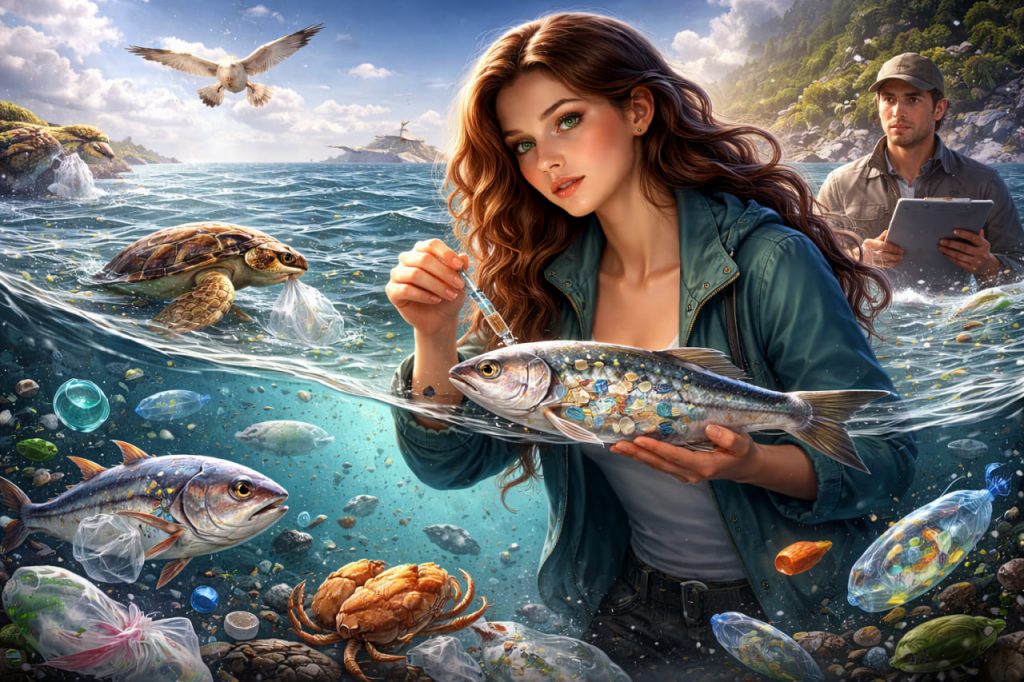
Plastic pollution has moved far beyond beaches and landfills, silently entering the food chain that sustains life on Earth. As plastic waste breaks down into microscopic fragments, it becomes accessible to organisms at every trophic level, from plankton to top predators. These particles are not inert; they interact with biological tissues, transport chemical additives, and accumulate as they move up the food web. Unlike many natural pollutants, plastic persists for decades or centuries, continuously cycling through ecosystems. Scientists increasingly recognize plastic in the food chain as a systemic environmental issue rather than an isolated contamination problem. Understanding its consequences reveals how deeply human-made materials have become embedded in natural processes.
How Plastic Enters the Food Chain
Plastic enters the food chain primarily through microplastics and nanoplastics, which form as larger plastic items degrade under sunlight, heat, and mechanical stress. These tiny particles are easily ingested by plankton, insects, and small aquatic organisms that mistake them for food. Once consumed, plastics move upward as predators eat contaminated prey. This process, known as trophic transfer, allows plastic to spread throughout ecosystems. Environmental chemist Dr. Laura Simmons explains:
“Plastic does not stay where it is discarded.
It follows the same biological pathways as nutrients.”
As a result, even remote ecosystems with no local plastic sources can become contaminated.
Bioaccumulation and Biomagnification
One of the most concerning aspects of plastic in the food chain is bioaccumulation, the gradual buildup of plastic particles and associated chemicals in an organism’s body. As predators consume multiple contaminated prey, the concentration of plastic increases at higher trophic levels, a process called biomagnification. Top predators, including large fish, birds, and mammals, often carry the highest plastic loads. This phenomenon mirrors patterns seen with toxic metals and persistent organic pollutants, but plastic introduces an additional layer of physical and chemical stress to organisms.
Chemical Exposure Through Plastic
Plastics are not chemically neutral materials. They often contain additives such as plasticizers, stabilizers, and flame retardants, which can leach into tissues after ingestion. Additionally, plastic surfaces attract and bind environmental pollutants, including pesticides and heavy metals. When ingested, plastics can act as chemical carriers, delivering concentrated toxins into biological systems. Toxicologist Dr. Miguel Ortega notes:
“The danger is not just the particle itself,
but the chemical cocktail it transports into living cells.”
This combined exposure complicates efforts to assess ecological and biological risk.
Effects on Animals and Ecosystems
Research shows that plastic ingestion can cause physical blockages, reduced feeding efficiency, inflammation, and energy loss in animals. Even when plastics do not cause immediate death, they can impair growth, reproduction, and immune function. At the ecosystem level, these individual effects accumulate, weakening populations and altering food web dynamics. Species that play key ecological roles may decline, triggering cascading effects throughout ecosystems. Plastic contamination thus becomes a driver of ecosystem instability, not merely individual harm.
Human Exposure Through the Food Chain
Humans are not separate from the food chain and are exposed to plastic through seafood, crops, drinking water, and even air. While research into long-term health effects is ongoing, scientists emphasize that chronic low-level exposure is widespread. Plastic particles have been detected in human tissues, raising questions about their interaction with biological systems. Importantly, experts stress that health implications are still being studied and that individuals should consult qualified specialists regarding health concerns. The presence of plastic in the food chain underscores how environmental pollution ultimately returns to human societies.
Why This Issue Is Hard to Reverse
Once plastic enters the food chain, removal becomes extremely difficult. Unlike visible pollution, microplastics cannot be easily filtered out of natural ecosystems. Their persistence means that even if plastic production were reduced today, existing contamination would continue to circulate for decades. Scientists emphasize prevention, material redesign, and ecosystem protection as the most effective long-term strategies. Understanding the consequences of plastic in the food chain highlights the urgency of addressing pollution at its source.
Interesting Facts
- Microplastics have been found in plankton, the base of many food webs.
- Top marine predators often contain the highest plastic concentrations.
- Plastic particles can bind pollutants at levels thousands of times higher than surrounding water.
- Microplastics are present in both marine and terrestrial food chains.
- Plastic contamination has been detected in ecosystems far from human settlements.
Glossary
- Food Chain — the transfer of energy and matter through feeding relationships.
- Microplastics — plastic particles smaller than 5 millimeters.
- Bioaccumulation — the buildup of substances in an organism over time.
- Biomagnification — increasing concentration of substances at higher trophic levels.
- Trophic Transfer — movement of materials through feeding interactions.