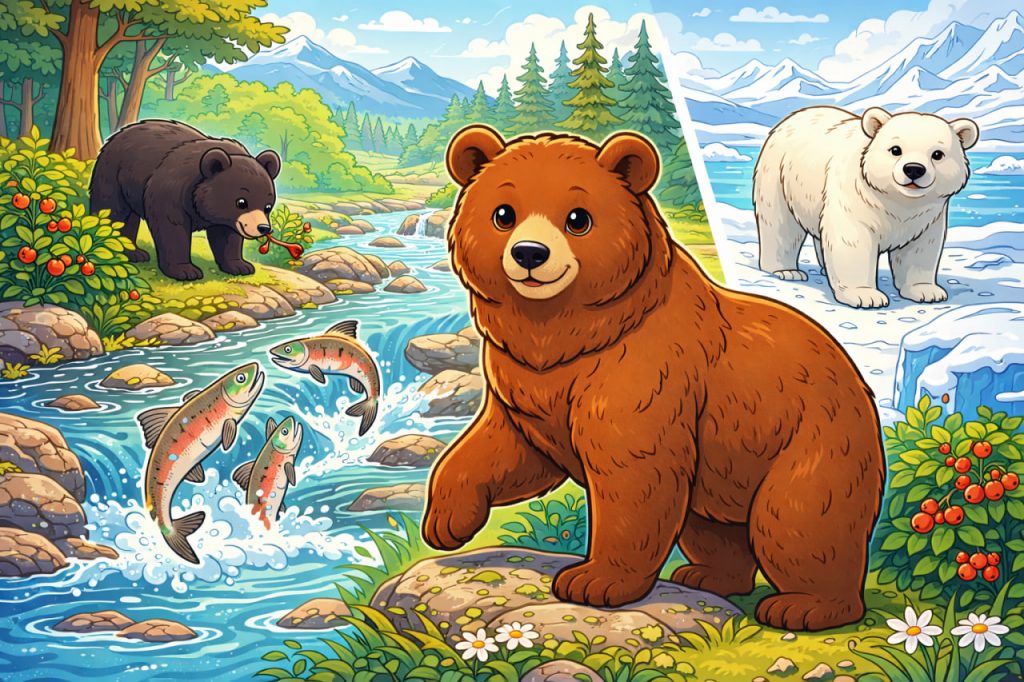
Bears are among the most impressive land mammals on Earth, combining immense physical strength with surprising intelligence and adaptability. They inhabit a wide range of environments, from Arctic ice fields and mountain forests to temperate woodlands and coastal regions. Despite their size and reputation, bears are not constant predators but highly flexible animals whose behavior changes with season, habitat, and food availability. Throughout history, bears have played a significant role in ecosystems as well as in human culture and mythology. Understanding bears helps reveal how large mammals survive in diverse environments and how they influence the balance of nature. Their presence often signals the overall health of the ecosystems they inhabit.
Physical Characteristics and Species Diversity
Bears belong to the family Ursidae and include several species such as brown bears, polar bears, black bears, and giant pandas. While their size, fur color, and habitat vary, all bears share common traits: powerful limbs, strong claws, and an exceptional sense of smell. Some species can detect food from kilometers away, making scent their primary sensory tool. Bears have dense bones and muscle mass that support their strength but also allow surprising agility. Although they appear slow, many bears can run faster than humans over short distances. This combination of power and adaptability makes bears highly effective survivors.
Diet and Seasonal Behavior
Most bears are omnivorous, meaning their diet includes both plant and animal matter. Depending on the season, bears may feed on berries, roots, insects, fish, small mammals, or carrion. This dietary flexibility allows them to adjust to changing food availability throughout the year. In colder regions, bears undergo hibernation, a state of reduced metabolic activity that helps them survive winter when food is scarce. Before hibernation, bears enter a phase of intense feeding to build fat reserves. These seasonal cycles are finely tuned to environmental conditions and are essential to bear survival.
Bears and Ecosystem Balance
Bears play an important role in maintaining ecological balance. By controlling prey populations and dispersing seeds through their diet, they contribute to forest regeneration and biodiversity. Salmon-eating bears, for example, transport nutrients from rivers into forests, enriching soil and supporting plant growth. As apex or near-apex species, bears influence the behavior and distribution of other animals. Ecologists often view bears as keystone species, meaning their presence has a disproportionately large effect on ecosystem structure. When bear populations decline, entire ecological networks can be disrupted.
Intelligence and Behavior
Despite their imposing appearance, bears are highly intelligent animals. Studies show that they possess strong memory, problem-solving skills, and the ability to learn from experience. Bears can remember food locations for years and adapt quickly to new challenges, including human-made obstacles. This intelligence, however, can lead to conflict when bears encounter human settlements. Wildlife researcher Dr. Emily Carter notes:
“Bears are not aggressive by nature,
but their intelligence and curiosity require careful coexistence with humans.”
Understanding bear behavior is essential for reducing human–wildlife conflict.
Bears in Human Culture
Bears have long held symbolic meaning in cultures around the world. They appear in myths as guardians, warriors, or embodiments of nature’s power. In some Indigenous traditions, bears are respected as teachers and protectors, while in others they symbolize endurance and renewal. Modern representations often soften the bear’s image, portraying it as gentle or playful, though this contrasts with its true wild nature. These cultural interpretations reflect humanity’s deep and complex relationship with one of the planet’s most formidable animals.
Interesting Facts
- Bears have one of the best senses of smell among land mammals.
- Some species can gain over 30% of their body weight before hibernation.
- Polar bears are strong swimmers and can travel hundreds of kilometers at sea.
- Bears can remember food sources for many years.
- Despite their size, bears are capable of climbing trees, especially when young.
Glossary
- Ursidae — the biological family that includes all bear species.
- Omnivorous — feeding on both plant and animal sources.
- Hibernation — a state of reduced metabolism during cold seasons.
- Keystone Species — a species that has a major impact on ecosystem structure.
- Apex Predator — an animal at or near the top of the food chain.