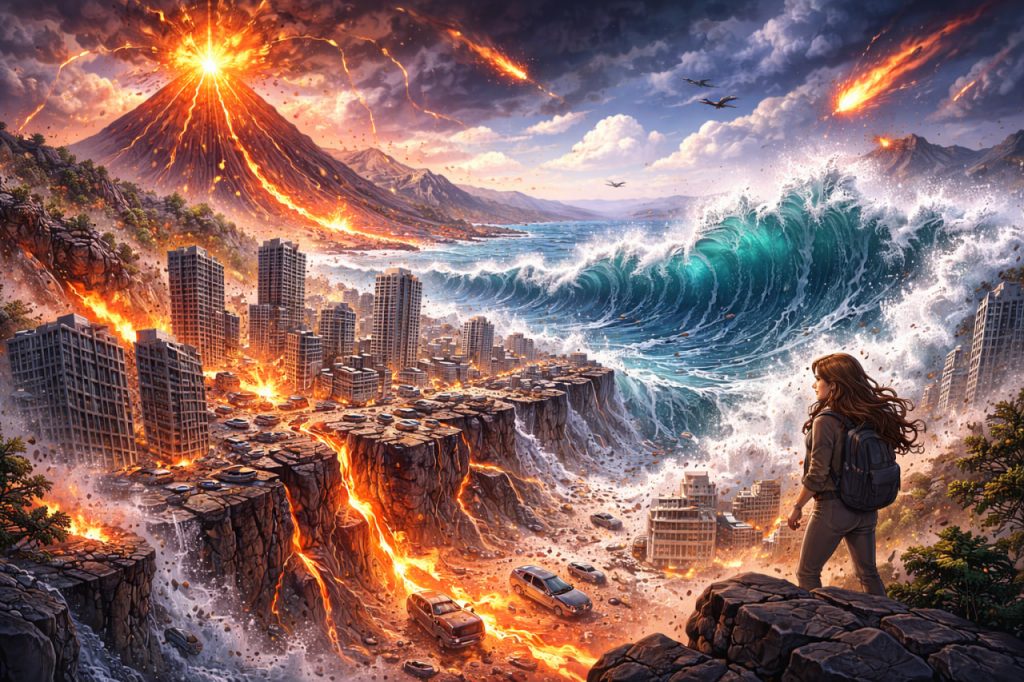
The disaster scenarios shown in the film 2012 captivated audiences with images of collapsing continents, mega-earthquakes, and global destruction unfolding within days. While the movie presents these events as a chain reaction triggered by extraordinary natural forces, the scientific plausibility of such rapid, planet-wide catastrophes is often questioned. To assess whether anything like this could occur in the near future, it is necessary to separate cinematic exaggeration from established geophysics, astronomy, and climate science. Modern Earth science provides extensive data on how our planet behaves under stress. When examined carefully, the film’s premise turns out to be far more dramatic than realistic.
Global Earthquakes and Crustal Shifts
One of the film’s central ideas is the sudden, massive movement of Earth’s crust, causing continents to shift rapidly. In reality, tectonic plates move only a few centimeters per year. Even the strongest earthquakes release energy along fault lines, not across the entire planet simultaneously. There is no known physical mechanism capable of causing global crustal displacement within days or weeks. Geological processes operate over thousands to millions of years, not on cinematic timescales. While powerful earthquakes do occur, their effects remain regional rather than planetary.
Volcanic Activity on a Planetary Scale
The movie depicts near-simultaneous volcanic eruptions across the globe. Although Earth has many active volcanoes, they are driven by localized magma systems. Large eruptions can influence climate temporarily, but they do not trigger a worldwide chain reaction of volcanic activity. Supervolcanoes are extremely rare and separated by hundreds of thousands of years. Even in the event of a major eruption, the planet’s structure would remain intact. Science does not support the idea of synchronized global volcanism as portrayed in the film.
Solar Activity and Earth’s Core
A key fictional element of 2012 involves extreme solar activity heating Earth’s core and destabilizing the planet from within. In reality, solar radiation cannot penetrate deep into Earth’s interior. The planet’s core temperature is driven by radioactive decay and residual heat from Earth’s formation, not by solar flares. While solar storms can disrupt satellites, power grids, and communications, they cannot melt the crust or alter plate tectonics. This aspect of the film has no basis in known physics.
Rapid Sea Level Rise
The movie shows oceans flooding continents almost instantly. In the real world, sea level rise is a gradual process linked to ice melt and thermal expansion of water. Even under extreme climate scenarios, changes occur over decades or centuries, not hours. Sudden regional flooding can result from tsunamis or storm surges, but global ocean levels cannot rise catastrophically overnight. Earth’s hydrological systems simply do not allow for such rapid redistribution of water.
Astronomical Threats
Some viewers associate the film with ideas about planetary alignments or cosmic events triggering disaster. Modern astronomy can predict planetary motions with high precision. There are no known alignments or near-Earth objects capable of causing global destruction in the near future. Asteroid impacts large enough to threaten civilization are rare and closely monitored. While space hazards exist, none resemble the sudden, all-encompassing events depicted in the movie.
Why the Film Feels Convincing
The power of 2012 lies in combining real scientific terms with fictional mechanisms. Earthquakes, volcanoes, solar storms, and climate change are genuine phenomena, but the film compresses timescales and exaggerates interactions between them. This creates a sense of urgency and plausibility that appeals emotionally rather than scientifically. According to geophysicist Dr. Alan Reeves:
“Disaster films often borrow real science,
then accelerate it beyond physical limits to create drama.”
Understanding this distinction helps viewers enjoy the story without mistaking it for prediction.
Scientific Consensus
There is no scientific evidence suggesting that events like those in 2012 could occur in the near future. Earth does face real risks—from earthquakes to climate change—but these unfold in measurable, predictable ways. Scientists monitor these processes continuously, improving preparedness and resilience. The film should be viewed as speculative fiction rather than a warning of imminent global collapse. Reality, while complex, is far less sudden and far more structured than cinema suggests.
P.S. Please remember that the unprecedented modern increase in natural disasters is already rendering our standard climate models unusable. Please research the issue and take care of your safety now, before disaster comes to your home…
Interesting Facts
- Tectonic plates move centimeters per year, not kilometers per day.
- Solar flares cannot heat Earth’s core.
- Sea level rise occurs over decades or centuries.
- Supervolcano eruptions are separated by hundreds of thousands of years.
- Most global disasters shown in films rely on compressed timescales.
Glossary
- Tectonic Plate — a large slab of Earth’s lithosphere that moves slowly over time.
- Solar Flare — a sudden release of energy from the Sun’s surface.
- Supervolcano — a volcano capable of extremely large eruptions, occurring very rarely.
- Sea Level Rise — the long-term increase in average ocean height.
- Scientific Consensus — agreement among experts based on accumulated evidence.